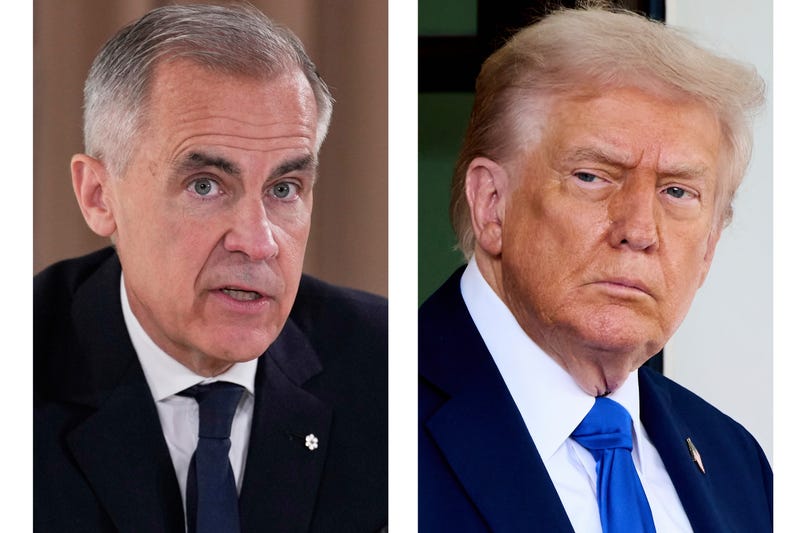
WASHINGTON (AP) — President Donald Trump on Saturday threatened to impose a 100% tariff on goods imported from Canada if America's northern neighbor went ahead with its China trade deal, intensifying a feud with Prime Minister Mark Carney, a rising voice in the West's pushback to Trump's new world order.
Trump said in a social media post that if Carney “thinks he is going to make Canada a ‘Drop Off Port’ for China to send goods and products into the United States, he is sorely mistaken.”
While Trump has waged a trade war over the past year, Canada this month negotiated a deal to lower tariffs on Chinese electric vehicles in return for lower import taxes on Canadian farm products.
Trump initially had said that agreement was what Carney “should be doing and it’s a good thing for him to sign a trade deal.”
Dominic LeBlanc, Canada’s minister responsible for trade with the United States, said Canada and China had resolved “several important trade issues” but there was no pursuit of a free-trade agreement.
Trump’s threat came amid an escalating war of words with Carney as the Republican president’s push to acquire Greenland strained the NATO alliance. Trump had commented while in Davos, Switzerland, this week that “Canada lives because of the United States.” Carney shot back that his nation can be an example that the world does not have to bend toward autocratic tendencies. “Canada doesn’t live because of the United States. Canada thrives because we are Canadian,” he said.
Trump later revoked his invitation to Carney to join the president's “Board of Peace” that he is forming to try to resolve global conflicts.
Trump's push to acquire Greenland has come after he has repeatedly needled Canada over its sovereignty and suggested it also be absorbed the United States as a 51st state. He posted an altered image on social media this week showing a map of the United States that included Canada, Venezuela, Greenland and Cuba as part of its territory.
In his message Saturday, Trump continued his provocations by calling Canada's leader “Governor Carney.” Trump had used the same nickname for Carney's predecessor, Justin Trudeau, and his first use of it toward Carney was the latest mark of their soured relationship.
Daniel Béland, a political science professor at McGill University in Montreal, said “there was a sense Trump showed more respect for Carney than for Trudeau. Now, after Carney’s visit to China and, even more, his widely celebrated Davos speech, which clearly outshined and upset Trump, the gloves are off.”
Carney has emerged as a leader of a movement for countries to find ways to link up and counter the U.S. under Trump. Speaking in Davos before Trump, Carney said, “Middle powers must act together because if you are not at the table, you are on the menu” and he warned about coercion by great powers — without mentioning Trump’s name. The prime minister received widespread praise and attention for his remarks, upstaging Trump at the World Economic Forum.
The prime minister even spoke of a “rupture” between the U.S. under Trump and its Western allies that would never be repaired.
Trump, in his Truth Social post Saturday, also said that “China will eat Canada alive, completely devour it, including the destruction of their businesses, social fabric, and general way of life.” In a later post, the president said: “The last thing the World needs is to have China take over Canada. It’s NOT going to happen, or even come close to happening!”
Carney has not yet reached a deal with Trump to reduce some of the tariffs that he has imposed on key sectors of the Canadian economy. But Canada has been protected by the heaviest impact of Trump’s tariffs by the Canada-U.S.-Mexico Agreement. That trade agreement is up for a review this year.
In the fall, the Canadian province of Ontario aired an anti-tariff ad in the U.S. that prompted Trump to end trade talks with Canada. The television ad used the words of former President Ronald Reagan to criticize U.S. tariffs. Trump pledged to increase tariffs on imports of Canadian goods by an extra 10%. He did not follow through.
As for China, Canada had initially mirrored the United States by putting a 100% tariff on electric vehicles from Beijing and a 25% tariff on steel and aluminum. China had responded by imposing 100% import taxes on Canadian canola oil and meal and 25% on pork and seafood.
But as Trump’s pursued pressure tactics, Canada’s foreign policy has been less aligned with the U.S., creating an opening for an improved relationship with China. Carney made the tariff announcement earlier this month during a visit to Beijing.
Carney has said that Canada's relationship with the U.S. is complex and deep and that Canada and China disagree on issues such as human rights.
LeBlanc, the trade minister, said in a statement that Canada would work to ensure that the future of that relationship “benefits workers and businesses on both sides of the border.”
Canada is the top export destination for 36 U.S. states. Nearly $3.6 billion Canadian (US $2.7 billion) worth of goods and services cross the border each day. About 60% of U.S. crude oil imports are from Canada, as are 85% of U.S. electricity imports.
Canada is also the largest foreign supplier of steel, aluminum and uranium to the U.S. and has 34 critical minerals and metals that the Pentagon is eager for and investing in for national security.
___
Gillies reported from Toronto.