


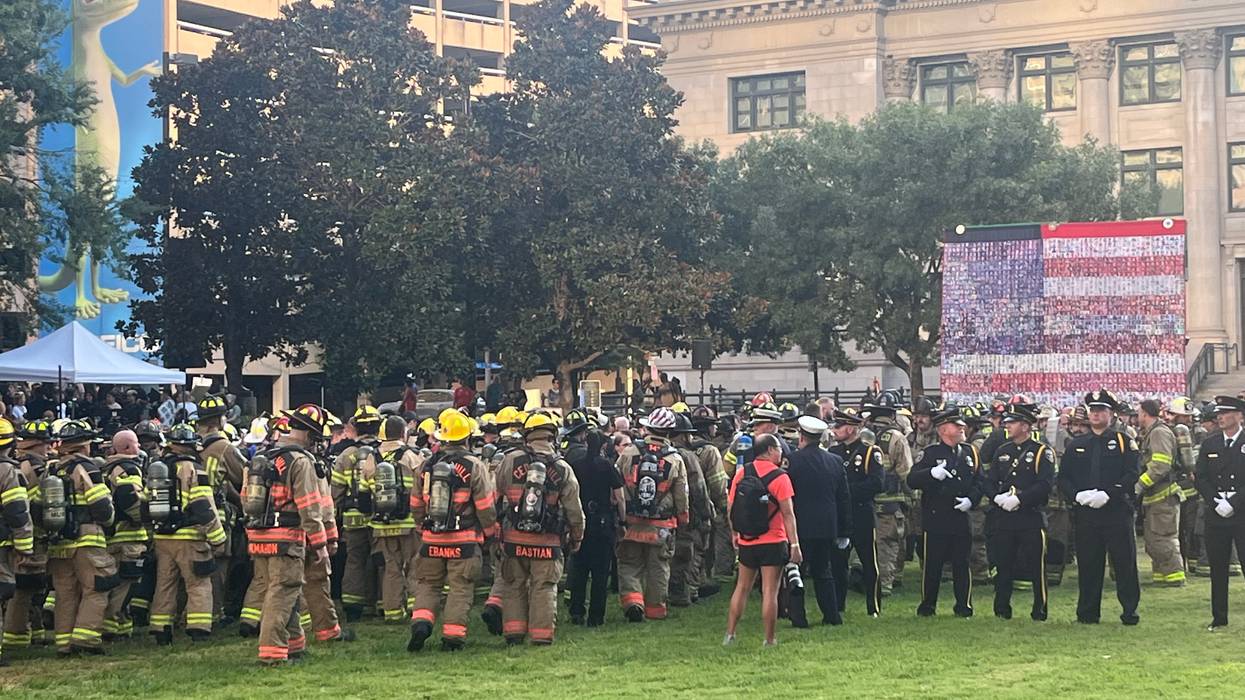

Firefighters, paramedics and police officers from across the country climbed a total of 110 stories inside a skyscraper in Downtown Dallas this weekend to mark the 25th anniversary of the September 11 attacks. This was the 15th year for the Dallas 9/11 Memorial Stair Climb.
A total of 343 firefighters, 70 police officers and nine paramedics made the climb. Each wore the name and picture of a first responder who died in the attack.
"I really do feel the emotions people were feeling back in 2001 from the ceremony to the ringing of the bells," says Jordan Davis, a firefighter from Josephine, Texas. "What gets me every time is being inside and hearing the PASS devices going off. The PASS device is an alarm on our air pack that says you're not moving. On 9/11, when the buildings crashed, that's all you could hear is the PASS devices going off."
Davis says he has attended the stair climb in Dallas the past three years. He came with several members of the department and says the stair climb can serve as a reminder of the uncertainty first responders face during every shift.
"Every day is different. That's why I like this job," he says. "Whether you're coming in and doing a lift assist for an older person or going to a car crash. I feel like it takes a certain kind of person to want to go toward the fire or toward the gunshots."
Dwayne Sprague works for the Commerce Fire Department; his son, Cole, is a firefighter in Canton.
"I was only three when 9/11 happened," Cole Sprague says. "Just trying to remember all the guys who climbed and lost their lives that day is a really humbling experience."
"I was on duty, I was four years into my career on 9/11," Dwayne Sprague says. "I sat there in front of the TV like everybody else, except I was in the fire station that day. The first thought in my mind when the towers came down was, 'Oh my gosh. How many firemen did we just kill?'"
The keynote address before the climb was given by Joseph Esposito, a 42 year FDNY veteran who was on duty September 11.
"Our motto is 'never forget,'" he says. "Before 9/11, we did this every day all around the country. Some were noticed, sometimes it wasn't noticed. Everybody was like, 'I can't believe they ran into that building.' This is what we do every single day, just this time it was this magnitude."
Esposito's brother, cousin and 11 members of his company died on September 11.
"It's not an easy job, and I'm glad people are starting to realize that," he says. "I'm honored and humbled to be here today. It's tough to explain everything. That day was the worst of mankind but yet, I saw the best of mankind. The country pulled together."
Firefighters gathered in Main Street Garden Park before the climb. Organizers set out newspapers and magazines from the days after the attacks.
"What we do is keep the memory of the actual day alive," says Diane Birdwell. "I've got all these images, and it really grounds people. It's not meant to make them cry, it's meant to make them realize, yes, we're enjoying each other's company, but this is why we're here."
People could also leave notes saying where they were on September 11. One said she was watching cartoons with her son when her husband called and told her to turn on the news. Another said she was listening to a CD in her car and found out when she stopped for gas, and the cashier told her what was happening.
Birdwell says those first-hand accounts can help kids and young adults who were born after the attacks understand the significance.
"The key to teaching any story in history is you use primary source-documents. You use reporting of the day, whether it be someone's diary, radio broadcasts, television," she says. "The hard part is to put it in perspective. I tell the kids, 'They left dishes in the sink. They had clothes at the dry cleaners. They had kids in school. They had a date to go out Friday night. They had lives, and their lives stopped.'"
The Dallas 9/11 Memorial Stair Climb raises money for Hearts and Helmets, a non-profit based in Sachse that supports first responders, healthcare workers and their families who have received a cancer diagnosis.


