


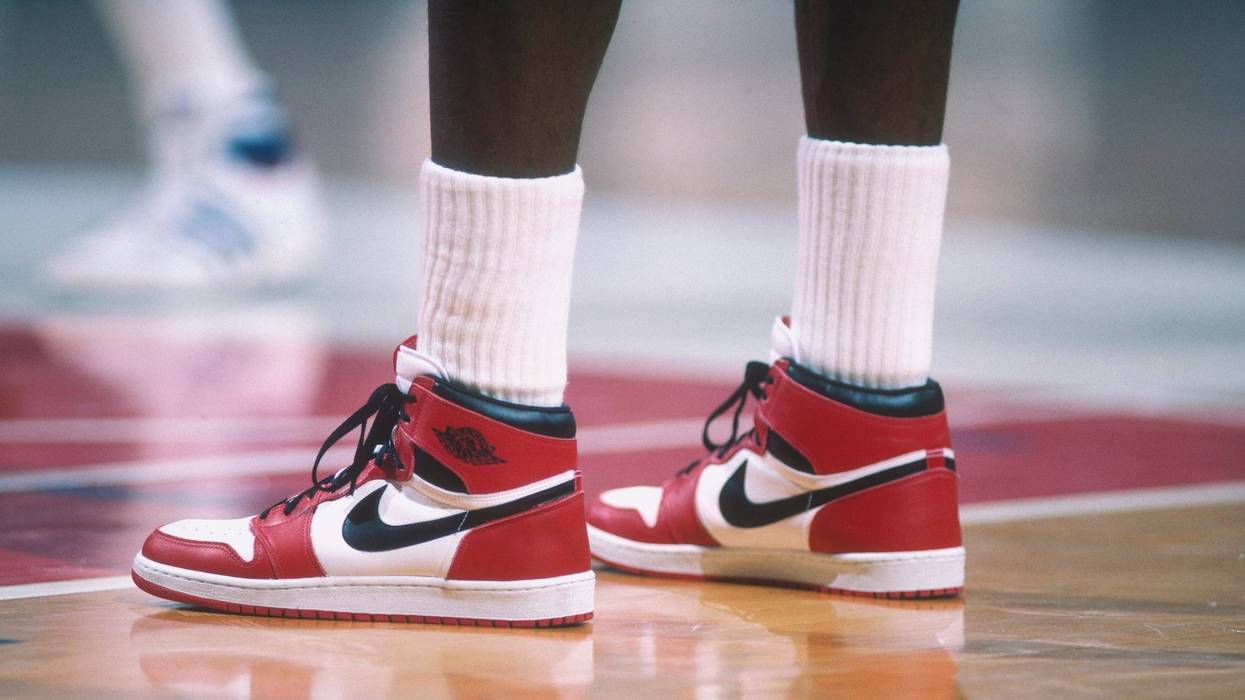

Scientists have cracked one of sports' most familiar - and most annoying - mysteries: why basketball shoes squeak on hardwood floors, and the answer turns out to be far more complex than anyone expected.
Researchers found that the rubber sole of a basketball shoe doesn't simply slide across the floor when a player cuts or pivots. Instead, the sole rapidly loses and regains contact with the surface thousands of times per second. That microscopic stuttering motion generates high-pitched sound waves - the squeak heard echoing through gyms from youth leagues to the NBA.
The study found that patterned treads on the bottom of the shoe play a key role in organizing those vibrations. Rather than producing random noise, the tread geometry helps arrange the ripples into a consistent, recognizable squeak. Smooth soles, by contrast, tend to produce more chaotic friction patterns and less defined sound.
While the finding might seem like a novelty, researchers say the implications extend well beyond shoe design. Understanding how rubber interacts with hard surfaces at such a fine scale could help engineers develop better-performing athletic footwear - potentially improving grip, reducing injury risk, and extending sole life. The same physics, scientists noted, has parallels in the study of earthquakes, where friction between surfaces that repeatedly lock and release is central to understanding how seismic energy builds and releases along fault lines.
The research adds to a growing body of work using everyday phenomena to unlock deeper principles of physics and materials science. Friction - despite being one of the most common forces in daily life - remains an area of active scientific investigation, with many of its mechanisms still not fully understood at the microscopic level.
For basketball players and fans, the squeak will likely never sound quite the same again. What once seemed like a simple rubber-on-floor annoyance is now understood to be a rapid, repeating mechanical event playing out thousands of times each second beneath every pivot and sprint.
LISTEN on the Audacy App
Tell your Smart Speaker to "PLAY 1080 KRLD"
Sign Up to receive our KRLD Insider Newsletter for more news
Follow us on Facebook | Twitter | Instagram | YouTube


