

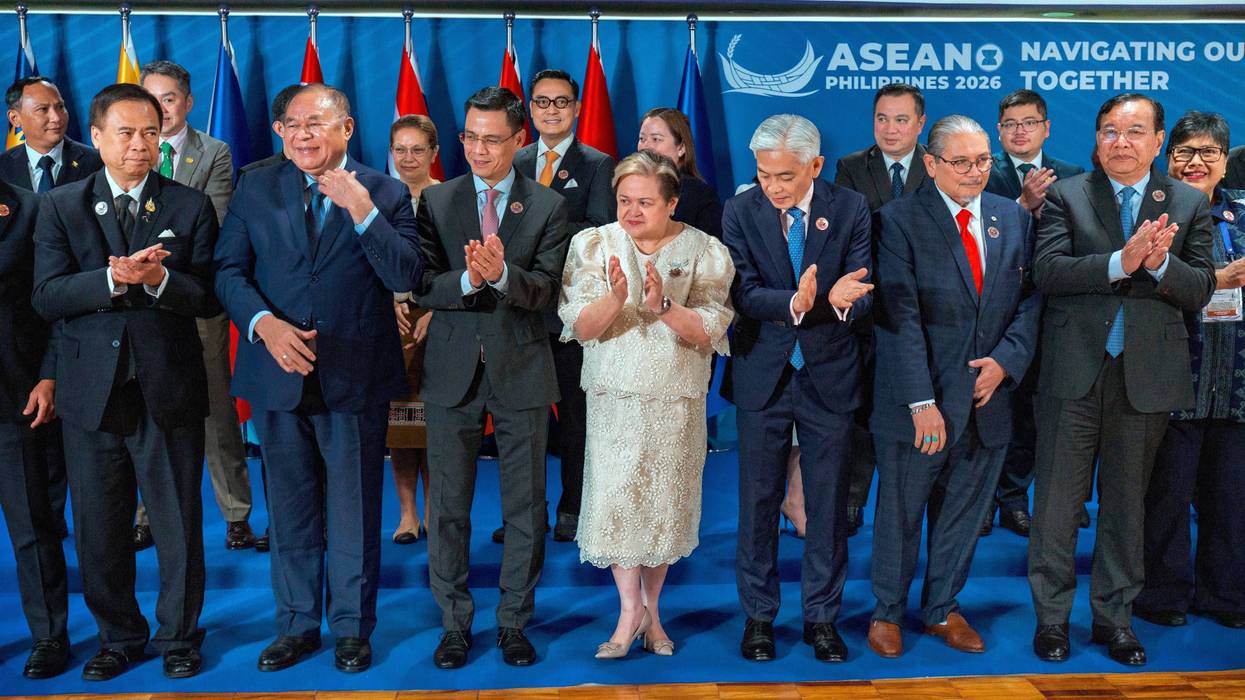

MANILA, Philippines (AP) — Southeast Asia’s top diplomats will express alarm over renewed hostilities in the Middle East and call for the full reopening of the Strait of Hormuz when they gather in the Philippine capital Tuesday for talks with Western and Asian counterparts.
Iran and some of the world’s most intractable conflicts will be high in the agenda of the annual talks held by the Association of Southeast Asian Nations and hosted by the Philippines, the 11-nation bloc’s current chair.
U.S. Secretary of State Marco Rubio, Chinese Foreign Minister Wang Yi and Russian Foreign Minister Sergey Lavrov are among the attendees. Ukraine’s top diplomat, Andrii Sybiha, has been invited to attend a Friday ceremony commemorating a 1976 nonaggression treaty of ASEAN, but will not be participating in the ASEAN meetings attended by Lavrov and Rubio.
Rubio and Lavrov have not announced any plans to meet each other or Sybiha while they are in Manila.
Iran war is among ASEAN's top concerns
Southeast Asia, a bustling region of more than 680 million people, relies heavily on Middle East oil and gas and was severely hit by the global supply and price shocks sparked by the Iran war. Philippine President Ferdinand Marcos Jr. declared a national energy emergency in March to ensure the availability of fuel, food and other basic goods and prevent hoarding and profiteering.
ASEAN foreign ministers will first meet among themselves on Tuesday to discuss the renewed hostilities between the United States and Iran and threats to shipping in the Strait of Hormuz, the waterway where roughly 20% of global oil supplies transited before the war.
“We underscored the importance of maintaining regional peace, stability and prosperity, upholding international law … including the need for a complete and immediate cessation of hostilities across all fronts in the Middle East,” the ministers said in a draft statement of concern, which was seen by The Associated Press.
“We acknowledged the further implications of the continued tensions in the Middle East on regional trade, energy and food security, including energy markets and supply chains, agricultural production," said the statement, which will be made public after their meeting.
The ministers “called for the restoration of the safe, unimpeded and continuous transit passage of vessels and aircraft in the Strait of Hormuz.”
Rubio meeting with ASEAN and Quad envoys
Rubio’s attendance in the ASEAN meetings was apparently aimed at dispelling concerns that the war in the Middle East would deter the U.S. from focusing on the Indo-Pacific, especially China’s actions in the disputed South China Sea and its pressure on Taiwan.
“The secretary’s visit advances a clear U.S. priority: a free and open Indo-Pacific that delivers safety, security and prosperity for the region and for the American people,” State Department spokesperson Thomas Pigott said in Washington.
Rubio is also expected to meet member of the Quad, which consists of the U.S., India, Japan and Australia, and is seen as a major component of the American strategy to counter China. It has been repeatedly criticized by Beijing as a U.S. scheme to contain its growing influence.
Myanmar's civil war and the South China Sea are among regional disputes
The foreign ministers have been under growing pressure to do more to help resolve the conflicts in their own region, primarily the civil war in Myanmar and the disputes in the South China Sea.
Since Myanmar's army wrested power from the democratically elected government of Aung San Suu Kyi in 2021, more than 8,100 people have been killed and nearly 22,500 remained in detention, according to the Assistance Association for Political Prisoners, a rights-monitoring group.
A five-point peace plan issued by ASEAN leaders in 2021 has failed to end the violence, mainly due to non-compliance by its military-backed government. The bloc has banned the country’s leaders and foreign minister from attending its top-level meetings, including this week’s meetings in Manila.
In a bid to break the impasse, the foreign ministers, led by the Philippine' Theresa Lazaro, met their Myanmar counterpart for the first time in five years this month in Bangkok, where they renewed calls for an end to the violence and renewed efforts to foster dialogue.
Rights groups criticized the meeting, saying it effectively abandoned the bloc’s ban on engaging the country’s senior officials and rewarded the generals without extracting any concession.
“It was not and should not be mischaracterized as an abandonment of the five-point consensus,” Lazaro said, referring to the peace plan. “The path to peace can only be obtained through resolute diplomacy with all parties to the conflict.”
The ministers will meet Wang Yi in Manila to discuss the status of negotiations between China and the regional bloc on a proposed pact called a “code of conduct,” which aims to prevent territorial disputes in the South China Sea from spiraling out of control.
The territorial standoffs involve China, Taiwan and ASEAN members Brunei, Malaysia, the Philippines and Vietnam, but confrontations in the disputed waters have particularly spiked between Chinese and Philippine coast guard and naval forces in recent years.