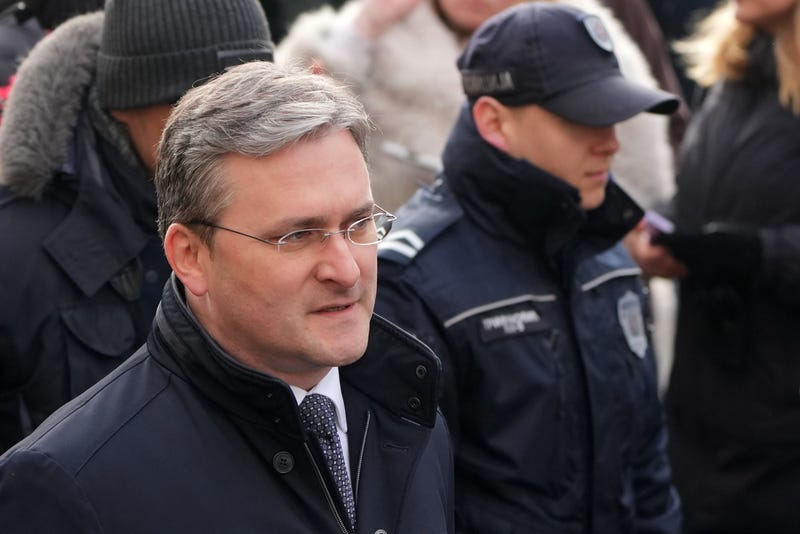
BELGRADE, Serbia (AP) — A Serbian government minister and three others went on trial on Wednesday on charges of abuse of office and falsifying of documents to help pave the way for a real estate project that was to be financed by a company of Jared Kushner, U.S. President Donald Trump’s son-in-law.
Kushner has since withdrawn from the planned multi-million investment that envisaged building a high-rise hotel, a luxury apartment complex, office spaces and shops to replace a sprawling bombed-out military complex in central Belgrade.
The plan was backed by the government of Serbia's autocratic President Aleksandar Vucic who had said it would help improve ties with the U.S. But the Serbian public and international heritage groups opposed the idea to turn a protected cultural heritage zone into a commercial compound.
Built by a prominent 20th century Yugoslav architect, Nikola Dobrović, the building was damaged in the 1999 U.S.-led NATO bombing of Serbia over Kosovo. The building is considered a masterpiece of modernist architecture, and heritage groups have called for it to be preserved and revitalized.
Many Serbs are still angry over the air war, launched to stop Belgrade’s crackdown against separatist ethnic Albanians in Kosovo.
Culture Minister Nikola Selakovic, who is a close ally of Vucic, and three other officials are accused of illegally lifting the protection status in 2024 for the site by forging documentation. If convicted they could face up to three years in prison. They pleaded not guilty as the trial opened.
Dozens of anti-government protesters chanting “thieves!” had gathered outside the organized crime court building as the defendants arrived.
The trial comes days after the Serbian parliament passed a set of legal changes seen as an attempt to curb the independence of Serbia's judiciary, particularly of the organized crime prosecutors who have been handling high-profile cases.
The European Union's Enlargement Commissioner Marta Kos urged Serbia to retract the amendments, describing them as “a serious step back on Serbia’s EU path."
Prosecutors on Wednesday held a 10-minute silent protest outside their offices against the changes.
Vucic, who has faced more than a year of street protests over a Nov. 2024 train station disaster, has launched a crackdown on protesters and moved to strengthen control over the police and other state institutions to tighten his grip on power. Many in Serbia blamed the collapse of a concrete canopy at the train station in the northern city of Novi Sad on sloppy renovation work fueled by corruption. Sixteen people died in the crash, triggering massive demonstrations.
Almost daily youth-led protests have shaken Vucic's tough rule in the Balkan country for the first time since his right-wing populist party came to power over a decade ago.
Vucic formally has promised to take Serbia into the EU but he has forged close ties with Russia and China while clamping down on democratic freedoms. He has labeled organized crime prosecutors as a “corrupt gang” and “criminals."