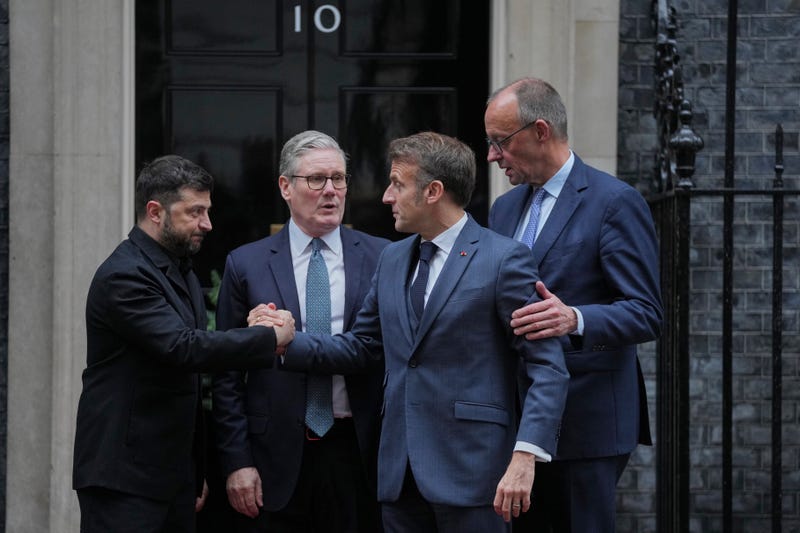
LONDON (AP) — President Volodymyr Zelenskyy met British, French and German leaders in London on Monday in a show of European support for Ukraine at what they called a “critical moment” in the U.S.-led effort to end Russia's war in Ukraine.
Prime Minister Keir Starmer held talks with Zelenskyy, French President Emmanuel Macron and German Chancellor Friedrich Merz at the British leader’s 10 Downing St. residence to try to strengthen Ukraine’s hand amid mounting impatience from U.S. President Donald Trump.
After the meeting, Starmer, Zelenskyy and the other leaders called Kyiv's European allies, urging them to keep up the pressure on Russian President Vladimir Putin.
“The leaders all agreed that now is a critical moment and that we must continue to ramp up support to Ukraine and economic pressure on Putin to bring an end to this barbaric war,” Starmer's office said in a statement.
“This is the furthest we’ve got in four years, and we welcome the fact that these talks are continuing at every level,” said Starmer's spokesman, Tom Wells. He added that “intensive work” will continue in the days ahead, although “there are still outstanding issues.”
Macron’s office said the session allowed the leaders “to continue joint work on the U.S. plan in order to complement it with European contributions, in close coordination with Ukraine.”
Answering reporters' questions in a WhatsApp chat later Monday, Zelenskyy said the current U.S. peace plan differs from earlier versions in that it now has 20 points, down from 28, after what he called some “obvious anti-Ukrainian points were removed.”
On security guarantees, Zelenskyy said the main questions to be resolved are: "What if after the end of the war, Russia will start another aggression? What will the partners be ready for? What could Ukraine count on?”
The answers to these questions "must be in the core of the security guarantees for Ukraine,” he said.
In an exchange with reporters on Sunday night, Trump appeared frustrated with Zelenskyy, claiming the Ukrainian leader “hasn’t yet read the proposal.”
Zelenskyy said Monday that Trump “certainly wants to end the war. ... Surely, he has his own vision. We live here, from within we see details and nuances, we perceive everything much deeper, because this is our motherland.”
Starmer, Macron and Merz took a more supportive stance toward Kyiv in comments before their Monday meeting, which lasted about two hours. The U.K. leader said the push for peace was at a “critical stage,” and stressed the need for "a just and lasting ceasefire.”
Merz, meanwhile, said he was “skeptical” about some details in documents released by the U.S. “We have to talk about it. That’s why we are here,” he said. “The coming days … could be a decisive time for all of us."
European leaders are working to ensure that any ceasefire is backed by solid security guarantees both from Europe and the U.S. to deter Russia from attacking again. Trump has not given explicit guarantees in public.
Zelenskyy said late Sunday that his talks with European leaders this week in London and Brussels will focus on security, air defense and long-term funding for Ukraine’s war effort. He said Monday that Ukraine needs support from both Europe and the U.S.
“There are some things we can’t manage without the Americans, things which we can’t manage without Europe, and that’s why we need to make some important decisions,” he said at Downing Street.
Starmer's office said the leaders instructed their national security advisers to continue discussions in the coming days, underscoring “the need for a just and lasting peace in Ukraine, which includes robust security guarantees.”
Obstacles in the peace plan
U.S. and Ukrainian negotiators completed three days of talks on Saturday aimed at trying to narrow differences on the U.S. administration’s peace proposal.
Zelenskyy said on Telegram that talks had been “substantive” and that National Security and Defense Council Secretary Rustem Umerov and Chief of the General Staff Andrii Hnatov were traveling back to Europe to brief him.
A major sticking point in the plan is the suggestion that Kyiv must cede control of the Donbas region of eastern Ukraine to Russia, which illegally occupies most but not all of the territory. Ukraine and its European allies have balked at the idea of handing over land.
Starmer said he “won’t be putting pressure” on Zelenskyy to accept a peace settlement.
Trump has had a hot-and-cold relationship with Zelenskyy since winning a second term, insisting the war was a waste of U.S. taxpayers’ money. Trump has also repeatedly urged the Ukrainians to cede land to Russia to end the nearly four-year conflict.
US releases national security strategy
The European talks follow the publication of a new U.S. national security strategy that alarmed European leaders and was welcomed by Russia.
Kremlin spokesman Dmitry Peskov said the document, which spells out the administration’s core foreign policy interests, was largely in line with Moscow’s vision.
“The nuances that we see in the new concept certainly look appealing to us,” he said Monday. “It mentions the need for dialogue and building constructive, friendly relations. This cannot but appeal to us, and it absolutely corresponds to our vision. We understand that by eliminating the irritants that currently exist in bilateral relations, a prospect may open for us to truly restore our relations and bring them out of the rather deep crisis.”
The document released Friday by the White House said the U.S. wants to improve its relationship with Russia after years of Moscow being treated as a global pariah and that ending the war is a core U.S. interest to “reestablish strategic stability with Russia.”
The document also says NATO must not be “a perpetually expanding alliance,” echoing another complaint by Russia. It was scathing about the migration and free speech policies of longstanding U.S. allies in Europe, suggesting they face the “prospect of civilizational erasure” due to migration.
Starmer’s government declined comment on the document, calling it a matter for the U.S. government.
Aerial attacks continue
Russia continued attacking Ukraine amid the diplomatic efforts. Its drones struck high-rise apartments in the northeastern Ukrainian city of Okhtyrka overnight, injuring seven people and extensively damaging the building, according to the head of the regional administration, Oleh Hryhorov.
In the northern city of Chernihiv, a Russian drone exploded outside a residential building, injuring three people and damaging a kindergarten, gas lines and cars, regional head Viacheslav Chaus said.
Ukraine’s air force said Russia fired 149 drones overnight, with 131 neutralized and 16 others striking their targets.
Meanwhile, Russian air defenses destroyed 67 Ukrainian drones overnight, Russia’s Defense Ministry said. The drones were shot down over 11 Russian regions, it said.
___
Novikov reported from Kyiv, Ukraine.