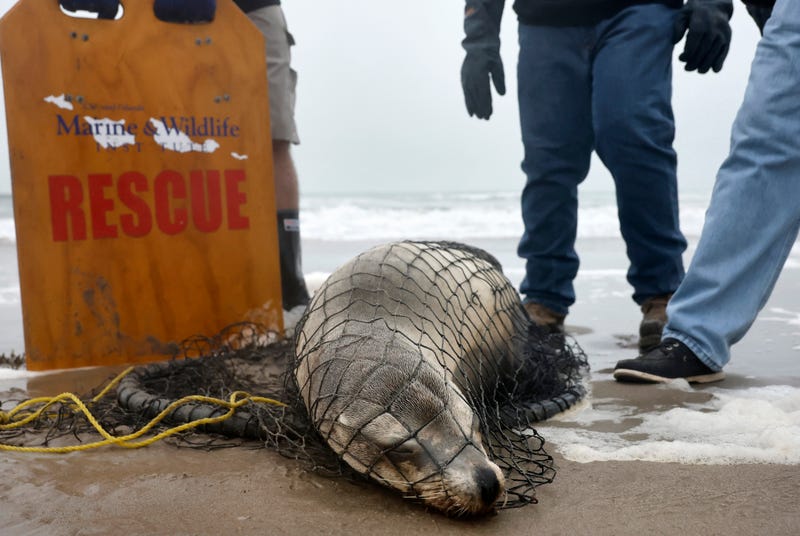

Responding to the discovery of multiple dead whales and sick sea lions on county beaches this year, the Los Angeles County Board of Supervisors Tuesday allotted $100,000 to the Marine Mammal Care Center in San Pedro for medical services, with an additional $600,000 possible.
Want to get caught up on what's happening in SoCal every weekday afternoon? Click to follow The L.A. Local wherever you get podcasts.
"Reported in recent weeks, hundreds of sea lions, dolphins and other animals have turned up in the sand dead or seriously ill -- alarming rescuers and beachgoers alike," said Supervisor Lindsey Horvath, who authored the motion with Supervisor Janice Hahn.
Horvath said this event was worse than one experienced in 2023, calling it "not only a sustainability and environmental crisis, but also a public safety crisis" that rescuers were not equipped to handle.
"With over 50 million people visiting the beaches annually, we need to take steps to keep the public safe," Horvath said.
The leading cause of the marine animals falling sick is domoic acid toxicosis, along with saxitoxin produced by algae that accumulates in fishes such as sardines and anchovies, according to the center's CEO, John Warner.
Consumption of this toxin can cause seizures, aggressive behavior, lethargy, dehydration, vomiting and even death in a variety of marine mammals, dolphins and seabirds.
"We're facing an unprecedented multi-toxin event," Horvath stated.
The motion states that recent tests from multiple locations showed rising levels of domoic acid.
Warner also said shellfish poisoning caused by saxitoxin was on the rise and alerts were issued for the public to avoid consuming shellfish from non-commercial sources who might not have subjected the fish to proper testing.
Officials said the MMCC receives over 4,000 calls annually to its rescue hotline, and calls concerning county-operated beaches make up 60% of all responses and animal admissions for rehabilitation.
"(This) is really the only organization equipped to do the important and frequently unsung work of providing care for our marine mammals that are suffering from domoic acid toxicosis," Hahn said.
The organization has cared for at least 410 marine mammals so far in 2025, but its annual budget only accommodates 300 animals, according to Horvath and Hahn, highlighting the need for increased funding.
The MMCC currently needs to raise between $3 million and $3.5 million annually to operate, most of which comes from private philanthropy, officials said.
Supervisor Holly Mitchell questioned whether the funding was too high, considering the county's current budget challenges.
Warner said the center's original proposal requested $750,000 but the county claimed only 60% of the county beaches were being assisted and called for reduced funding.
"I want to support (the request) but it shouldn't just be on us particularly when we're supporting a non-profit, and we're looking at curtailments to direct county departments," Mitchell added, saying that "if the ask was $750,000 -- 60% of that, if that's fair and accurate would get us to $450,000."
Tuesday's motion adds that the MMCC took over operations of animal rescue and response from Marine Animal Rescue, which shut down in 2022, increasing its costs by $600,000.
Mitchell offered an amendment asking the Department of Harbor and Beaches and the CEO to report back in five days identifying funding sources and a schedule of regular updates, which was accepted to the original motion.
The CEO was directed to identify up to $600,000 in additional funds for fiscal year 2025-26, and to put in a place a long-term funding strategy.
"This motion delivers critical support to the frontline responders rescuing and caring for these animals, while also helping us prepare for a future where these events will be more frequent and more severe due to climate change," Horvath said in a statement.
"We must act urgently and continue to invest in solutions to protect both public health and our coastal ecosystem."
The board also directed the county departments to create an emergency response plan for future mass-stranding events and toxic algal blooms in partnership with the MMCC and the Office of Emergency Management.
"The Marine Mammal Care Center has done extraordinary, often unsung work for years to care for our ocean life. But their staff and volunteers are overwhelmed by yet another domoic acid crisis. They need our help now," said Hahn, who represents the San Pedro area.
"I'm grateful to MMCC's leadership, staff, and volunteers for their tireless work to save marine mammals and to keep people safe. Help is coming," she added.
Follow KNX News 97.1 FM
Twitter | Facebook | Instagram | TikTok