

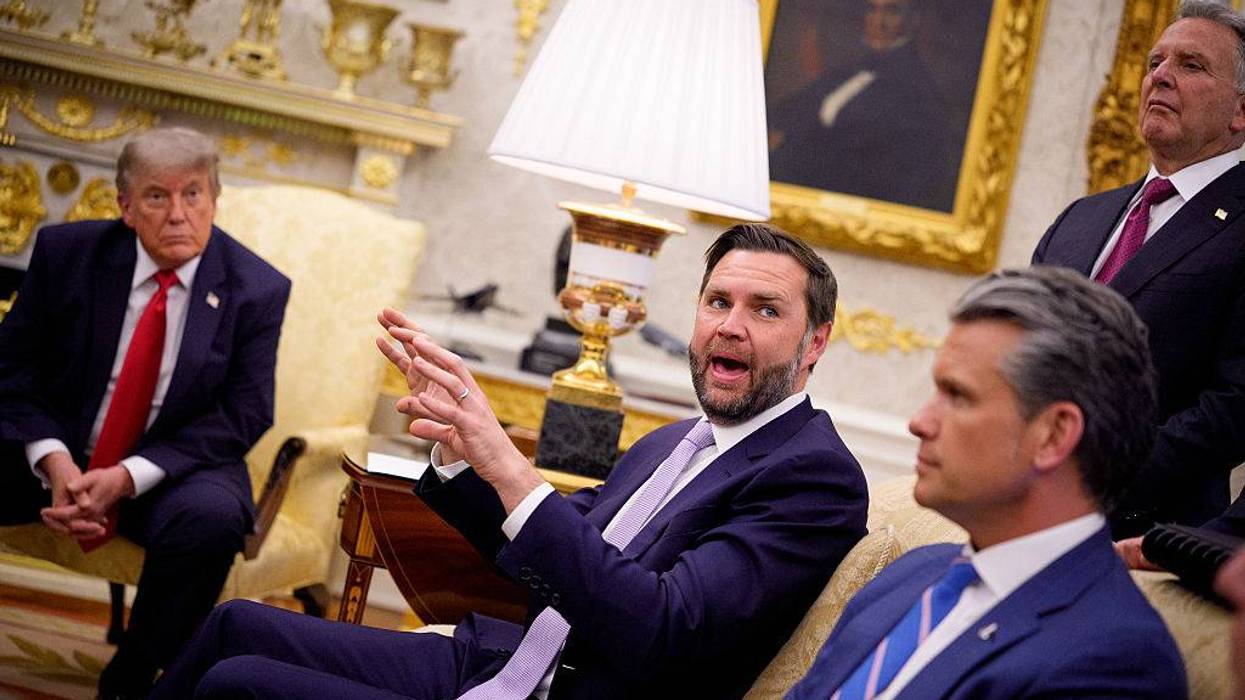

“If Watergate happened tomorrow, it would be like, a 12-hour news story – the idea that it would have taken down a presidency is crazy,” said Vice President JD Vance during a recent talk at the Richard Nixon Presidential Library and Museum to promote his new book “Communion”.
Vance was referring to the Watergate scandal, a case of political corruption that resulted in former President Richard Nixon, a Republican, resigning from office in 1974. To this day, Nixon is the only U.S. president to resign.
During Nixon’s first term, men linked to the Committee to Re-Elect the President broke in to the Democratic National Committee and bugged phone lines. Then, Nixon’s camp covered it up. Reporters Bob Woodward and Carl Bernstein at The Washington Post helped break the story to the public, earning the paper a Pulitzer Prize and the basis for the Oscar winning film “All the President’s Men”.
Amid the cover-up, Nixon won a landslide election in 1972. However, a Senate investigation began the following year and he was eventually impeached.
“Nixon’s secret White House tapes, uncovered in the course of the Senate Watergate hearings, revealed the truth about the Nixon presidency – and about Nixon himself,” explained the University of Virginia’s Miller Center. “As much as Americans may have wanted to believe the president when he told them that he wasn’t involved in the Watergate cover-up, the tapes proved otherwise. Americans could not reconcile Nixon’s public statements with the private recordings, and many could reach only one conclusion: Their president had lied to them.”
In the aftermath of the scandal, the word “Watergate” has become “synonymous with political crime and corruption,” according to the Federal Bureau of Investigation. It’s now common to add -gate to the end of something to signify that it’s a scandal.
During his talk at the Nixon library in Yorba Linda, Calif., Vance framed the Watergate as the “deep state” taking down Nixon. He compared it to “what happened to Donald Trump in his first administration,” referring to current President Donald Trump.
Vance also said that he sees himself in Nixon. Both were senators before becoming vice president and Nixon was also “hated by the media,” Vance said.
“I’m actually fascinated by Nixon as a character in history. I think that his historical legacy is enjoying a bit of a renaissance,” he said of the former president.
While Vance claimed that the media hates him, he’s also done his fair share of media-bashing that’s been praised by the Trump administration. The Washington Post, the paper that helped uncover Watergate, has reported on Trump’s “falsehoods,” in the past. Around the end of his first term, its Fact Checker had identified “30,573 false or misleading claims made by President Trump during his White House tenure.”
This isn’t the first time that Vance has made controversial comments. Just this month, he revealed that he regretted a comment he previously made about “childless cat ladies” on the left.
Vance’s comment about Watergate, not surprisingly, was met with backlash.
“What he’s saying is stupid,” said Joe Scarborough of “Morning Joe” on MS Now. He also said Vance’s words defined “deviancy” and that Nixon was the one who used the deep state to go after political enemies.
Rep. Jamie Raskin (D-Md.) said in an X post that: “Vance recognizes that the Watergate break-in is like a cub scout prank compared to the massive, all-encompassing corruption and criminality of the Trump presidency.”
Writing about Vance’s comments this week, The New Republic said: “the idea that Watergate would have taken down a presidency is not at all crazy. But Vance’s assertion shows that the Overton window [what the public will accept at a particular time] for acceptable conduct has shifted. And not by accident: Americans have to wade through a constant barrage of offenses, from Trump being convicted on 34 felony counts for hush-money payments to adult film actress Stormy Daniels, to normalizing political prosecution of enemies, to creating a slush fund for all the January 6 insurrectionists he pardoned after encouraging them to attack the Capitol.”
Notably, Nixon himself acknowledged the import of the Watergate scandal when he resigned.
“I have never been a quitter. To leave office before my term is completed is abhorrent to every instinct in my body. But as president, I must put the interests of America first,” Nixon said.