

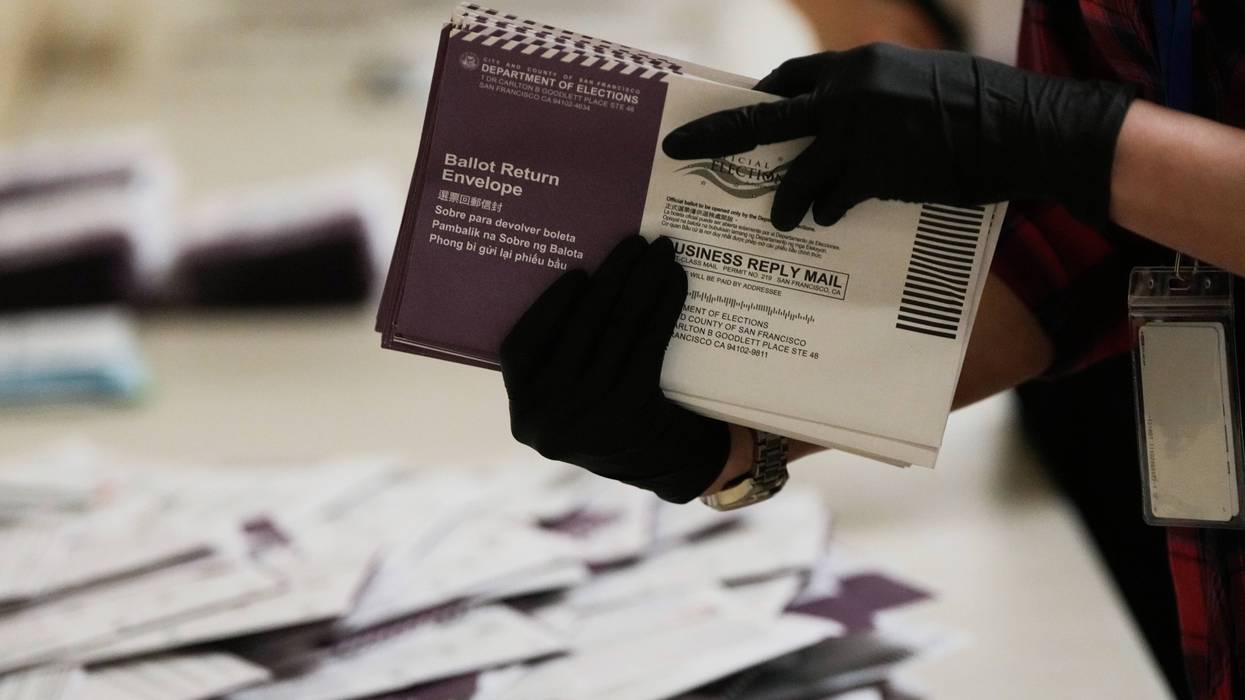

BOSTON (AP) — A federal judge on Tuesday heard from voting rights groups and a coalition of two dozen states that want the courts to halt President Donald Trump’s executive order seeking to create a federal voter list and limit who can receive a mail ballot.
The plaintiffs argued in two lawsuits that Trump’s order should be found unconstitutional because the states and Congress, not the president, have the power to set election rules. They also told the court that the move imposes a costly burden on state election officials to comply and would spread fear about the possibility of prosecution.
"This is going to be a sea change in the way that some states administer their ballots," said Michael Cohen, who was part of a team representing California, adding that “it will be difficult to overstate the disruption that this will cause.”
Trump's executive order, the second one aimed at elections during his second term, comes as he continues to raise the specter of widespread voting by noncitizens as a reason to change election rules. But states already have detailed processes aimed at keeping their voter rolls accurate, and voting by noncitizens has been shown to be rare. It also is a felony that can be punishable by deportation.
His latest order is being challenged through multiple lawsuits, including two filed in U.S. District Court in Boston.
The American Civil Liberties Union, which represented the League of Women Voters in one of the two Boston cases, has called the order “a dangerous attempt to disenfranchise eligible voters nationwide." The group said the order transforms "the U.S. Postal Service from a neutral mail carrier to an arbiter of who may cast a ballot by mail.”
“This case challenges an extraordinary and abusive assertion of executive power over the administration of federal elections,” the organization said in its complaint.
The hearing comes less than a week after another judge declined to halt the order. U.S. District Judge Carl Nichols, a Trump appointee in Washington, agreed with the Trump administration’s contention that it was too early to block the order because it has yet to be implemented.
The administration, in its motions to dismiss the lawsuits, argued that the plaintiffs lack standing to bring their claims. They also argued the motions are premature and that plaintiffs lack the legal basis to bring their Administrative Procedure Act claim, which governs how federal agencies develop and issue regulations.
Stephen Pezzi, a lawyer for the Trump administration, said the harms the plaintiffs referenced were subjective, since much can change with the voting list before it is finalized. He also said no one would be prosecuted for violating the executive order.
Missouri Solicitor General Lou Capozzi, speaking for the states supporting the list, argued it was too early to say how his state might use the list, but that it was “unlikely” any voter would be removed this year from the voter rolls because of it.
“We are not exactly sure how we would use it,” Capozzi said, adding that "we don't want this process to be strangled in the crib, so to speak.”
U.S. District Judge Indira Talwani took the requests for motions to halt the order, along with motions to dismiss the cases under advisement.
During oral arguments, Talwani expressed concerns about whether the federal system envisioned under the executive order could be ready for the upcoming midterm elections and about the risks posed to election workers who rely on a state list that differs from the federal one. She also raised doubts about the reliability of a federal list — noting, for example, women who changed their names after getting married or someone who has moved from state to state might be missed.
“Isn’t there a reasonable fear and concern on behalf of voters that they will be precluded?” Talwani asked.
Trump issued the order in March after a bill he supported to overhaul voting stalled in Congress. The order would have had the federal government create a list of eligible voters and then directed the Postal Service to deliver mail ballots only to those on the list. Election officials argued that it was ripe for abuse and could cause chaos, and the postal union has objected to the idea of mail carriers policing ballots.
The Postal Service has published a proposed rule required by Trump's executive order in the Federal Register. Among other things, the rule would not apply to primary elections or overseas ballots.
Since his 2020 presidential election l oss to Democrat Joe Biden, Trump has groundlessly claimed mail voting is rife with fraud and has launched a federal investigation into that year’s vote, even though repeated audits and investigations, including ones run by Republicans, found it was free of widespread fraud. Trump also has said he wants to “take over” election administration in Democratic areas.