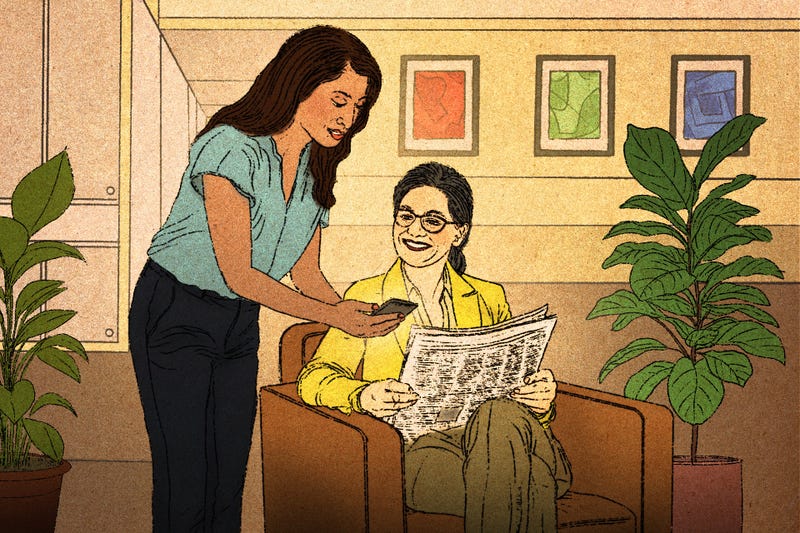
NEW YORK (AP) — Barbara Goldberg brings a stack of newspapers to the office every day. The CEO of a Florida public relations firm scours stories for developments relevant to her clients while relishing holding the pages in her hand. "I want to touch it, feel it, turn the page and see the photos," Goldberg said.
Generation Z employees at O’Connell & Goldberg don’t get her devotion to newsprint when so much information is available online and constantly updated, she said. They came of age with smartphones in hand. And they spot trends on TikTok or Instagram that baby boomers like Goldberg might miss, she said.
The staff's disparate media consumption habits become clear at a weekly Monday staff meeting. It was originally intended to discuss how the news of the day might impact the firm's clients, Goldberg said. But instead of news stories, the conversation often turns to the latest slang, digital tools and memes.
The first time it happened, she listened without judgment, and thought, “Shoot, this is actually really insightful. I need to know the trending audio and I need to know these influencers." Of her younger colleagues, she said, "they know the cultural conversation that I wasn’t thinking about.”
With at least five generations participating in the U.S. workforce, co-workers can at times feel like they speak different languages. The ways people born decades apart approach tasks may create misunderstandings. But some workplaces are turning the natural divides between age groups into a competitive advantage through reverse mentoring programs that recognize the strengths each generation brings to work and uses them to build mutual skills and respect.
Unlike traditional mentorships that involve an older person sharing wisdom with a younger colleague, reverse mentoring affords less experienced staff members the opportunity to teach seasoned colleagues about new trends and technologies.
“The generational differences, to me, are something to leverage. It’s like a superpower,” Goldberg said. “It’s where the magic happens.”
Here are some ways to make the most of a multigenerational workplace.
Mentoring up
Beauty product company Estée Lauder began a reverse mentoring program globally a decade ago when its managers realized consumers were rapidly getting beauty tips from social media influencers instead of department stores, said Peri Izzo, an executive director who oversaw the initiative.
The voluntary program now has roughly 1,200 participants. The mentors are millennials, born 1981 to 1986, and Gen Zers, born starting in 1997. They're paired with mentees who are part of the U.S. baby boom of 1946 to 1964, and members of Generation X, born 1965 to 1980, according to the generational definitions of the Pew Research Center.
At the start of a new mentoring relationship, participants do icebreaker activities like a Gen Z vocabulary quiz. The young mentors take phrases they use with friends in group chats and quiz older colleagues about what they mean, said Izzo, who at age 33 qualifies as a young millennial. For example, if a Gen Zer says something is “living rent-free in your head,” it refers to someone or something that constantly occupies your thoughts.
"Most of the mentees knew what it was, but then one mentee’s reaction was, ‘Oh I get it, my son lives rent-free in my house,’ and everyone thought it was so funny because they were like, ‘You really don’t understand the context that it’s being used on TikTok and amongst millennial and Gen Z,’” Izzo said.
Madison Reynolds, 26, a product manager on the technology team at Estée Lauder, is a Gen Zer and serves as a reverse mentor in the program. She and her contemporaries teach their older colleagues phrases such as “You ate it up,” which means you did a good job. When her manager tries out Gen Z phrases, Reynolds offers feedback, saying, “No, that's not right," or “You got it.”
Give and take
When 81-year-old hotelier Bruce Haines brought in athletes from Lehigh University’s wrestling team to participate in a mentorship program at the Historic Hotel Bethlehem in Pennsylvania, he taught them about entrepreneurship by having the students shadow managers in various departments. He also gained valuable marketing insights from the students, which he hadn’t anticipated.
“It’s been energizing for me. It’s almost reinvigorating," Haines, the hotel's managing partner, said. “We tended to be Facebook-focused. We’re a luxury destination hotel, so we tend to be an older crowd that we’re reaching. They enhanced our marketing by alerting us that we need to be on Instagram and YouTube and get out there and reach the younger people.”
The students also suggested offering prepackaged pints of ice cream to the hotel's in-house parlor because their contemporaries didn’t want to wait around for cones. “We were really missing out, and it’s truly increased our ice cream sales and our profitability,” Haines said.
Old-fashioned people skills
Carson Celio, 26, is an account supervisor at the PR firm Goldberg leads. She's part of the cohort that advises the CEO about what's trending on TikTok and what's over with. She says Goldberg has taught her how to successfully work a room and spark conversations that feel natural and organic.
Celio was a sophomore in college when COVID-19 hit, which pushed most of her classes online, including a public speaking course. “We have spent so much time online and conducting meetings over Zoom or Teams.” As a result, in-person networking can feel overwhelming to her generation, she said. “Learning the value of actually being face to face with people and building those connections — Barbara has helped me a lot with that.”
A text or a tome
At Harvard Medical Faculty Physicians, a medical group that employs 2,400 doctors in eastern Massachusetts, Dr. Alexa B. Kimball adapts her communication style to a range of age groups. Some mature clinicians send very long emails, which can be unproductive.
“When you have an email conversation that’s in its 15th response, that tells you you should pick up the phone,” Kimball, the group's CEO, said. On the other extreme, some of the youngest trainees communicate with six-word texts, she said.
A reverse mentoring program that teachers doctors about different communication styles helped when the practice launched a new medical records system that required 14 hours of training. Following the training, Kimball paired workers with more tech-savvy colleagues, who tended to be younger, to provide support.
Phased retirement
Robert Poole, 62, is the only person at health care technology company Abbott who manages the laser used to create nearly microscopic components of a cardiovascular device. Since he’s approaching retirement, Abbott hired Shahad Almahania, 33, an equipment engineer, to work alongside him and absorb some of his decades of knowledge.
“The equipment is all custom, so it takes a long time to learn how to run it and keep it running,” Poole said.
Poole, who began working in the 1980s, said he also learns from Almahania. When Abbott removed landline telephones five years ago, he migrated to group chats like Slack, asking her for help deciphering the meaning of emojis.
“When you strip away all the generational stereotypes, ... every age group, every person, is looking for some of the same things,” said Leena Rinne, vice president at online learning platform Skillsoft. “They want supportive leadership. They want the opportunity to grow and to contribute in their workplace. They want respect and clarity.”
___
Share your stories and questions about workplace wellness at cbussewitz@ap.org. Follow AP’s Be Well coverage, focusing on wellness, fitness, diet and mental health at https://apnews.com/hub/be-well