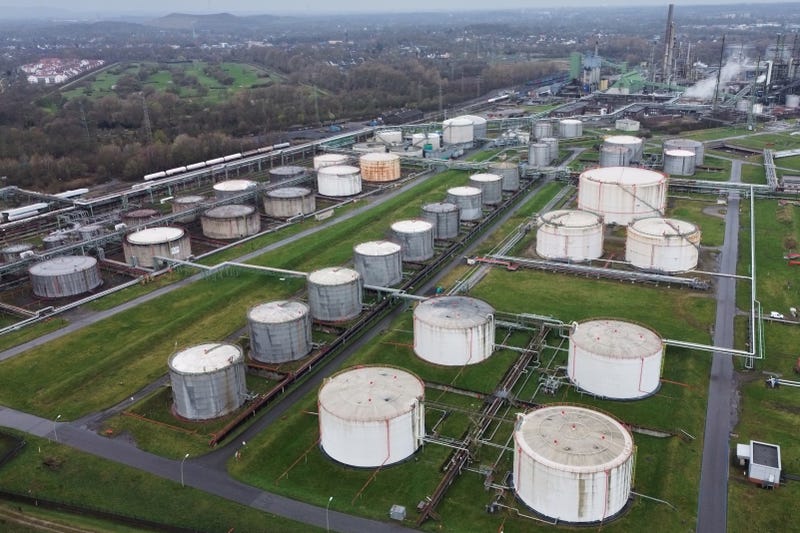
BERLIN (AP) — The International Energy Agency agreed Wednesday to release the largest volume of emergency oil reserves in its history, in a bid to counter the effects on energy markets of the war in the Middle East.
The Paris-based organization said it will make 400 million barrels of oil available from its members’ emergency reserves. It’s a larger stock than the 182.7 million barrels that were released in 2022 by the IEA's 32 member countries in response to Russia’s invasion of Ukraine.
IEA member countries currently hold over 1.2 billion barrels of public emergency oil stocks, with a further 600 million barrels of industry stocks held under government obligation.
In response to US and Israel strikes, Iran has attacked commercial ships across the Persian Gulf, escalating a campaign of squeezing the oil-rich region as global energy concerns mount.
Iran has effectively stopped cargo traffic in the narrow Hormuz Strait through which about a fifth of all oil is shipped from the Persian Gulf toward the Indian Ocean. It has also targeted oil fields and refineries in Gulf Arab nations, aiming at generating enough global economic pain to pressure the United States and Israel to end their strikes.
G7 Energy ministers on Tuesday said they supported in principle “the implementation of proactive measures to address the situation, including the use of strategic reserves."
According to the IEA, export volumes of crude and refined products are currently at less than 10% of pre-war levels.
THIS IS A BREAKING NEWS UPDATE. AP’s earlier story follows below.
BERLIN (AP) — Germany and Austria said Wednesday they are releasing parts of their oil reserves following an International Energy Agency request for members to release a record 400 million barrels to help temper energy price spikes due to the Iran war.
Japan also said it will release some of its reserves starting Monday.
Group of Seven energy ministers met Tuesday at IEA headquarters in Paris to look at ways to bring down prices that have risen because of the Iran war. IEA executive director Fatih Birol said afterward that they discussed all available options, including making IEA emergency oil stocks available to the market.
The largest-ever previous collective release of emergency stocks by IEA member countries was 182.7 million barrels, in the wake of the energy shock prompted by Russia’s full-scale invasion of Ukraine in 2022. The reserves were established in 1974 following the Arab oil embargo.
IEA members currently hold over 1.2 billion barrels of public emergency oil stocks, with a further 600 million barrels of industry stocks held under government obligation.
It was not immediately clear how much Germany and Austria were releasing.
The Group of Seven is comprised of the leading industrialized nations of Canada, the United States, France, Italy, Japan, Germany and Britain. Austria is not a member. Leaders of the G7 were set to hold a meeting via videoconference later Wednesday to discuss energy issues.
Germany’s economy minister Katherina Reiche said the country would release parts of its oil reserves following the IEA request “to release oil reserves amounting to 400 million barrels, which is a good 54 million tons.”
She said it would take a couple of days before the delivery of the first quantities.
“Germany stands behind the IEA’s most important principle of mutual solidarity," Reiche said.
In response to U.S. and Israeli strikes, Iran has attacked commercial ships across the Persian Gulf, escalating a campaign of squeezing the oil-rich region as global energy concerns mount. Iran has effectively stopped cargo traffic in the Strait of Hormuz through which about a fifth of all oil is shipped from the Persian Gulf toward the Indian Ocean.
Iran has also targeted oil fields and refineries in Gulf Arab nations, aiming at generating enough global economic pain to pressure the United States and Israel to end their strikes. Reports of sea mines allegedly laid by Iran in the Strait of Hormuz have also fueled concerns about the security of international energy supplies.
G7 energy ministers on Tuesday announced they supported in principle “the implementation of proactive measures to address the situation, including the use of strategic reserves.”
According to the IEA, export volumes of crude and refined products are currently at less than 10% of prewar levels.
Austrian Economy Minister Wolfgang Hattmannsdorfer said his country was releasing part of the emergency oil reserve and extending the national strategic gas reserve, adding: “One thing is clear: in a crisis, there must be no crisis winners at the expense of commuters and businesses.”
The German government also said it will introduce a measure to allow gas stations in Germany to raise fuel prices no more than once a day. The federal government wants to introduce this as quickly as possible, Reiche said.
In Austria, starting Monday, price increases at gas stations will be allowed only three times a week, the country’s economy minister said.
Oil reserves have been tapped when the market has faced major disruption in the past, including wars in Iraq, Libya and, most recently, Ukraine.
___
Petrequin reported from Paris.