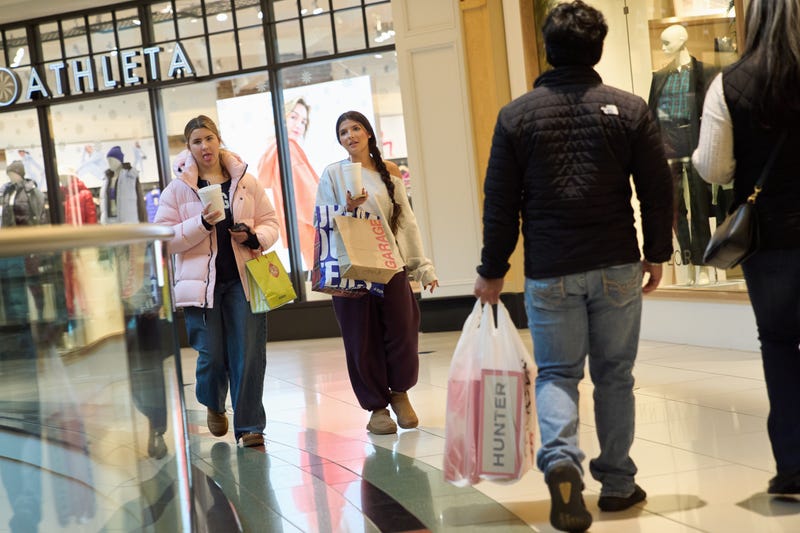
WASHINGTON (AP) — At a time when Americans are frustrated and angry over the high cost of living, the government released a report Thursday showing that inflation had cooled unexpectedly in November.
But economists quickly warned that that last month's numbers were suspect because they’d been delayed and likely distorted by the 43-day federal shutdown. And most Americans have not felt any let up in the high prices they are paying for food, insurance, utilities and other basic necessities.
The Labor Department reported Thursday that its consumer price index rose 2.7% in November from a year earlier. Yet, year-over-year inflation remains well above the Federal Reserve's 2% target. Americans, dismayed by high prices, handed big victories to Democrats in local and state elections last month.
The inflation report was delayed eight days by the shutdown, which also prevented the Labor Department from compiling overall numbers for consumer prices and core inflation in October and disrupted the usual data-collecting process. Thursday’s report gave investors, businesses and policymakers their first look at CPI since the September numbers were released on Oct. 24.
Consumer prices had risen 3% in September from a year earlier, and forecasters had expected the November CPI to match that year-over-year increase.
“It’s likely a bit distorted,’’ said Diane Swonk, chief economist at the tax and consulting firm KPMG. “The good news is that it’s cooling. We’ll take a win when we can get it.’’
Still, Swonk added: “The data is truncated, and we just don’t know how much of it to trust.’’ By disrupting the economy – especially government contracting – the shutdown may have contributed to a cooling in prices, she said.
Kay Haigh, global co-head of fixed income and liquidity solutions at Goldman Sachs Asset Management, warned that the November numbers were “noisy ... The canceling of the October report makes month-on-month comparisons impossible, for example, while the truncated information-gathering process given the shutdown could have caused systematic biases in the data.''
Many economists don't expect to get a reliable read on inflation until next month when the Labor Department releases CPI numbers for December.
Energy prices, driven up by sharply higher fuel oil prices, rose 4.2% in November. Excluding volatile food and energy prices, so-called core inflation rose 2.6%, compared with a 3% year-over-year gain in September and the lowest since March 2021.
U.S. inflation remains stubbornly high, partly because of President Donald Trump’s decision to impose double-digit taxes on imports from almost every country on earth along with targeted tariffs on specific products like steel, aluminum and autos.
The president’s tariffs have so far proved less inflationary than economists feared. But they do put upward pressure on prices and complicate matters at the Fed, which is trying to decide whether to keep cutting its benchmark interest rate to support a sputtering job market or whether to hold off until inflationary pressures ease. The central bank last week decided to reduce the rate for the third time this year, but Fed officials signaled that they expect just one cut in 2026.
"The Fed will instead focus on the December CPI released in mid-January, just two weeks before its next meeting, as a more accurate bellwether for inflation,'' said Haigh at Goldman Sachs.
Trump delivered a politically charged speech Wednesday that aired live during prime time on network television, seeking to pin the blame for economic challenges on Democrats.
The speech was a rehash of his recent messaging that has so far been unable to calm public anxiety about the rising cost of groceries, housing, utilities and other basic goods.
As the holiday season approaches, Americans are dipping into savings, scouring for bargains and feeling like the overall economy is sputtering, a new AP-NORC poll finds.
The vast majority of U.S. adults say they’ve noticed higher than usual prices for groceries, electricity and holiday gifts in recent months, according to the survey from The Associated Press-NORC Center for Public Affairs Research.
Roughly half of Americans say it’s harder than usual to afford the things they want to give as holiday gifts, and similar numbers are delaying big purchases or cutting back on nonessential purchases more than they would normally.
Trump has promised an economic boom, yet inflation has stayed elevated and the job market has weakened in the wake of his import taxes.
Trump’s tariffs are taking a toll on companies like Wolverine Worldwide, which makes footwear brands like Merrell and Saucony. Facing extra tariff costs of $10 million this year and $55 million in 2026, the Rockford, Michigan, company had to increase prices between 5% and 8% on some products in June, and will have to raise prices again next year. It’s put a freeze on hiring and capital investments.
The company is getting squeezed even as it diversifies its sourcing network away from China, which now makes less than 10% of its products. During Trump’s first term, Wolverine shifted production to Vietnam. Now it’s moving to Bangladesh, Cambodia and Indonesia.
The problem isn’t just the cost of the tariffs. It’s the uncertainty caused by the unpredictable way that Trump rolls them out. “From a business leader’s perspective, it’s one thing if there’s bad news,” said Wolverine CEO Christopher Hufnagel. “Just tell me what the bad news is, and I’ll go work to try to solve for it. It’s the uncertainty of how it actually plays out that causes so much trouble because then we’re modeling all these different scenarios and it seems like things can change in the middle of the night.”
____
D'Innocenzio contributed to this story from New York.