


PHILADELPHIA (KYW Newsradio) -- Philadelphia's city commissioners on Monday showed off millions of dollars worth of machinery that will process the hundreds of thousands of mail-in ballots voters are casting in this election. The operation has been assembled at the Convention Center.
Commission Chair Lisa Deeley led the mayor, city council president and a herd of reporters through a cavernous exhibit hall, from the machines that will allow election workers to open envelopes and extract ballots at a rate of 1,200 per hour to the ones that will count the ballots even faster.
"This investment is going to make a tremendous difference in our ability to get through these ballots," she said.
There was a machine operating during the tour, sending out mail-in ballots that have been requested. Then there are ballot extractors, which will begin operating at 7 a.m. on Election Day. They slit open the returned ballots on the first pass, then pull out the secrecy envelope with the ballot inside on the second pass.
Then they'll be put into a machine that can count the ballots at a rate of 32,000 an hour. The extractors will be a bit of a bottleneck, because they can only open 12,000 ballots an hour. Still, it is an exponential increase over what human beings could do without machines, so it is expected to go a lot faster than the primary in June.
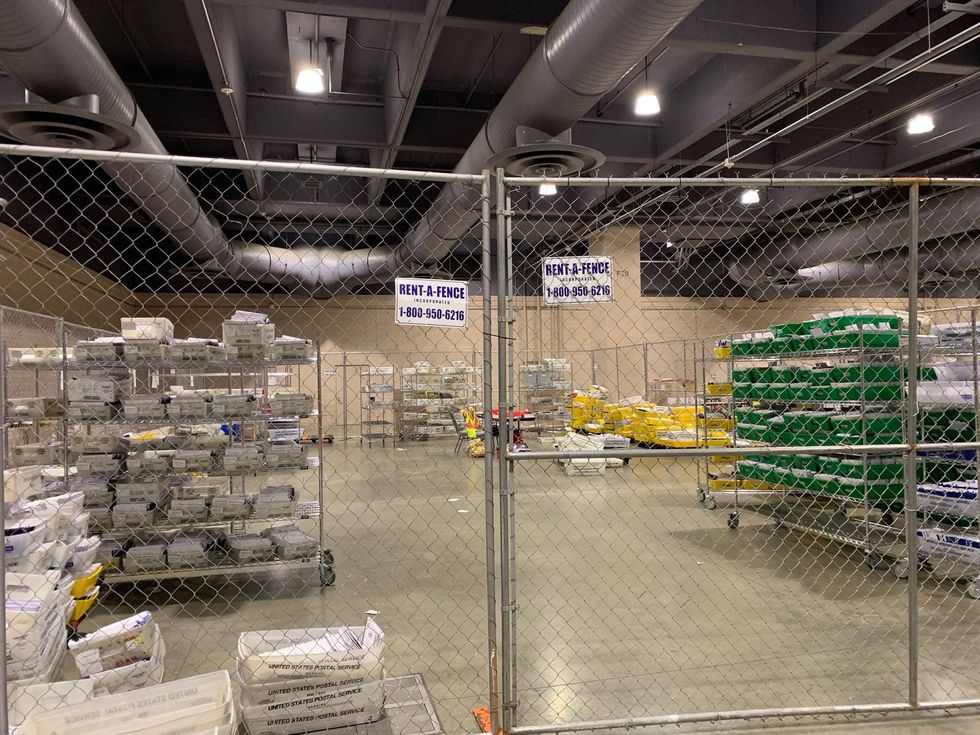 The 265,000 mail-in ballots that have been returned so far are stored being a fence until Election Day.Pat Loeb/KYW Newsradio
Deeley and the other officials understand the anxiety that surrounds this new method of voting. Council President Darrell Clarkes says polls show only 50% of Black voters are "very confident" their votes will be counted.
"I wish they could see this operation here," Clarke said. "I am extremely impressed."
With all the emphasis on mail-in ballots, Clarke also praised the simultaneous operation to prepare for in-person voting. There will be 713 polling places operating with 3,700 machines in use.
He particularly urged young people who protested over the summer to make a plan to vote.
"Now is your time to make something about it. I mean, you can't simply carry a sign in protest without voting."
The operation was made possible with a $5 million grant from a nonpartisan voting advocacy nonprofit.
David Thornburg, of the election watchdog group Committee of 70, says he's impressed by the operation.
"This gives me much confidence that we'll be ready for the onslaught," he said.
The city is expecting 400,000 mail-in ballots, but 728,000 people voted in Philadelphia in 2016, and officials are hoping for better turn out this time around. So, even with all those mail-in ballots, the city commissioners are simultaneously getting ready for almost an equal number of in-person voters on Election Day.


