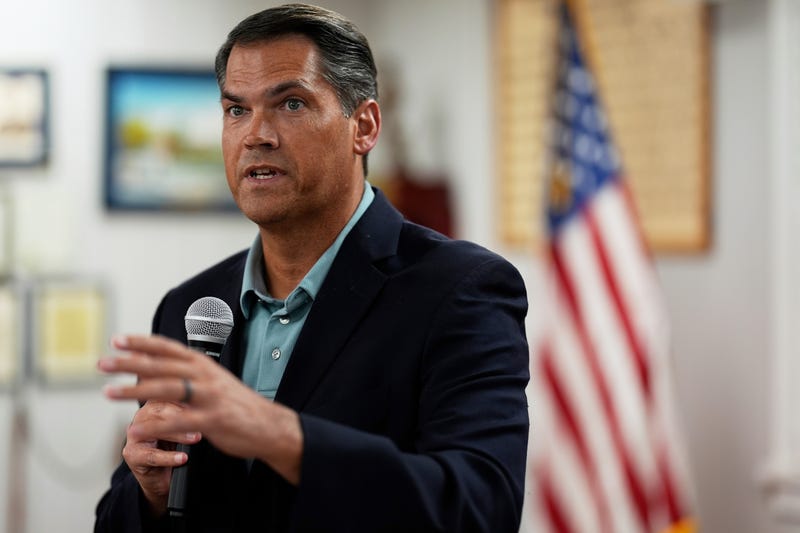
MARIETTA, Ga. (AP) — Under the fluorescent lights of an American Legion hall near Atlanta, in front of more than a dozen Democratic activists, Geoff Duncan apologized for all the things that he did as a Republican.
He regrets opposing gun control. He's sorry for fighting the expansion of Georgia's Medicaid program. And he's most remorseful about supporting some of the strictest abortion rules in the country.
“Unlike most folks in politics, I’m willing to say I’m sorry for that," Duncan said.
He's doing a lot of apologizing these days because the former Republican is running for governor as a Democrat, trying to win over members of his newly-adopted party in a crowded primary in a critical battleground state. Although some view Duncan as an interloper, he's pitching himself as Democrats' best chance to break their 24-year losing streak for Georgia's highest office.
“You’ve got to win more than your base,” Duncan said. “And so I’m the only one that shows up in this Democratic primary that’s building a big enough coalition of Democrats, independents, and this growing batch of disgusted Republicans.”
Duncan was a standard-issue suburban Republican serving as lieutenant governor until the 2020 election, when he rejected President Donald Trump's false claims about fraud. His stand earned him the respect of many Democrats, and he campaigned for Kamala Harris in 2024. Now he's testing whether that can translate into votes in the party's primary.
He's not the only one. Former Republican congressman David Jolly is running for governor in Florida and former Republican lawyer George Conway is running for Congress in New York City, both as Democrats.
Their success or failure could provide lessons for the national party as it debates whether to focus on progressive ideas or court moderates and even conservatives turned off by Trump. Some still question why Harris barnstormed with Liz Cheney, a former Republican congresswoman, rather than focusing on motivating liberal voters during her failed presidential campaign.
“The question for the Democratic Party is, which kind of church do you want to be?" asked Democratic commentator and political consultant Paul Begala. ”Do you want to be a church that hunts down heretics, or do you want to be a church that seeks out converts?"
Democrats are curious
There are six other people seeking the Democratic nomination as Georgia prepares to choose a successor to Republican Gov. Brian Kemp, who has served two terms and can't run again.
Other candidates include former Atlanta Mayor Keisha Lance Bottoms, former state Sen. Jason Esteves, former elected state Labor Commissioner Michael Thurmond, and state Reps. Ruwa Romman and Derrick Jackson.
Some Democrats are at least curious about Duncan, a perpetually tanned former minor-league baseball player. Tamara Stevens, a Democratic activist in Forsyth County north of Atlanta, said Esteves is her “ideal candidate.” But she's considering Duncan because she's seeking the most likely winner.
“I don’t have to agree with him on every issue. I don’t have to like him personally," Stevens said. "I want a candidate that can win. Because we’ve been on the losing end far too long, and it’s been devastating to our community.”
Mindy Seger, a prominent Cobb County Democrat who attended Duncan's meeting at the American Legion hall, described him as “relatable” but had her doubts.
“I think people have trust issues,” she said. “I do.”
Fred Hicks, a Democratic strategist in Georgia, noted Duncan kept identifying as a Republican, even while campaigning for Kamala Harris, until finally converting last August. He said some Democrats fear Duncan could be "a Trojan horse.”
“It looks like he just wants to be in power and he couldn’t get there by being a Republican" Hicks said.
Purity or pragmatism for primary voters?
Duncan's challenge was clear when he was campaigning at a coffee shop in Atlanta on the day after he announced his candidacy in September. While talking to reporters, he stood under a mural of civil rights icons and Democratic politicians — including Bottoms, one of Duncan's primary opponents.
Black voters are typically the majority of the Democratic primary electorate in Georgia, with Black women having particular influence. Hicks said it’s a “bit of reach” to believe they'll choose Duncan over Bottoms, Esteves and Thurmond, who are all Black.
“I think he’s going to really struggle with that when you have different types of Democrats who have been Democrats for their entire life who are running," Hicks said.
Duncan’s message about transcending partisanship could attract donors. He said in Marietta that he had already received 8,900 contributions from all 50 states, although he didn’t say how much he'd raised.
One option in Georgia — which doesn’t register voters by party — is for Duncan to court independents and Republicans to cross over into the Democratic primary on May 19. Two years ago, more than 37,000 typically Democratic voters voted in the Republican primary to help Secretary of State Brad Raffensperger defeat Trump’s handpicked candidate.
Duncan said he’s building “big enough a coalition that we can not only win a primary, but we can win a general election."
Begala said Democrats alarmed by the Trump administration may look past purity tests in 2026.
“Electability is a more potent message in a primary this year than I have ever seen,” he said.
He said converting former Republicans will be key to any Democratic victories in states like Georgia, Texas or Alaska.
“You actually have to get people coming over to your side who used to be on the other side,” Begala said.
Whit Ayres, a longtime Republican pollster and consultant, estimates around 10% of Republicans remain deeply opposed to Trump, not counting those who already left the party. But they may already be voting in Georgia's Republican primary, where Raffensperger is running for governor.
He's skeptical that Democratic primary voters will think strategically about a general election, rather than just seek out the candidates who most closely align with their own views.
“Donald Trump has changed so many things about American politics that I think we need to keep an open mind about other things that might be changed,” Ayres said. “But we’re going to have to have the folks like the Liz Cheneys, the Geoff Duncans, the George Conways prove that they can be successful as Democrats before many of us will believe.”