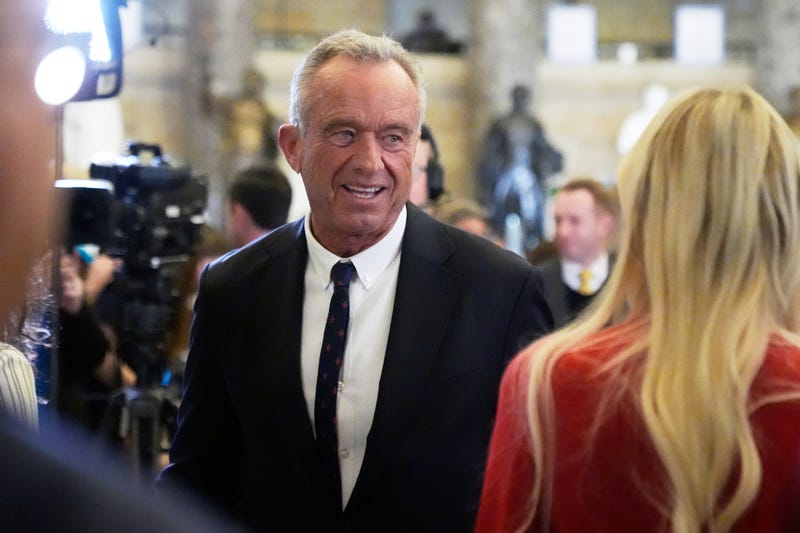
In the Trump administration’s campaign to promote healthy eating, Robert F. Kennedy Jr. has not stopped at his slogan urging people to “eat real food” to prevent disease.
In recent speeches and podcast appearances, the nation’s health secretary also has claimed that diet can “cure” schizophrenia and diabetes and allow people to rid themselves of bipolar disorder diagnoses. Researchers say the comments overstate current evidence about the real and promising role that food can play in managing illness.
“Food is medicine, and you can heal yourself with a good diet,” Kennedy said on comedian Theo Von’s “This Past Weekend” podcast in February.
The talking point aligns with an idea from Kennedy’s “Make America Healthy Again” allies that has gotten some bipartisan support: The role of food in health deserves more attention.
Scientists agree that diet can contribute to some diseases and also can be valuable in treating them. But public health advocates say Kennedy’s exaggerations are part of a pattern in which he cherry-picks and misrepresents scientific research, a tendency that he has regularly applied to vaccine science, enraging doctors.
It is the latest example of Kennedy being “incredibly careless and irresponsible” in talking about health issues, said Kayla Hancock, director of a public health project at the advocacy group Protect Our Care.
Dr. Theresa Miskimen Rivera, president of the American Psychiatric Association, fears the language could drive patients to self-medicate with food alone.
“The concern always is that people can have hope and they might interpret that as, ‘Well, I don’t need medication. I do not need treatment. I just need to follow the diet,’” Rivera said.
Kennedy oversteps the evidence on diet and psychiatric disorders
In an early February speech at the Tennessee Capitol, Kennedy cited the work of Dr. Christopher Palmer, a Harvard Medical School researcher who in 2019 wrote about two patients with schizophrenia who experienced remission of their symptoms following a high-fat, low-carbohydrate ketogenic diet.
Kennedy said that Palmer had “cured schizophrenia using keto diets.”
Palmer has called that inaccurate. He told The Associated Press that “as much as I wish we had cures for mental illness or other chronic diseases, it is important that we use more precise language.” Palmer prefers the word “remission.”
During the same speech, and later on Joe Rogan's podcast, Kennedy referred to studies “where people lose their bipolar diagnosis by changing their diet.” He said “there’s a big paper about to come out" showing results.
Kennedy spokesman Andrew Nixon said those comments referred to a “growing body of research” on the issue, including a University of California, Los Angeles, study investigating the effect of a keto diet on teenagers with bipolar disorder.
That study is still recruiting patients and will not be completed until March 2027, according to a posting on a federal website. Any publication would come months after that.
Rivera, of the American Psychiatric Association, said Kennedy’s claims exaggerate the evidence. Studies testing the role of the ketogenic diet on mental health conditions have been small, anecdotal or pilot studies, she said. Many did not include a control group of patients following a regular diet.
“At this point, it’s premature. We cannot draw definitive conclusions,” Rivera said. “There is not enough evidence to recommend a specific diet or as a standalone, without medication such as antipsychotics or mood stabilizers.”
It is true that research into the effects of ketogenic and other diets on psychiatric disorders is accelerating, Palmer said. He said 20 controlled clinical trials using the keto diet for severe mental illness are underway, with results of two trials set for publication within the next year.
Palmer said he is “very enthusiastic” about diet as a promising therapy for serious psychiatric disorders, but that patients with mental illness should still talk with their doctors.
“I want to implore patients: Please do not stop your medications on your own,” he said. “Please do not even try a ketogenic diet on your own as a treatment for schizophrenia or bipolar disorder.”
Diabetes experts are split on the impact of Kennedy's words
Kennedy’s comments on Von’s podcast that “most diabetes can be cured through diet” also have been scrutinized. Some experts say the health secretary overstated the role of diet.
Type 1 diabetes, an autoimmune disorder, cannot be cured by diet alone, said Dr. Willa Hsueh, an Ohio State University endocrinologist and researcher. A healthy diet and exercise are keys to managing Type 2 diabetes, but it can be difficult to use those tools alone to reverse the disorder, she said.
“The secretary is not wrong that it can work," Hsueh said. "But it’s not common for people to cure themselves ... by diet alone.”
Others defended Kennedy’s claims about the disease that affects 40 million people in the United States.
Dr. Dariush Mozaffarian, a cardiologist and director of the Food is Medicine Institute at Tufts University, said a healthy diet could help “most individuals” with Type 2 diabetes lower their blood sugar levels, reverse symptoms and allow them to stop taking medications for the condition.
“Whether you consider that a cure or remission, that’s medical speak, right?” Mozaffarian said.
He acknowledged that Kennedy is not “always perfectly precise in the terminology and there could be risks to that.” But he welcomed the high-level focus on the role of diet in improving chronic disease.
“I’d rather exaggerate and get some attention and action than keep doing what we’re doing, which is have millions of Americans suffering from diet-related diseases,” Mozaffarian said.
MAHA supporters want to see more focus on food
Mark Gorton, president of the Kennedy-aligned MAHA Institute, said he was not familiar with the studies Kennedy referenced, but that nutrition has been “an incredibly overlooked area in our medical system for decades.”
“I think to the extent that it is possible, we should be prioritizing focusing on diet and getting back to living healthy rather than taking sick people and medicating them forever, which is the current way our system works,” Gorton said.
Kody Green, a mental health advocate with schizophrenia, said that he supports healthy eating, but that he needed psychiatric medications. He worries that Kennedy's comments could deter schizophrenia patients from trying drugs that are already stigmatized.
“For some people, maybe food can help with the issues they have, but schizophrenia is a very serious mental illness,” Green said. "Until further research is done, making claims like that can be really dangerous to people in my community.”
___
The Associated Press Health and Science Department receives support from the Howard Hughes Medical Institute’s Department of Science Education and the Robert Wood Johnson Foundation. The AP is solely responsible for all content.