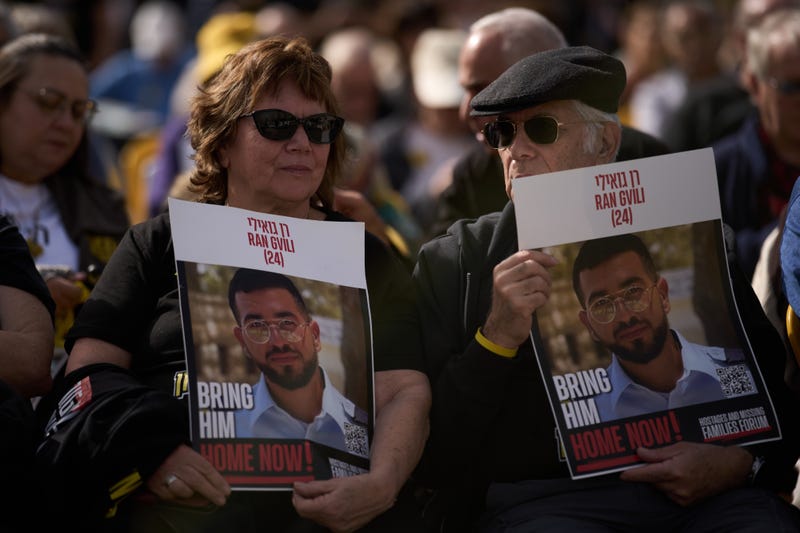
JERUSALEM (AP) — Israel says the remains of the final hostage in Gaza have been recovered, clearing the way for the next phase of the ceasefire that stopped the Israel-Hamas war.
Monday’s announcement came a day after Israel’s government said the military was conducting a “large-scale operation” in a cemetery in northern Gaza to locate the remains of Ran Gvili.
The return of all remaining hostages, living or dead, has been a key part of the Gaza ceasefire’s first phase, and Gvili’s family had urged Israel’s government not to enter the second phase until his remains were recovered and returned.
Israel and Hamas have been under pressure from ceasefire mediators including Washington to move into the second phase of the U.S.-brokered truce, which took effect on Oct. 10.
Israel had repeatedly accused Hamas of dragging its feet in the recovery of the final hostage. Hamas had said it had provided all the information it had about Gvili’s remains, and accused Israel of obstructing efforts to search for them in areas of Gaza under Israeli military control.
Israel’s military had said the large-scale operation to locate Gvili’s remains was “in the area of the Yellow Line” that divides the territory.
The ceasefire deal aims to wind down the war that was sparked by the Hamas-led attack on southern Israel on Oct. 7, 2023, that killed about 1,200 people and saw 251 taken hostage. Gvili, a 24-year-old police officer known affectionately as “Rani,” was killed while fighting Hamas militants during the attack.
Before Gvili’s remains were recovered, 20 living hostages and the remains of 27 others had been returned to Israel since the ceasefire, most recently in early December. Israel in exchange has released the bodies of hundreds Palestinians to Gaza.
The next phase of the 20-point ceasefire plan has called for creating an international stabilization force, forming a technocratic Palestinian government and disarming Hamas.
THIS IS A BREAKING NEWS UPDATE. AP’s earlier story follows below.
JERUSALEM (AP) — Israeli teams were combing through a Gaza cemetery Monday for the remains of the final hostage in Gaza, the military said, after Hamas claimed it had done all required of it under the ceasefire agreement to search the side of the territory not controlled by troops.
The search marked a dramatic last-ditch effort by Israel to find the body of Ran Gvili as Washington and other mediators apply pressure to move forward with the U.S.-brokered ceasefire agreement.
The clearest sign of progress would be Israel opening the Rafah crossing between Gaza and Egypt for Palestinians to enter and exit the territory. Prime Minister Benjamin Netanyahu's office says Israel will open the crossing once the search for Gvili is finished.
Israeli fire, meanwhile, killed two Palestinians in Gaza, health authorities said, and Israel’s Supreme Court considered a petition to allow the foreign press independent access to Gaza.
Israel says the search for Gvili's remains could last days
A military official said that the search for Gvili's remains began over the weekend in the areas of Shuja’iyya, Daraj and Tuffah, based on intelligence. The official said troops were joined by rabbis and dental experts to help identify Gvili. The official spoke on condition of anonymity because they were discussing an operation still underway.
According to two Gaza City residents, the search took place in a cemetery in the Tuffah neighborhood, which includes hundreds of bodies. The residents, who asked to be unidentified for fear of reprisal, said Israeli forces were digging graves in the Batsh Cemetery, pulling bodies out before leaving them in the open.
Israeli military officials were quoted in local media as saying the operation could take days to complete.
Hamas had searched for Gvili's body on the side of the ceasefire line currently occupied by most of Gaza's Palestinians.
Israeli troops control the eastern portion of Gaza, under the agreement. The militant group said Sunday it had given mediators all the information it had about Gvili’s location and claimed Israel was searching one of the sites it had specified, across the ceasefire line where the militant group is not permitted.
The return of all remaining hostages, alive or dead, has been a central part of the first phase of the ceasefire that took effect on Oct. 10. Before Monday, the previous hostage was recovered in early December.
Also key to the agreement is opening the Rafah crossing, which Palestinians see as their lifeline to the world. The crossing remained closed Monday. It has been largely shut for entry to and exit from Gaza since May 2024, but for a small period in early 2025.
Gvili’s family has urged Netanyahu’s government not to enter the ceasefire’s second phase until his remains are returned. But pressure has been building, and the Trump administration has already declared in recent days that the second phase is underway.
Palestinians killed in Gaza
Israeli forces on Monday fatally shot a man in Gaza City’s Tuffah neighborhood, according to Shifa Hospital, which received the body. The man was close to an area where the military has launched the search operation for Gvili, the hospital said.
Another man was killed in the eastern side of Bureij refugee camp in central Gaza, according to Al-Aqsa Martyrs hospital, which received his body. The circumstances of his death were not immediately clear.
More than 480 Palestinians were killed by Israeli fire since Oct. 10, according to Gaza's Health Ministry. The ministry, which is part of the Hamas-led government, maintains detailed casualty records that are seen as generally reliable by U.N. agencies and independent experts.
Israel's top court considers petition to open Gaza for international journalists
The Foreign Press Association on Monday asked Israel’s Supreme Court to allow journalists to enter Gaza freely and independently.
The FPA, which represents dozens of global news organizations, has been fighting for more than two years for independent media access to Gaza. Israel has barred reporters from entering Gaza independently since the Oct. 7, 2023, attacks by Hamas, which triggered the war, saying entry could put both journalists and soldiers at risk.
The army has offered journalists brief, occasional visits under strict military supervision.
FPA lawyers told the three judge panel that the restrictions are not justified and that with aid workers moving in and out of Gaza, journalists should be allowed in as well. They also said the tightly controlled embeds with the military are no substitute for independent access. The judges are expected to rule in the coming days.
___ Magdy reported from Cairo.
___
Find more of AP’s coverage at https://apnews.com/hub/israel-hamas-war