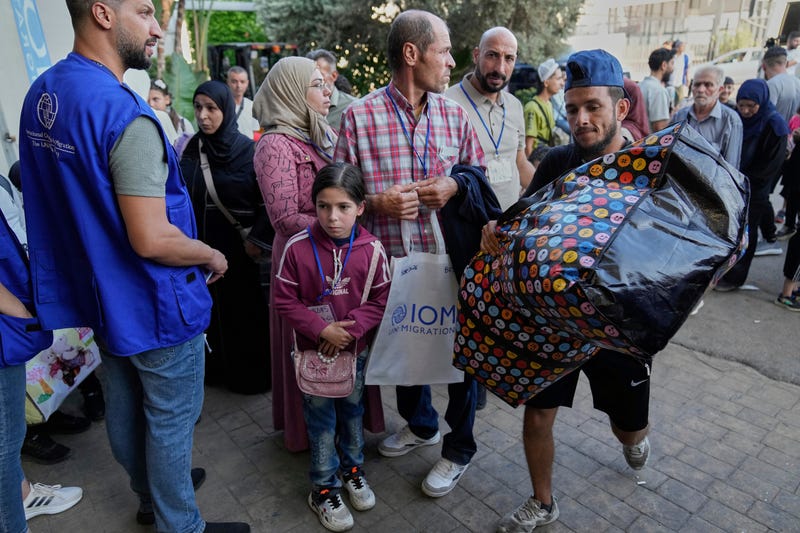
BEIRUT (AP) — The head of the U.N. refugee agency in Lebanon said Thursday that the move by the United States to lift sweeping sanctions on Syria could encourage more refugees to return to their country.
The U.S. Senate voted Wednesday to permanently remove the so-called Caesar Act sanctions after the administration of President Donald Trump previously temporarily lifted the penalties by executive order. The vote came as part of the passage of the country's annual defense spending bill. Trump is expected to sign off on the final repeal Thursday.
An estimated 400,000 Syrian refugees have returned from Lebanon since the ouster of former Syrian President Bashar Assad in December 2024 following a nearly 14-year civil war, UNHCR Lebanon Representative Karolina Lindholm Billing said, with around 1 million remaining in the country. Of those, about 636,000 are officially registered with the refugee agency.
The U.N refugee agency reports that altogether more than 1 million refugees and nearly 2 million internally displaced Syrians have returned to their homes since Assad’s fall.
Refugees returning from neighboring countries are eligible for cash payments of $600 per family upon their return, but with many coming back to destroyed houses and no work opportunities, the cash does not go far. Without jobs and reconstruction, many may leave again.
The aid provided so far by international organizations to help Syrians begin to rebuild has been on a “relatively small scale compared to the immense needs,” Billing said, but the lifting of U.S. sanctions could “make a big difference.”
The World Bank estimates it will cost $216 billion to rebuild the homes and infrastructure damaged and destroyed in Syria's civil war.
“So what is needed now is big money in terms of reconstruction and private sector investments in Syria that will create jobs,” which the lifting of sanctions could encourage, Billing said.
Lawmakers imposed the wide-reaching Caesar Act sanctions on Syria in 2019 to punish Assad for human rights abuses during the country’s civil war.
Despite the temporary lifting of the sanctions by executive order, there has been little movement on reconstruction. Advocates of a permanent repeal argued that international companies are unlikely to invest in projects needed for the country’s rebuilding as long as there is a threat of sanctions returning.
New refugees face difficulties
While there has been a steady flow of returnees over the past year, other Syrians have fled the country since Assad was ousted by Islamist-led insurgents. Many of them are members of religious minorities fearful of being targeted by the new authorities — particularly members of the Alawite sect to which Assad belonged and Shiites fearful of being targeted in revenge attacks because of the support provided to Assad during the war by Iran and the Lebanese Shiite militant group Hezbollah.
Hundreds of Alawite civilians were killed in outbreaks of sectarian violence on Syria’s coast in March.
While the situation has calmed since then, Alawites continue to report sporadic sectarian attacks, including incidents of kidnapping and sexual assault of women.
About 112,000 Syrians have fled to Lebanon since Assad’s fall, Billing said. Coming at a time of shrinking international aid, the new refugees have received very little assistance and generally do not have legal status in the country.
“Their main need, one of the things they raise with us all the time, is documentation because they have no paper to prove that they are in Lebanon, which makes it difficult for them to move around,” Billing said.
While some have returned to Syria after the situation calmed in their areas, she said, “Many are very afraid of being returned to Syria because what they fled were very violent events.”