
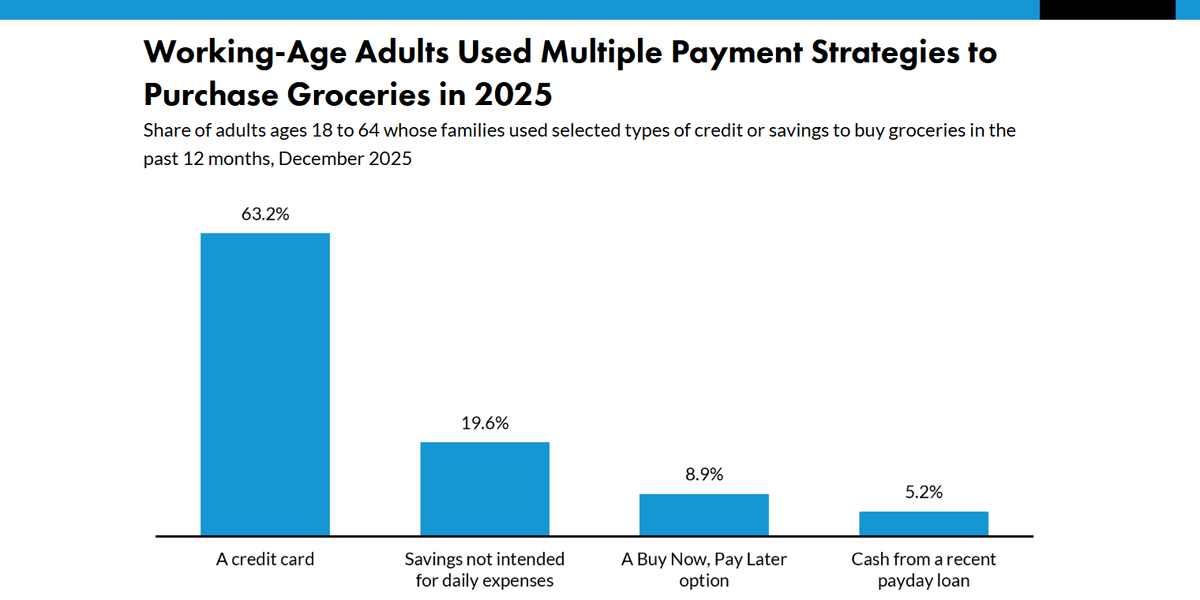
Millions of Americans are borrowing money or draining their savings to buy groceries, with more than a quarter of working-age adults relying on credit cards to buy groceries in a new survey.
About 20% of working-age adults reported tapping into long-term savings not intended for everyday expenses to pay for groceries in the last 12 months.
New insight from the Urban Institute found.
- Over 1 in 4 working-age adults used credit cards to purchase food for their families and experienced repayment challenges.
- Nearly 1 in 10 working-age adults used Buy Now, Pay Later options to pay for groceries; among them, 1 in 3 (34.8 percent) missed a BNPL payment.
- Nearly 1 in 5 working-age adults (19.6 percent) reported paying for groceries with savings not intended for daily expenses.
- Nearly 1 in 20 working-age adults (5.2 percent) used cash from a recent payday loan to purchase groceries.
- Working-age adults with low and moderate incomes were more likely to experience repayment challenges than those with high incomes: more than half of low- and moderate-income working-age adults who paid for groceries with credit cards did not always pay the full balance, compared with just over a third of higher-income adults.
- Just over half (51.3 percent) of working-age adults reported that their grocery costs increased a lot in the past 12 months. They were more than twice as likely (12.4 percent) not to make the minimum payment when using credit cards to purchase groceries, compared with those who reported that their grocery costs increased a little (5.2 percent) or not at all (4.8 percent).
- More working-age adults reported using a credit card to pay for groceries and not always making the minimum payment in 2025 than in 2023 (an increase of 1.6 percentage points, from 7.1 percent in 2023 to 8.7 percent in 2025).
At the same time, grocery prices have jumped 32% over the past five years, making food affordability a top concern for many Americans.
Food prices are on the rise due to increasing fuel costs, leading to financial strain for many Americans.
Stagnant wages and inflation are forcing people to turn to high-interest credit cards or payday loans to cover basic expenses. The economic impact of the war in Iran will be felt for years to come, exacerbating the financial crisis.
https://www.urban.org/research/publication/many-families-rely-credit-and-savings-afford-groceries
Urban Institute data
"Families still need to eat. They will still need to pay for their basic needs," Kassandra Martinchek, a co-author of the study and public policy expert at the Urban Institute, told CBS News. "Now they have the additional burden of also needing to repay debt — it could constrain their ability to meet their basic needs in the future and get back on their financial feet."
Researchers found that Congress could address the issue by investing in safety-net programs and expanding access to credit counseling, but previous cuts to these programs are hindering progress.