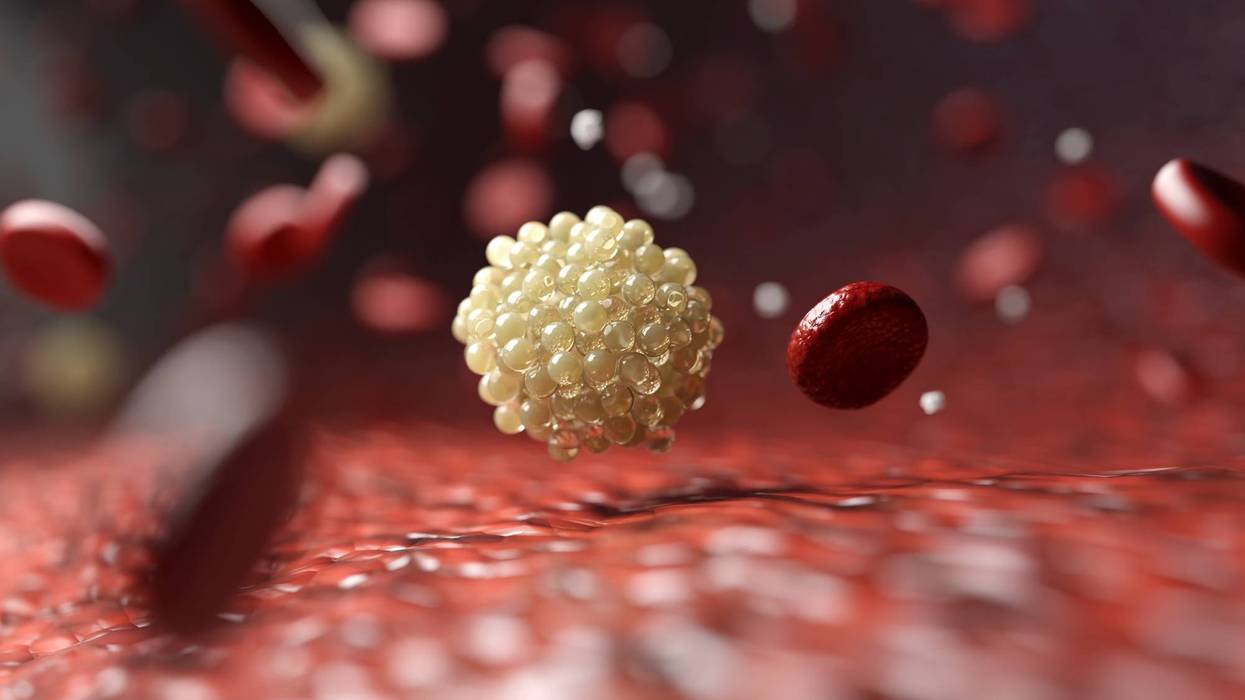

Most of us know it’s smart to avoid having high levels of cholesterol. What some people might not realize is that certain cancers actually feed off cholesterol.
This week, researchers released findings about their work to use cancer’s hunger for cholesterol to starve the disease. It was focused on cancer cells with a mutation in the tumor-suppressing TP53 gene known to produce extra cholesterol (a lipid, or fat-like substance found in the body).
Human bodies need some cholesterol to build cells and make hormones, according to the American Heart Association, but too much can cause health issues. Cancers with TP53 mutations account for roughly half of all cancers, including a large subset of breast cancers, and study authors were in part looking for more treatment possibilities for patients with these cancers.
“We recognized a real opportunity in targeting the enzymes that control cholesterol transport, especially since cancer cells depend on this process far more than normal cells do,” said Ryan Loughran, a postdoctoral associate in the Emerling lab and lead author of the study.
According to a press release from Sanford Burnham Prebys Medical Discovery Institute, cancer cells with the mutation in the tumor-suppressing TP53 might be “more vulnerable to starvation if scientists can put a stop to the steady supply of the lipid.” Scientists from the institute worked with collaborators at the University of Illinois Chicago to conduct the research. Their work was published Friday in the Science Advances journal.
Tumors that gorge on cholesterol are able to accelerate growth beyond the capabilities of normal cells, the press release explained. Around the tumors, there are enzymes that help move cholesterol – these are an important part of the researchers’ cancer-cholesterol trap.
“Without the help of these enzymes, a cholesterol traffic jam occurs, blocking the cancer cell’s ability to fuel tumor growth,” the Sanford Burnham Prebys Medical Discovery Institute said.
To test out the traffic jam theory, the research team looked to family of cell membrane lipids known as phosphoinositides and the kinase enzymes that regulate them.
“The investigators had shown that a branch of the lipid enzyme family known as phosphatidylinositol-5-phosphate 4-kinases (PI5P4Ks) were required for the growth of cancers with TP53 mutations in mice, and they suspected that this tumor prevention was due to the enzymes’ role relocating cholesterol in the cell,” said the institute.
Through experiments with mouse and human cancer cells, the scientists showed that PI5P4Ks influenced the movement and behavior of organelles that carry cholesterol around our cells. Specifically, the enzymes seemed to push cholesterol-laden lysosome waste disposal organelles near the exterior of the cell membrane, where they would be in proximity with many receptor proteins, enzymes and signaling molecules, including the mechanistic target of rapamycin complex 1 (mTORC1).
That mTORC1 enzyme governs cell growth and Sanford Burnham Prebys Medical Discovery Institute said it “runs amok” in cancer.
Without PI5P4Ks enzymes, the cholesterol-laden lysosomes remained in the interior of the cells, further from the mTORC1 enzyme. According to the research team, that led to reduced interaction with mTORC1 and a block of signals associated with tumor growth.
“The mTOR activation pathway is really what drives tumorigenesis, and so mTOR is an important target for cancer drug development,” said Brooke Emerling, PhD, the director of and associate professor in the Cancer Metabolism and Microenvironment Program at the Sanford Burnham Prebys NCI-Designated Cancer Center. “If we can target mTOR activity in aggressive cancers by blocking the sensing of cholesterol, that would be a promising treatment strategy.”
According to the National Library of Medicine, TP53 is known as the “guardian of the genome” and when mice lose it, they are usually fated to die from cancer within months. However. Emerling said deleting kinases can keep animals 100% protected from tumors. She said cholesterol is the reason why.
When the kinases are absent, the “the link between lysosomal cholesterol and mTORC1 is compromised, a bit like two ships passing in the night,” Emerling added.
Now, the next step is to find ways to cut off cancer cells from their cholesterol supply. Statins, a cholesterol medication, have been suggested but researchers are concerned that tumors will become resistant to them.
“We’ll continue to explore blocking PI5P4Ks as a more targeted approach tailored to how tumors operate,” said Emerling.
In recent years, there has been an uptick in cancer among younger people, something that the Memorial Sloane Kettering Cancer Center addressed earlier this year. Just this week, Tulsi Gabbard resigned as President Donald Trump’s director of national intelligence citing a need to help her husband, who is battling cancer at age 37.