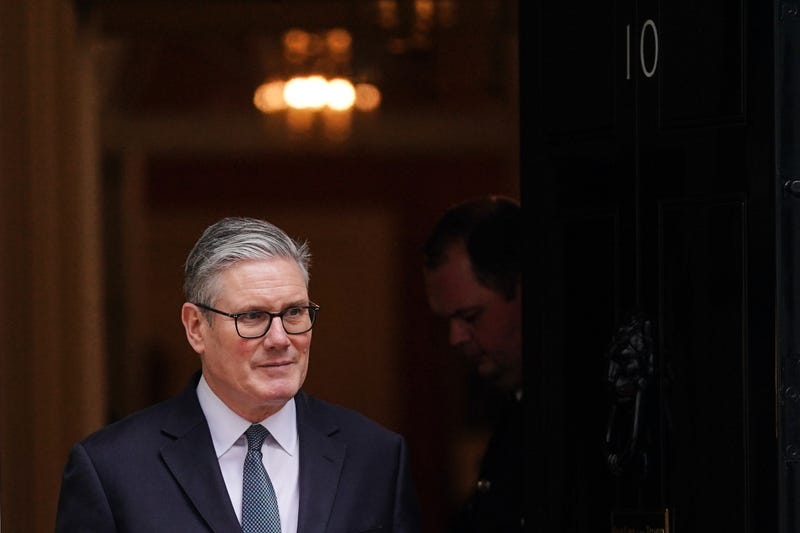
LONDON (AP) — U.K. Prime Minister Keir Starmer is heading to China, seeking a thaw in relations with Beijing at a time of strained ties with the United States.
He's hoping for an economic boost to Britain, but risks the wrath of China hawks at home — and of U.S. President Donald Trump, who’s already heaping tariffs and criticism on America’s closest allies.
Starmer is due to meet China’s President Xi Jinping and Premier Li Qiang during the visit to Beijing and Shanghai that starts Wednesday, the first by a U.K. leader since 2018. He is expected to be accompanied by Business Secretary Peter Kyle and dozens of corporate chiefs as Britain seeks Chinese technology and investment, alongside greater access to the world’s second-largest economy for U.K. financial services, cars and Scotch whisky.
“China is no longer just the world’s factory; it is also becoming a global market,” said Zhao Minghao, a professor in the Institute of International Studies at Shanghai’s Fudan University.
The key word stressed by both sides is “pragmatic.” As Trump roils the world order, both London and Beijing are looking for a more stable relationship.
China's government said it sees the visit as an opportunity to enhance political trust and deepen "pragmatic cooperation.”
“In the current complex and volatile international situation, it is in the common interest of both peoples of China and the U.K., as permanent members of the U.N. Security Council, to maintain communication and strengthen cooperation,” Chinese Foreign Ministry spokesperson Guo Jiakun said Tuesday at a daily briefing in Beijing.
From golden era to big chill
Kerry Brown, director of the Lau China Institute at King’s College London, said the trip comes as dramatic shifts in geopolitics create new opportunities for U.K.-Chinese relations.
But he said “Starmer is going to be talking to a very skeptical audience.
“Britain has not been very consistent in its relations with China. We have been very hot and cold,” Brown said.
The relationship has soured since the short-lived “golden era” proclaimed in 2015 by Conservative Prime Minister David Cameron, who took Xi to a traditional English pub during a state visit. Beijing’s crackdown on civil liberties in Hong Kong, China’s support for Russia in the Ukraine war and growing concern about espionage and economic interference have widened the gap between London and Beijing.
Cameron’s Conservative successors barred Chinese investment in sensitive telecoms infrastructure and squeezed China out of investment in new U.K. nuclear power plants.
Starmer’s center-left Labour Party government carried out a review of relations with Beijing after it was elected 18 months ago. It says its approach is one of hard-headed pragmatism — protecting national security from Chinese espionage and interference while keeping up diplomatic dialogue and economic cooperation with the Asian superpower.
Both Britain’s economy — the world’s sixth largest — and Starmer’s popularity could use a boost.
His government has struggled to deliver the economic growth it promised and ease a cost-of-living crisis for millions of households. Labour lags behind hard-right Reform UK in opinion polls, and nervous Labour lawmakers openly mull whether it would be better to ditch Starmer for a more charismatic leader, such as Manchester Mayor Andy Burnham.
America’s allies look to China
Starmer’s visit to China comes as cracks are starting to appear in his attempt to strike up a warm relationship with Trump — efforts rewarded with a trade deal that reduced U.S. tariffs on Britain’s key auto and aerospace industries.
For months Starmer refrained from public criticism as Trump attacked the mayor of London, slammed British immigration policy and sued the BBC for $10 billion.
But in recent days, Starmer has spoken out against Trump’s desire to take over Greenland — calling it “completely wrong” — and condemned Trump’s disparaging comments about the role of U.K. and other NATO troops in Afghanistan, which Starmer called “insulting” and “appalling.”
Starmer says Britain does not need to choose between the U.S. and China. But he travels to Beijing days after Canadian Prime Minister Mark Carney. Next month it’s the turn of German Chancellor Friedrich Merz, as some of America’s strongest allies hedge their bets against the unpredictable Trump.
Zhao said growing unease among U.S. allies over Washington’s recent policy moves, including on tariffs, Greenland and the war in Ukraine, “have triggered a wave among allies to recalibrate their policies to ‘de-risk’ from the United States.”
But rapprochement with Beijing brings the risk of a rift with Washington. Trump has threatened to slap a 100% tariff on all Canadian goods after Carney struck a trade deal with China on his trip this month.
Espionage and human rights concerns
Starmer’s critics say the government is being naive about China’s threat to Britain’s security and weak in the face of pressure from Beijing.
The trip follows U.K. approval of a 20,000 square-meter (around 215,000 square-foot) Chinese Embassy near the Tower of London despite strong opposition from critics who say the “mega-embassy” will make it easier for China to conduct espionage and intimidate dissidents.
Starmer also faces criticism over an agreement to hand over the Chagos Islands in the Indian Ocean to Mauritius. The government says the move will secure the future of a key U.K.-U.S. military base against legal challenge, but critics argue it opens the door to Chinese influence. Last week Trump spoke out against the deal, reversing his previous support.
Human rights are another tricky area. Chris Patten, who was governor of Hong Kong from 1992 until the British colony was handed back to China in 1997, said Starmer should be firm in raising disagreements over issues including the treatment of China’s Uyghur minority and the imprisonment of Jimmy Lai, a Hong Kong pro-democracy campaigner and British citizen.
“You have to say with them, without being impolite, exactly what you think,” Patten said. “They know we’re different, but they want to have a reasonable relationship with us and, particularly given the state of the world with Trump, we should want to have a reasonable relationship with them.”
Brown, from King's College, said Starmer will likely consider his trip a success if it secures significant investment and avoids major political pitfalls.
“What they’re going to do is basically commit to consistency, a bit more predictability,” he said. “Friends where we can be friends, otherwise agree to disagree.”
___
Associated Press writer E. Eduardo Castillo in Beijing contributed to this report.