

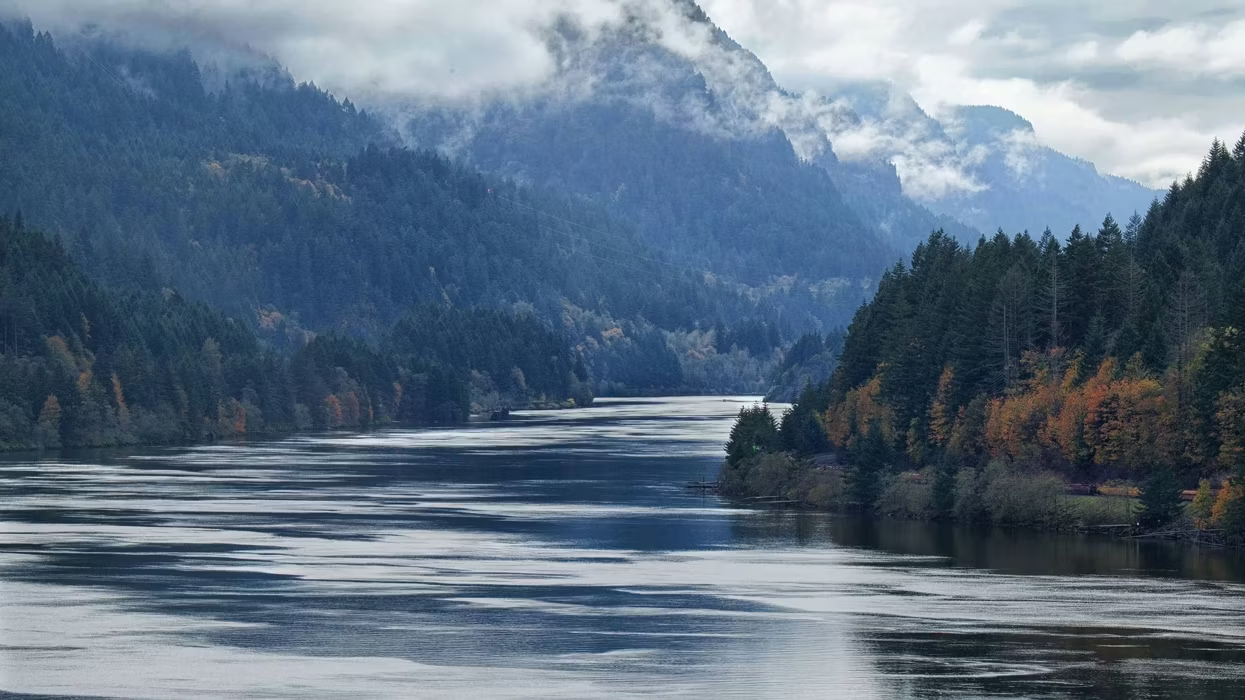

For decades, a mystery has been hanging over the Columbia River Gorge, an often-misty river canyon in Oregon. What happened to the family who vanished from the area in 1958? Where did they go?
Now the case has finally been solved, with the help of DNA analysis and a private diver. In a Thursday press release shared on Facebook, the Hood River County Sheriff’s Office revealed that human remains found in Cascade Locks last year are the remains of the missing family.
“The Hood River County Sheriff’s Office has concluded its investigation, having found no evidence of a crime,” said the press release.
Parents Kenneth and Barbara Martin were with their daughters Barbie, 14; Virginia, 13, and Susan, 11, visiting the gorge to collect Christmas greenery in early December 1958 when they went missing, the sheriff’s office said. They disappeared on Dec. 7, but the remains of Virginia and Susan were found downstream some months later.
After the section of the Columbia River Highway that reached from Portland to the Hood River was completed in 1916, the Cascade Locks canal became a popular scenic area for travelers to visit, the Cascade Locks Historical Museum explained. An old lock structure closed in 1938 with the completion of the Bonneville Dam, but the old locks remained a scenic destination.
In 1953, just a few years before the Martins went missing, the U.S. Army Corps of Engineers removed an upper lock gate and guard gate and left a lower lock gate that had already been submerged in water for 15 years. Then the area was further developed for recreational use, but the museum noted that photographs from the 1969 installation of a footbridge where the upper lock had been “show that no safety barriers were in place to prevent cars and people from falling into the canal.”
While the years went by changes continued, but Kenneth, Barbara and Barbie’s whereabouts remained unclear, even as the area was extensively searched. Their 1954 Ford station wagon was also nowhere to be found. Donald, the Martins’ son, was in the U.S. Navy and stationed in New York State when his family vanished, according to DNASolves.com.
“In addition to the lack of safety features at the time, diving technology was not as advanced. Wetsuits were still cutting-edge military technology, aqualungs were only beginning to become commercially available, and divers primarily relied on old-fashioned diving suits,” said the historical museum.
By 2024, diving technology had come a long way. Archer Mayo, a private search and recovery diver, managed to locate what he believed to be the Martins’ station wagon “upside down in a large underwater pit in the Columbia River,” according to DNASolves.com.
An attempt by the Hood River County Sheriff’s Office to pull the car to the surface using a crane last March brought up just the undercarriage of the rusted vehicle, leaving the passenger cabin upside-down in the underwater pit. Still, investigators were able to link the car to the Matins, and Mayo continued to explore the wreckage. Mayo located human remains last August and turned those remains over to the sheriff’s office, which then turned them over to the Oregon State Medical Examiner’s Office.
Forensic genetics laboratory Othram Inc. in Woodlands, Texas, provided a DNA analysis of the remains, using the identity inference method. This method “allows scientists to identify individuals from DNA evidence even when no direct comparison sample is initially available,” said the sheriff’s office.
“Othram scientists developed DNA extracts from the remains and generated a comprehensive Single Nucleotide Polymorphism (SNP) profile for one of the unidentified individuals,” the office continued. “SNPs are the most common type of genetic variation and are commonly used in forensic genetic genealogy. Unfortunately, the other two DNA profiles were too degraded to be fully sequenced.”
With the successful profile, they were able to identify the remains of Kenneth Martin. An anthropological assessment helped identify Barbara Martin and Barbie Martin’s remains.
“This identification reflects a sustained coordinated effort, scientific partnership, and continued advancements in forensic genetic genealogy,” said the sheriff’s office. “We appreciate the work of Othram Inc. in conducting the specialized testing, the Research Triangle Institute (RTI) for supporting the analyses.”
Next of kind have been notified of the revelation, authorities said. Those relations have requested privacy and no media contact.