


GT World Challenge America arrived at Michelin Raceway Road Atlanta for Round 4 of 7 from June 12 through June 14, 2026, marking SRO America’s first visit to the Braselton circuit since 2011. The return brought six SRO America championships and more than 100 race cars to Road Atlanta, a 2.54-mile, 12-turn circuit that’s earned its reputation as one of the most respected road courses in America.
At first glance, that may sound like something only lifelong race fans would fully understand. But that’s what made this weekend so interesting to me. GT World Challenge America isn’t hard to appreciate once you understand what you’re watching. It brings familiar performance brands into a real racing environment, then lets professional and amateur drivers compete in cars connected to what enthusiasts already recognize on the street, even though the race cars themselves are purpose-built machines.
 Daryl Killian
What GT World Challenge America Is
The easiest way to understand GT World Challenge America is to start with the cars.
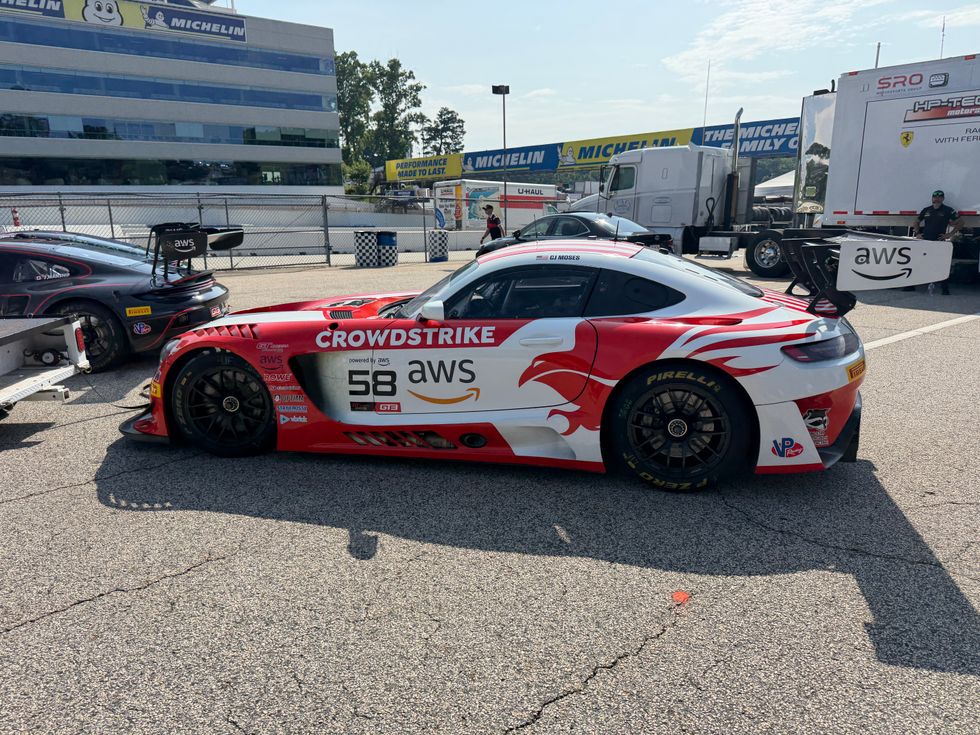
This is GT3 racing. GT3 cars are based on production sports cars and supercars, but they’re not simply showroom cars with numbers on the doors. They’re built for competition with roll cages, race suspension, aerodynamic upgrades, racing brakes, safety systems, and the engineering needed to survive real race conditions.
That’s why the grid feels familiar and serious at the same time. Mercedes AMG, Porsche, BMW, Ferrari, Ford, McLaren, and Aston Martin aren’t just badges. They’re part of a larger competition structure where manufacturers, teams, and drivers are all trying to prove something.
GT World Challenge America is the North American part of a much larger global platform operated by SRO Motorsports Group. SRO connects GT racing across other regions, including Europe, Asia, and Australia. That means a race weekend in Georgia is tied to a much bigger world of sports car racing.
The American championship also changed significantly for 2026. Instead of two shorter races, GT World Challenge America now runs one three-hour race at each event. That changes the way the race feels. It’s not only about the fastest lap. It’s about pace, patience, pit stops, driver changes, tire management, fuel strategy, and execution.
The class structure also helps explain why so much is happening at once. GT World Challenge America includes Pro, Pro Am, and Am categories. That means one race can have multiple battles unfolding simultaneously. Some drivers are full professionals. Some are accomplished amateur or gentleman drivers. Some teams are chasing the overall win, while others are fighting for class podiums and championship points.
That’s one of the smartest parts of this format. It gives serious racing fans plenty to follow, but it also gives someone walking in for the first time a way to connect. You can pick a brand, follow a driver, watch a team, or simply pay attention to how strategy changes over three hours.
Why Road Atlanta Felt Personal
Road Atlanta isn’t just another stop on the schedule. It has history, personality, and a way of making speed feel alive.
For me, it also came with a coincidence I couldn’t ignore.
My birthday is June 12, 1969. This event opened on June 12. Road Atlanta was built in 1969. The track has 12 turns. I turned 57 that day.
That was enough for me to pay attention before I ever put on a helmet.
The track itself does the rest. Road Atlanta is 2.54 miles of elevation change, blind crests, fast sections, and corners that seem to arrive faster than your brain can process—the famous esses reward commitment. The downhill sections make the car feel like it’s falling into the next corner. The track has rhythm, but it also demands respect.
That’s why this was such a good place for GT World Challenge America to return. These cars are built for road courses that challenge drivers and teams. Road Atlanta gives them exactly that. It’s fast, technical, and unforgiving enough to show the difference between simply having horsepower and knowing how to use it.
The official Road Atlanta entry list included GT3 entries from Aston Martin, BMW, Ferrari, Ford, McLaren, Mercedes AMG, and Porsche. That kind of variety makes the racing easier to connect with because these are brands people already know. But once the green flag drops, the badge alone isn’t enough. The team still has to manage the car, the drivers, the pit stops, and the pressure.
That’s where the sport becomes more than a collection of beautiful machines. It becomes competition.
The competition itself delivered an impressive result. The No. 27 JMF Motorsports Mercedes-AMG GT3 EVO driven by Jason Daskalos and Philip Ellis—yes, the same Philip Ellis who drove my hot lap—captured both the Overall and Pro-Am class victory. Finishing second overall and taking the Pro class win was the No. 12 AF Corse USA Ferrari 296 GT3 EVO driven by Matias Perez Companc and Frederik Schandorff. Rounding out the overall podium in third and finishing second in Pro-Am was the No. 29 Turner Motorsport BMW M4 GT3 EVO driven by Justin Rothberg and Robby Foley.
The Mercedes AMG GT 63 PRO Hot Lap
My ride wasn’t in one of the GT3 race cars on the official grid. It was the road-going Mercedes-AMG GT 63 PRO, which is still far more car than most people will ever experience at speed.
That distinction helped me understand the weekend better.
The Mercedes-AMG GT 63 PRO gave me that sensation. The Mercedes AMG GT3 EVO race cars gave me the sport.
The GT 63 PRO is a production AMG coupe available to the public, but it’s built for people who want far more than a luxury grand tourer. It uses a twin-turbo 4.0-liter V8 rated at 603 horsepower and 627 pound-feet of torque, and it adds track-focused hardware such as more aggressive cooling, carbon-ceramic brakes, and serious Michelin track rubber. Car and Driver listed its tested GT 63 PRO at a base price of $199,650 and an as-tested price of $211,660.
I didn’t have the window sticker for the exact car Mercedes used for my hot lap, so I won’t pretend to know that specific vehicle’s final price or exact options. But the bigger point is easy to understand. This was not a pretend performance car. It was a publicly available AMG coupe engineered to survive the kind of speed, braking, and cornering that most owners will never touch on public roads.
The hot lap was arranged through Mercedes-Benz USA and the Mercedes AMG Motorsport racing program, and my driver was Philip Ellis. That’s not a casual detail. Ellis is a two-time defending IMSA GTD Champion, and he was also listed in the No. 27 JMF Motorsports Mercedes AMG GT3 EVO for the Road Atlanta weekend.
Before we got anywhere near the track, there were waivers to sign. More than one. I joked that I was signing my life away, but once you experience Road Atlanta at speed, you understand why the paperwork comes first.
This wasn’t a slow ride for photos. It was a controlled, professional, high-speed introduction to what a serious performance car can do in the hands of a serious driver.
I’ve done a lot of hot laps over the years. Race cars. Supercars. Professional drivers. Manufacturer programs. Big tracks.
This may have been the fastest and most exciting minute and a half of my life.
From the passenger seat, everything happens faster than expected. The braking feels violent but precise. The steering inputs are small but confident. The acceleration is immediate. The cornering forces remind you that grip isn’t just something you read about in a spec sheet.
The most impressive part wasn’t the speed alone. It was Philip Ellis’ calmness. He wasn’t wrestling the car. He was placing it exactly where it needed to be. The car moved with purpose. The track came at us quickly, but he always seemed to be one step ahead of it.
That’s when the difference between a fast driver and a professional race car driver becomes obvious.
Most people can press an accelerator. Far fewer can carry speed into a corner, trust the car, feel the track, and repeat that process lap after lap with traffic, pressure, tire wear, and strategy all in play.
What I Learned From The Weekend
I came to Michelin Raceway Road Atlanta as a first-time media participant. Before I fully understood the scale of GT World Challenge America, I got the kind of introduction that made it all click.
I strapped into a Mercedes-AMG GT 63 PRO, signed the waivers with the appropriate blend of optimism and humility, and let Philip Ellis show me what Road Atlanta feels like when a champion is behind the wheel.
That experience changed how I watched the rest of the weekend.
And it became even more meaningful when Ellis and teammate Jason Daskalos went on to win the race outright in the No. 27 JMF Motorsports Mercedes-AMG GT3 EVO. Watching the same driver who had just taken me around Road Atlanta at speed stand atop the podium with both the Overall and Pro-Am victories added a personal connection to the race results that I wasn't expecting.
Once you feel even a small piece of Road Atlanta at speed, the paddock starts to make more sense. The tire carts. The cool-down routines. The driver changes. The engineers. The focus inside the garages. The constant rhythm of preparation. A three-hour race isn’t just about horsepower or bravery. It’s about timing, execution, patience, and trust.
That’s what makes GT World Challenge America such a strong entry point into modern sports car racing.
It takes brands people already know and places them in a format that rewards more than raw speed. It rewards discipline. It rewards strategy. It rewards consistency. It rewards teamwork. It rewards the ability to stay calm when everything around you is loud, fast, and unforgiving.
It also gives fans different ways to connect.
You can follow the manufacturers. You can follow the teams. You can follow the drivers. You can watch the class battles. You can study the pit strategy. Or you can simply stand near the fence and let the sound of a GT3 field make the first impression for you.
That’s the beauty of it. You don’t have to know every rule before you enjoy it. The sport gives you a way in.
If you like Mercedes, Porsche, BMW, Ferrari, Ford, McLaren,n or Aston Martin, there’s already a reason to pay attention. If you like performance cars, there’s a reason to keep watching. If you appreciate skill, pressure, and competition, there’s even more to learn once the race starts unfolding.
For me, the weekend started with a birthday, a track built the same year I was born, and a hot lap that reminded me why I fell in love with cars in the first place.
I came for a media experience.
I left with a much better understanding of why people build weekends, travel plans, friendships,s and family traditions around sports car racing.
How Fans Can Follow GT World Challenge America
For anyone who wants to learn more, the best starting point is the official GT World Challenge America website. The site includes the calendar, news, entry lists, results, and background on the series.
The Watch Live page is the best place to follow qualifying and race coverage online. If the series is coming to a track near you, the calendar is where to start planning.
That’s probably my biggest takeaway from Road Atlanta. GT World Challenge America isn’t just background noise for hardcore racing fans. It’s one of the clearest ways to understand modern performance culture because it brings together road-car brands, professional drivers, amateur competitors, team strategy, and real endurance racing in one place.
I came to Road Atlanta for a hot lap and a story.
I left with a much better understanding of the series.