

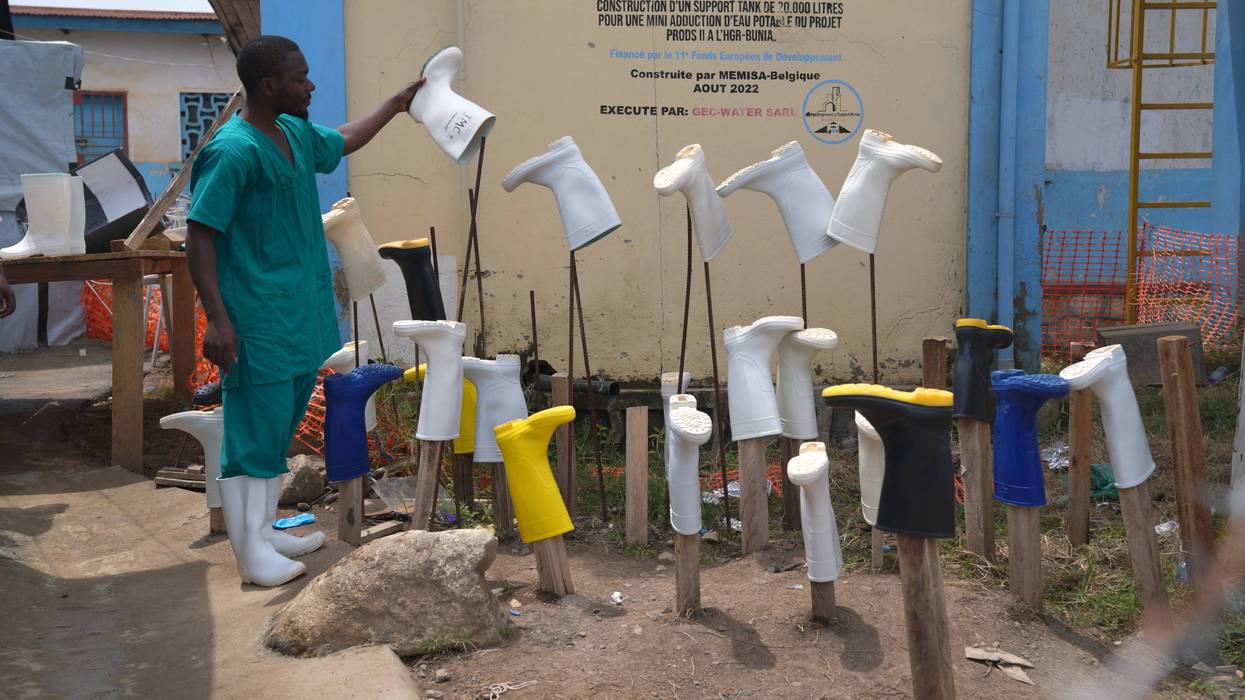

BUNIA, Congo (AP) — At least 2,000 people have died in Congo’s Ebola outbreak, the fastest-growing on record, according to the latest data, as rebel conflict, bad roads and work stoppages over payment issues challenge the urgent response in a remote region.
Government data published overnight into Tuesday showed the outbreak has 4,381 confirmed cases, including 2,011 deaths. Starting from the first confirmed case, the death toll was reached almost three times faster than in the 2014-16 Ebola outbreak in West Africa, the worst on record.
The current outbreak was declared on May 15 but health authorities now say sequencing showed it began months earlier, in February.
It took about nine weeks for the outbreak to record the first 1,000 deaths, but it’s taken just around three weeks for the figure to double, as experts say the crisis is moving faster than efforts to track and manage it.
At the epicenter in eastern Congo's Ituri province, friends and family members gathered in tears on Tuesday for the burial of Jeannine Katusabe, 38, one of the latest to die.
Christophe Logo, a family representative, said Katusabe first sought traditional treatment at home and only went to the local Ebola treatment center after her condition worsened. “Unfortunately, she did not recover,” he said.
Identifying cases early can be nearly ‘impossible’
This is already the second-largest outbreak in history, behind the 2014-2016 outbreak's over 28,000 cases including over 11,000 deaths. The outbreak has been expanding across five eastern provinces near South Sudan, Uganda and Rwanda.
The ongoing outbreak has had a case fatality rate of 45.9%, more than the 39.6% rate recorded in the 2014-2016 outbreak.
This Ebola outbreak is unlike most previous ones. The rare Bundibugyo virus responsible for it has no approved vaccines or treatments. Clinical trials for those have begun in Ituri province.
Although the type of Ebola responsible for the 2014-2016 outbreak is considered the deadliest, government data shows this Bundibugyo outbreak has killed a higher percentage of people as care and support are not getting to patients quickly enough. Many people are reporting symptoms late or not at all.
“In the absence of an effective vaccine, control (for the outbreak) rests on identifying cases and then nursing them in secure facilities until they recover or sadly perish,” said Paul Hunter, a professor in medicine at the University of East Anglia in the U.K.
In a remote region like this with an ongoing conflict and interrupted communications, routine surveillance can be very difficult and “identifying cases early enough to prevent spread can be impossible,” Hunter said.
Authorities in eastern Congo have restricted public gatherings and shut the main airport in Ituri to limit spread of the disease. But mass movements due to trade, mining and displacements from conflict have continued.
The response has been behind from the start
The World Health Organization on Monday said some cases early in the outbreak were wrongly attributed to malaria and typhoid, and that early testing was conducted for the more common type of Ebola, delaying the realization of what was unfolding
Officials are “chasing the virus, the virus is ahead of us," the WHO regional director for Africa, Dr. Mohamed Yakub Janabi, told a news conference.
The new death toll is “alarming,” said Dr. Jean-Marie Akandabo, who is helping manage patients at a clinic in Ituri.
Akandabo said the major challenges he's seen are limited care for patients and poor community engagement. Some people have described widespread misinformation about the virus in sometimes hostile communities that long have been wary of outsiders after years of attacks by rebel groups.
“We must not take this disease lightly, because it continues to kill and no one is safe,” Akandabo said.
The current outbreak is the 17th — and largest — the Central African nation has faced. The first Ebola virus to be identified was in 1976 near the Ebola River in what is now Congo.
___
Asadu reported from Abuja, Nigeria. Associated Press writer Mark Banchereau contributed from Dakar, Senegal.