


CHICAGO (WBBM Newsradio) – Scientists at the University of Chicago have begun analyzing data from a NASA balloon mission that spent more than three weeks circling Antarctica, searching for elusive particles from the far reaches of the universe.
The mission, known as Payload for Ultrahigh Energy Observations, or PUEO, launched Dec. 20 aboard a high-altitude balloon operated by NASA. The balloon floated above the ice of Antarctica for 23 days before the payload was released and brought back to Earth by parachute.
PUEO was designed to detect ultra-high-energy neutrinos – nearly massless subatomic particles that constantly pass through Earth but rarely interact with anything. Scientists believe a small fraction of these neutrinos are extraordinarily energetic and may be created near violent cosmic events such as black holes or collisions between neutron stars.
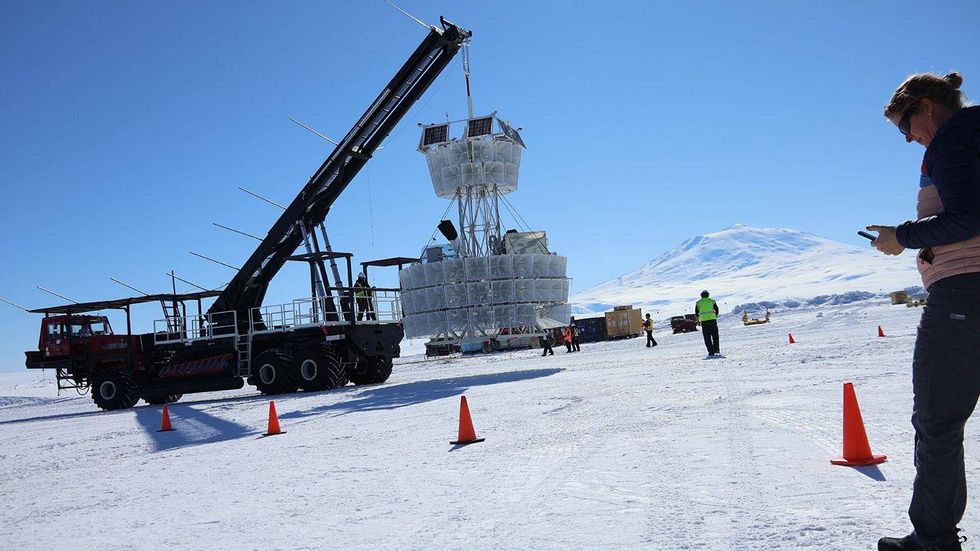 UChicago Prof. Abby Vieregg, who headed the PUEO mission, takes notes on the assembly.Cosmin Deaconu
The experiment relied on the unique properties of Antarctic ice. When a high-energy neutrino strikes the ice, it can generate faint radio waves that travel long distances through the frozen surface. PUEO's array of radio antennas was built to detect those signals from high above the continent.
Developed over the past five years by research groups around the world, the instrument features nearly 100 antennas arranged in rings around a central processing system designed to filter out background noise and identify potential neutrino signals.
 A NASA-made balloon carries an instrument named PUEO, built by an international collaboration led by the University of Chicago to search for extremely energetic neutrinos.NASA/Scott Battaion
After the flight ended, scientists recovered PUEO's data recorder, often described as its "black box." The data is being transported from McMurdo Station to Christchurch before being shipped to Chicago, where researchers will begin a detailed review.
Scientists say it could take about a year to determine whether PUEO detected any of the rare signals it was designed to find. If successful, the results could provide new insight into some of the most extreme and energetic processes in the universe.