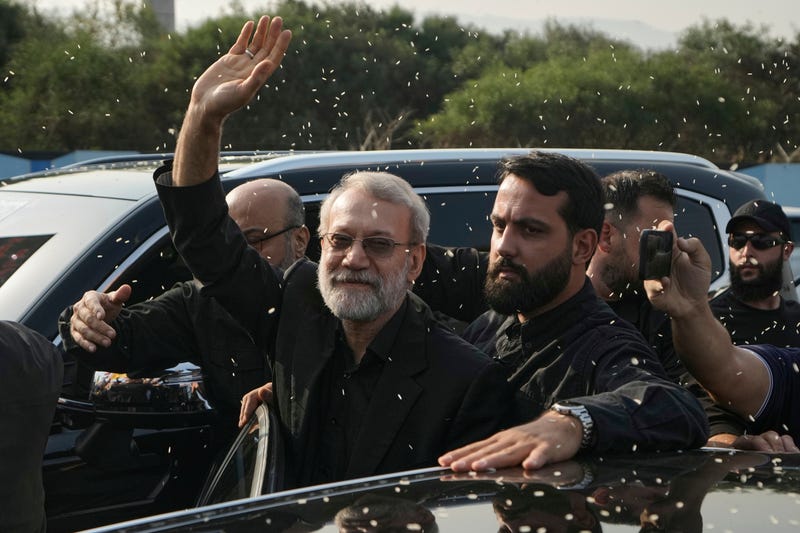
DUBAI, United Arab Emirates (AP) — Israel killed two senior Iranian security officials in a major blow to the Islamic Republic’s leadership as it faces its greatest test in decades, and Iran responded Wednesday with renewed missile and drone attacks on its Gulf Arab neighbors and Israel.
Ali Larijani, secretary of Iran’s Supreme National Security Council, was considered one of the most powerful figures in the country since Supreme Leader Ayatollah Ali Khamenei was killed in an airstrike on the first day of the war. Gen. Gholam Reza Soleimani was the head of the Revolutionary Guard’s all-volunteer Basij.
Iran confirmed the killings of the men, who were key to Iran’s violent crackdown on protests in January that challenged the theocracy’s 47-year rule.
In response, Iran launched a barrage of what it said were multiple-warhead missiles Wednesday at central Israel to avenge Larijani's death. Israel’s medical service said two people were killed in Ramat Gan, east of Tel Aviv.
Saudi Arabia, Kuwait and other Arab states also faced barrages of Iranian-fired missiles and drones Wednesday that were intercepted by air defense systems.
With concerns growing about a global energy crisis, an Iranian official said Tehran had no intention of relinquishing its tight grip on shipping through the Strait of Hormuz, a crucial waterway for oil.
U.S. Central Command said the U.S. military fired multiple 5,000-pound deep penetrator bombs Tuesday on Iranian missile sites along Iran’s coastline near the Strait of Hormuz.
It announced the bombings hours after President Donald Trump said that NATO and most other allies had rejected Trump's calls to help secure the strait.
Iran launches multiple-warhead missiles at Israel
Iran acknowledged launching multiple-warhead missiles at Israel early Wednesday, the latest use of a weapon designed to spread maximum damage and evade Israel’s multiple layers of air defenses.
Footage filmed by The Associated Press showed the release of the cluster munition from at least one missile over Israel. A statement from the paramilitary Revolutionary Guard said the force launched the Khorramshahr-4 and Qadr multiple-warhead missiles to avenge Larijani’s killing.
Israeli Defense Minister Israel Katz said Tuesday that Larijani and Soleimani “were eliminated” in strikes overnight. The Israeli military said it also struck more than 10 Basij posts across Tehran.
Israeli Prime Minister Benjamin Netanyahu said the killings were aimed at “undermining this regime to give the Iranian people the opportunity to remove it.” But there have been no signs of anti-government protests since the war began, as many Iranians shelter from the American and Israeli strikes.
The Iranian judiciary’s news agency, Mizan, quoted the Revolutionary Guard as confirming the killing of Soleimani. Other Iranian state media confirmed Larijani’s death.
Larijani, a former parliamentary speaker, was a senior policy adviser to the late Khamenei on strategy in nuclear talks with the Trump administration. He was sanctioned by the U.S. Treasury in January for his role “coordinating” Iran’s violent suppression of nationwide protests.
Soleimani was also sanctioned by the U.S., the European Union and other nations, over his role in suppressing dissent for years through the Basij.
The killings of the top officials came on the eve of “Chaharshanbe Souri," or the Festival of Fire, shortly before the Persian new year. Authorities have sent threatening text messages telling the public not to turn out for the festival, warning the celebrations could be used by “rioters.”
Iran continues strikes on neighboring countries
In Iraq, a strike hit inside the U.S. Embassy compound in Baghdad early Wednesday, two Iraqi security officials said, speaking on condition of anonymity because they were not authorized to comment. No further details were immediately available. There was no immediate statement from the State Department. A day earlier, a drone crashed inside the compound.
Saudi Arabia’s Defense Ministry shot down a ballistic missile targeting the area around Prince Sultan Air Base, which hosts American forces and aircraft.
In the United Arab Emirates, an Iranian projectile struck near an Australian military base Wednesday, sparking a small fire but causing no injuries, Australia’s Prime Minister Anthony Albanese said. His comments appeared to correspond with explosions heard by AP journalists in Dubai near Al Minhad Air Base, which is used by Western nations as a transshipment point across the wider Mideast.
Iran’s grip on the Strait of Hormuz, through which a fifth of the world’s oil is transported, is sparking concerns about tightening energy supplies — unnerving the world economy.
A few ships have crossed through the strait, and Iran has said the waterway technically remains open — just not for the United States, Israel and their allies. About 20 vessels have been struck.
With oil prices rising, Trump has demanded that roughly a half-dozen countries send warships to ensure ships can pass through the strait but said he has not gotten any support.
The European Union’s top diplomat said the 27-nation bloc does not want to be dragged into the conflict with Iran. “This is not Europe’s war,” Kaja Kallas told EU lawmakers Tuesday. “We were not consulted.”
Meanwhile, the International Atomic Energy Agency said Wednesday it received a report from Iran that its Bushehr nuclear power plant complex had been hit by a projectile but there were no injuries and the plant suffered no damage. It reiterated the call by IAEA’s leader, Rafael Mariano Grossi, “for maximum restraint during the conflict to prevent risk of a nuclear accident.”
Renewed Israeli strikes in Lebanon
The Israeli military continued its strikes on Iran-backed Hezbollah militants in Lebanon.
Israeli strikes hit apartment buildings in central Beirut early Wednesday, killing at least 6 people and wounding 24 others, the Lebanese health ministry said.
Another strike in the Nabatiyeh district killed three people and wounded another, Lebanon’s health ministry said Wednesday. Rescue teams were searching for eight missing people, it said.
Israel’s strikes have displaced more than 1 million Lebanese — roughly 20% of the population — according to the Lebanese government, which says more than 900 people have been killed. In Israel, 14 people have been killed by Iranian missile fire. At least 13 U.S. military members have been killed.
More than 1,300 people have been killed in Iran since the conflict started Feb. 28, according to the Iranian Red Crescent.
___
Watson reported from San Diego, and Magdy from Cairo. Associated Press writers Mike Corder in The Hague, Netherlands; David Rising in Bangkok; Aamer Madhani in Washington; Qassim Abdul-Zahra in Baghdad; Koral Saeed in Herzliya, Israel; and Bassem Mroue and Sally Abou AIJoud in Beirut contributed.