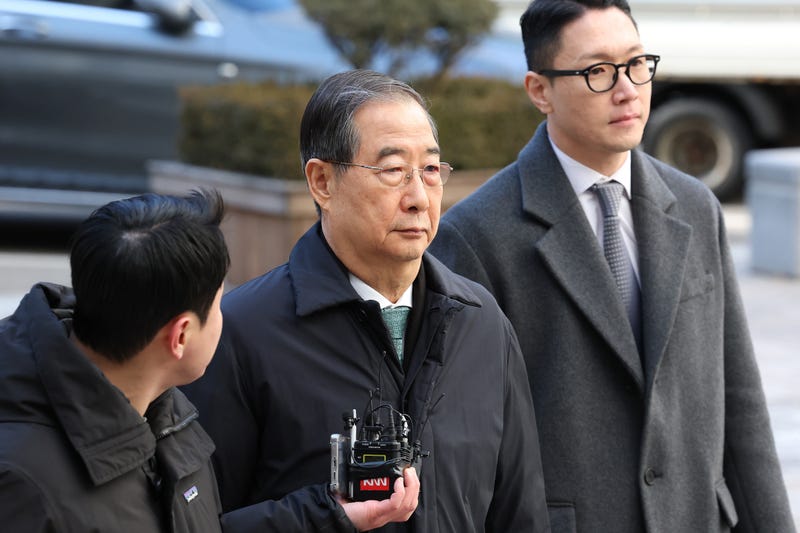
SEOUL, South Korea (AP) — A South Korean court ruled Wednesday that the 2024 imposition of martial law by then President Yoon Suk Yeol constituted an act of rebellion as it sentenced his prime minister to 23 years in prison for his involvement.
Ex-Prime Minister Han Duck-soo became the first Yoon administration official convicted of rebellion charges in relation to Yoon’s martial law imposition in December 2024. The verdict is expected to set the stage for upcoming rulings involving Yoon and his other associates, who also face rebellion charges.
Han, who was appointed by Yoon prime minister, the No. 2 post in South Korea, served as one of the three caretaker leaders during moments of the martial law crisis that led to Yoon’s impeachment and eventually his removal from office.
Han gets lengthy prison term for rebellion
Rebellion is one of the gravest criminal charges in South Korea, with the independent counsel recently demanding the death penalty for Yoon, who was charged with masterminding a rebellion. The Seoul Central District Court is to rule on Yoon’s rebellion charges on Feb. 19.
In its televised verdict Wednesday, the Seoul court determined Yoon’s martial law decree amounted to a rebellion, viewing his dispatch of troops and police officers to the National Assembly and election offices as “a riot” or “a self-coup” that was meant to undermine the constitutional order and was serious enough to disrupt stability in South Korea.
The court sentenced Han for playing a key role in Yoon’s rebellion by trying to give procedural legitimacy to his martial law decree by getting it passed through a Cabinet Council meeting. The court also convicted Han of falsifying the martial law proclamation and destroying it and lying under oath.
Han, who could appeal Wednesday’s ruling, has steadfastly maintained that he had told Yoon that he opposed his martial law plan. He has denied most of the other charges.
The court said Han neglected his responsibilities as prime minister to protect the constitution, choosing instead to take part in Yoon’s rebellion in the belief that it might succeed.
“Because of the defendant’s action, the Republic of Korea could have returned to a dark past when the basic rights of the people and the liberal democratic order were trampled upon, becoming trapped in the quagmire of dictatorships for an extended period,” Judge Lee Jin-gwan said.
Han was acting president during martial law crisis
Han's lengthy sentence came as a surprise as the independent counsel earlier requested a 15-year prison term for him.
The 76-year-old is a career bureaucrat who served as prime minister twice during his 40 years of public service — first under liberal President Roh Moo-hyun from 2007 to 2008 and later under Yoon.
Han became acting president after Yoon was impeached by the opposition-controlled National Assembly later in December 2024. But he was also quickly impeached following wrangling with opposition lawmakers over his refusal to fill vacant seats at the Constitutional Court, which was deliberating whether to formally throw Yoon out of office. Observers said at the time that restoring a full court bench could increase prospects for Yoon's ouster.
The Constitutional Court later reinstated Han as acting president. But after the court formally dismissed Yoon as president in early April, Han resigned to run for the presidency in last June’s snap election. He eventually withdrew from the race after failing to win the main conservative party's nomination.
Lee Jae Myung, a former leader of the main liberal opposition Democratic Party, won the election.
Yoon has denied his rebellion charges
Yoon, who has already been in jail for months, faces eight criminal trials including his rebellion case over the martial law decree and other allegations. Last Friday, Yoon received a five-year prison term at the Seoul court for defying attempts to detain him, fabricating the martial law proclamation and denying some Cabinet members their rights to deliberate on his martial law decree.
Yoon, a conservative, has steadfastly denied the charges of rebellion, saying he only aimed to draw public support of his fight against the Democratic Party which obstructed his agenda. Speaking at Friday’s court session, Yoon denounced the investigations of his charges as “frenzied," arguing that they involved “manipulation” and “distortion.”
In his martial law declaration, Yoon called the opposition-controlled assembly “a den of criminals” and vowed to eliminate “shameless North Korea followers and anti-state forces.” But many of the troops and police officers he sent to the assembly didn’t aggressively control the area as thousands of people gathered there to protest Yoon’s decree. Enough lawmakers ultimately got in an assembly chamber and voted down Yoon’s decree.
No major violence occurred, but Yoon’s short-lived martial law enforcement harkened back to past dictatorships that South Koreans hadn’t seen since the 1980s. The ensuing political turmoil and power vacuum in the country tarnished its international image and rattled its diplomacy and financial markets.
Besides Han, Yoon’s defense, safety and justice ministers, spy and police chiefs as well as some of his top military commanders have been arrested and indicted on rebellion charges.