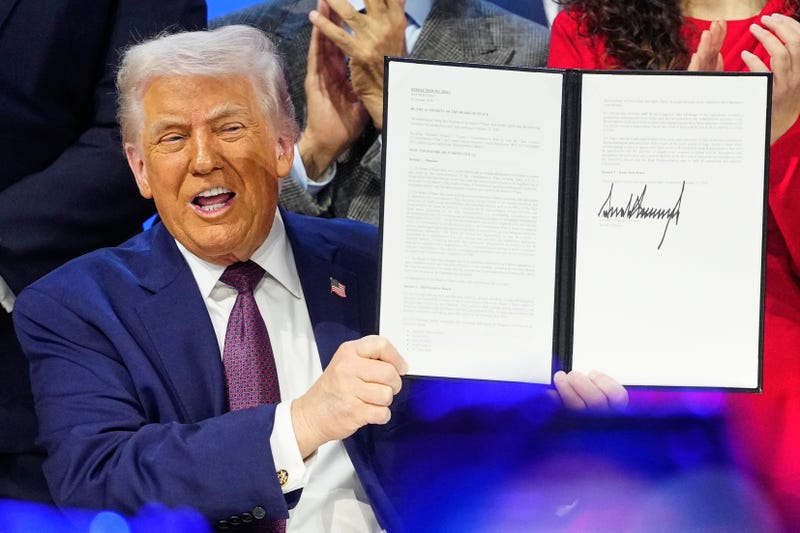
UNITED NATIONS (AP) — President Donald Trump’s latest attempt to sidestep the United Nations through his new Board of Peace appears to have inadvertently backfired after major world powers rejected U.S. aspirations for it to have a larger international mandate beyond the Gaza ceasefire and recommitted their support for the over 80-year-old global institution.
The board to be chaired by Trump was originally envisioned as a small group of world leaders overseeing his plan for Gaza's future. But the Republican president’s ambitions have expanded to envisioning the board as a mediator of worldwide conflicts, a not very subtle attempt to eclipse the Security Council, which is charged with ensuring international peace and security.
The board's charter also caused some dismay by stating Trump will lead it until he resigns, with veto power over its actions and membership.
His secretary of state, Marco Rubio, tried to ease concerns by saying the board's focus right now is only on the next phases of the Gaza ceasefire plan.
“This is not a replacement for the U.N., but the U.N. has served very little purpose in the case of Gaza other than the food assistance,” Rubio said at a congressional hearing Wednesday.
But Trump's promotion of a broadened mandate and his floating of an idea that the Board of Peace “might” replace the U.N. have put off major players and been dismissed by U.N. officials.
“In my opinion, the basic responsibility for international peace and security lies with U.N., lies with the Security Council,” Secretary General Antonio Guterres said Thursday. “Only the Security Council can adopt decisions binding on all, and no other body or other coalition can legally be required to have all member states to comply with decisions on peace and security.”
In Security Council statements, public speeches and behind closed doors, U.S. allies and adversaries have dismissed Trump’s latest plan to overturn the post-World War II international order with what he describes as a “bold new approach to resolving global conflict.”
“The U.S. rollout of the much broader Board of Peace charter turned the whole exercise into a liability,” according to the International Crisis Group’s Richard Gowan, a U.N. watcher and program director. “Countries that wanted to sign on to help Gaza saw the board turning into a Trump fan club. That was not appealing.”
“If Trump had kept the focus of the board solely on Gaza, more states, including some more Europeans, would have signed up,” he said.
Key Security Council members haven't signed on
The four other veto-wielding members of the Security Council — China, France, Russia and the United Kingdom — have refused or have not indicated whether they would join Trump's board, as have economic powers such as Japan and Germany.
Letters sent this month inviting various world leaders to be “founding members” of the Board of Peace coincided with Trump’s vow to take over Greenland, a semiautonomous territory of NATO ally Denmark, and punish some European countries that resisted. That was met with stark rebuttal from Canada, Denmark and others, who said Trump’s demand threatened to upend an alliance that has been among the West's most unshakeable.
Shortly after, Trump pulled a dramatic reversal on Greenland, saying he had agreed with the NATO secretary-general on a “framework of a future deal” on Arctic security.
Amid the diplomatic chaos, British Prime Minister Keir Starmer, who at the time had not responded to Trump’s Board of Peace invitation, met with Guterres in London and reiterated “the UK’s enduring support for the UN and the international rules-based system,” according to a statement.
Starmer emphasized the U.N.’s “pivotal role in tackling global problems which shape lives in the UK and all over the world.” The United Kingdom later declined to join the board.
France, Spain and Slovenia declined Trump’s offer by mentioning its overlapping and potentially conflicting agenda with the U.N.
French President Emmanuel Macron said last week that the board goes beyond “the framework of Gaza and raises serious questions, in particular with respect to the principles and structure of the United Nations, which cannot be called into question.”
Spain would not join because the board excluded the Palestinian Authority and because the body was “outside the framework of the United Nations,” Prime Minister Pedro Sánchez said.
Some countries are urging a stronger UN
America’s adversaries also have shunned the board.
“No single country should dictate terms based on its power, and a winner-takes-all approach is unacceptable,” China’s U.N. ambassador, Fu Cong, said at a Security Council meeting Monday.
He called for the United Nations to be strengthened, not weakened, and said the Security Council’s status and role “are irreplaceable.”
In a clear reference to the Board of Peace, Fu said, “We shall not cherry-pick our commitments to the organization, nor shall we bypass the U.N. and create alternative mechanisms.”
So far, about 26 of some 60 invited countries have joined the board, and about nine European countries have declined. India did not attend Trump’s signing ceremony at the World Economic Forum meeting in Davos, Switzerland, last week but is reportedly still deciding what to do. Trump revoked Canadian Prime Minister Mark Carney’s invitation.
“It’s hardly surprising that very few governments want to join Trump’s wannabe-U.N., which so far looks more like a pay-to-play club of human rights abusers and war crimes suspects than a serious international organization,” said Louis Charbonneau, U.N. director for Human Rights Watch. “Instead of handing Trump $1 billion checks to join his Board of Peace, governments should work on strengthening the U.N.”
Eight Muslim nations that agreed to join the board issued a joint statement that supported its mission in Gaza and advancement of Palestinian statehood. Turkey, Saudi Arabia, Egypt, Jordan, Indonesia, Pakistan, Qatar and the United Arab Emirates made no mention of Trump’s global peacemaking plan.
The Crisis Group’s Gowan said their focus could be a way to “get a foothold in discussions of Gaza” at the start, as Trump’s ceasefire plan has already faced several setbacks.
“I remain unconvinced that this is a real long-term threat to the U.N.,” Gowan said.