


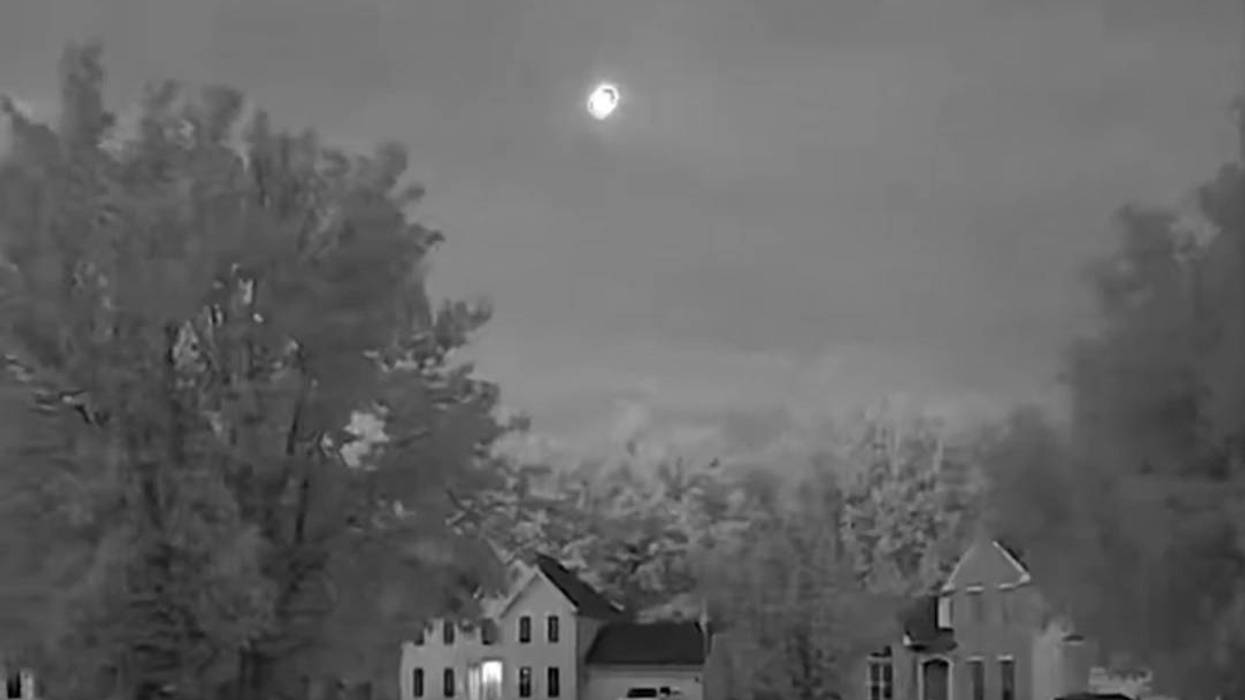

Buffalo, N.Y. (WBEN) - For those who were awake just after 5 a.m. on Wednesday morning, they had the chance to not only see a meteor streak across the Southeast sky in Western New York, but also likely hear the boom or rumble associated with it.
While there isn't much information about what exactly happened yet Wednesday morning, Tim Collins from the Buffalo Astronomical Association believes it was a sporadic fireball, or bolide, that passed through the Earth's atmosphere.
"Just a random space rock that happened to intersect with Earth's orbit and pull it in like Earth does, like a giant vacuum cleaner in space," said Collins in an interview with WBEN. " There isn't a ton of information yet, but from what I've seen out there, people are reporting that it was green. A green meteor will certainly be an indication of the metal magnesium, so it doesn't help us in identifying whether it's a piece of a comet or an asteroid. We're still waiting for more information."
While these types of incidents get attention when they happen, Collins admits it's not as often these occur as one may think.
"It's kind of a random situation," he said. "There's a lot of junk in space, but there's also a lot of space in space. It's not like we're going to see them every day. This one was probably no bigger - I'm just guessing here - than a basketball when it finally burned up and entered the atmosphere, but it made the large noise because it's traveling faster than the speed of sound. And once it hits the air resistance, it starts to slow down and get closer to speeds less than the speed of sound. So sonic booms are probably what we heard."
The last time a meteor or bolide happened to pass through the Earth's atmosphere over Western New York was a few years back, according to Collins.
"We had one that came through, I don't remember the exact date, but it does happen every other year or so," Collins noted. "It's random so you don't know, but they're high enough up that everybody gets to see some. But when they're a little bit lower, like this one was, they put on a really great show. Not many people talk about it, I'm amazed at how well this one actually tracked through and actually got some traction for everybody to react. It's fun to see, and I wish we could have more. But we get what we get."
In an instance like this one Wednesday, Collins says the meteor is already breaking and burned up, so not much of it will survive any potential impact with the ground. However, there's always a small chance that little pieces of debris could sprinkle dust down onto the surface, leaving micro meteorites.
"That is possible, but really the missing variables here are how high up it was and where it was overhead," Collins added. "Everybody here is reporting it was South/Southeast. What we need to find is somebody who saw it overhead, or somebody who saw it in the North to kind of establish a corridor before we can do any kind of meteorite hunting, and that's hard to do. Those are the kind of things you're looking for next."
When meteors are as small as the one that burned across the Western New York skies on Wednesday, they are impossible to detect and predict.
"You have NASA teams looking at things for large asteroids, but nobody's really tracking anything this particularly small," Collins said. "And this kind of size really doesn't do a lot of damage, if it does survive to the ground. But it doesn't look like that's what happened in this case."
For anyone who may be confused about what exactly took place Wednesday morning, Collins says there are ways to know that this was a meteor, or bolide that passed through the area.
"The telltale sign of a bolide, like this one, is it'll be a streak, it'll suddenly brighten. And after it brightens, you'll hear the sound," he explained. "This sound travels slower than light, but that sound is slowing down past the speed of sound back to a stationary object when it either strikes the ground or completely disintegrates."
And for those who manage to capture one of these bolides or meteors on a home or security camera, Collins encourages people to continue sharing what they saw.
"What they're already doing by posting on social media is feeding into some of the research," Collins said. "The American Meteorological Society are the ones that really do the research on these things, and they're already combing social media for this. So any Ring cameras, if you post them, they will find them, because they know how to search. And searches are getting so good right now that even hours later, I'm finding Ring footage now. So doing what you're already doing is the way to do it. Nothing special needs to be done."
Collins adds there will likely be more information to come out over the next few days about the meteor that passed through the region.
"This is not a major event that's going to send teams of scientists our way. It's just a bolide falling from the sky, so it really isn't going to stir up a lot of heavy research," Collins acknowledged. "But we'll see what we get, and somebody will pay attention to it, because it was one, someone will look. But it'll eventually fade away, like most things do."


