


Buffalo, N.Y. (WBEN) - Tuesday is St. Patrick's Day, and for many, it's an opportunity to be Irish for a day and dress in all green, drink a couple of Irish beers and enjoy some festive Irish delicacies.
However, for many in Buffalo and Western New York, it's more importantly a time to reflect and celebrate a strong Irish culture locally that helped build the city into what it is today.
"I would say the Irish, in many respects, built Buffalo and Western New York," said Erin Barr, assistant professor of American History at SUNY Buffalo State. "They arrived on the [Erie] Canal, but they also built the Canal, the railroads, the grain elevators, and then they operated those grain elevators - deeply involved in the working class history of this community. St. Patrick's Day involves, often, green beer and parades and celebrating, but there is a much deeper cultural context to that."
"They were used to hard work, and they came here, and they did a lot of building of Buffalo with hard work," added Peg Overdorf, Old First Ward resident and the director of the Buffalo Riverfest Park. "They were the front runners of the building of the Erie Canal, they hand dug it with shovels, and they settled here in this neighborhood. It's called the 'Old First Ward', because it was a voting district. And people refer to themselves as coming from parishes, prevalent parishes here, and one is still open - Our Lady of Perpetual Help on O'Connell [Street]. St Bridget's burned down, it was on Louisiana Street. And then if you go over the bridge a bit - we call it 'The Valley', because you have to get in-and-out of it over a bridge - that church over there is St. Stephen's church."
Like a lot of "Rust Belt" industrial American cities, Buffalo is made up of immigrants, and immigrants that have been coming since the early and mid-19th century up until the present day.
"When you celebrate St. Patrick's Day, you're really plugging into that legacy of coming from unfortunate circumstances, often, working hard, building a new life, but this desire to always remain connected culturally, often religiously and spiritually," Barr said in an interview with WBEN. "But through all sorts of things like music, dance and food - particularly important for the Irish and St. Patrick's Day. It has really deep roots in this community."
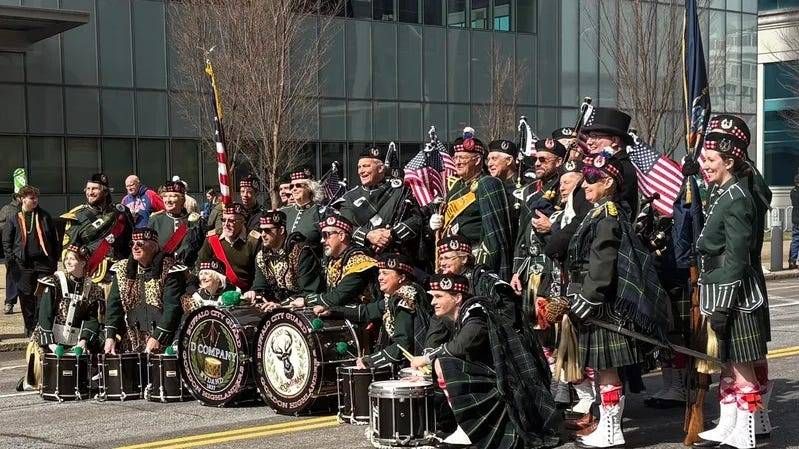
Growing up in an Irish household, St. Patrick's Day was a big celebration for Overdorf, and the Old First Ward parade was an even bigger party.
"That's why I brought back the parade in 1994," Overdorf said with WBEN. "The parade had started down here in a little tavern on the corner of Chicago and Miami. The tavern has since closed and now it's a vacant lot, but there was a couple taverns there. The first parade started there, and was at the Elk Market Terminal. So in '94, a couple of friends, we started the parade again, and it traced some of the original route from 1913, and the parade is still going on."
Overdorf feels it's important for many in Western New York to learn more about the local Irish heritage and culture so it's never forgotten.
"A lot of the younger people are taking note of it and becoming involved, rather than always having a frenzy party. They know now we work collaboratively with the Irish Center as well," Overdorf said. "Friday night, I attended the Amherst Gaelic League party at the Irish Center as well, so it's good that all the Irish are all collaborating and all working together for the same cause. And it is a very dominant ethnic group in the city of Buffalo."
"I think if we interpret any of our heritages - in this case, Irish immigration - in a shallow way, if we think of it as shallow or just an esthetic or just a day, only St. Patrick's Day for drinking and celebrating, then we don't appreciate it as deeply as we should," Barr added. "If we lose the dance, the language, the culture, the music, the food, the stories that our grandparents and our great aunts and uncles all passed down to us, then we can sometimes forget how important they are to who we are. So especially if you're in America, odds are your people came from elsewhere. And in my case, in your case, lots of different versions of elsewhere - different countries, different places. So to remain connected with that past, we know ourselves better, and we know our community better."
One way Overdorf is hopeful to highlight the Irish culture locally is to put some of the ethnicity and heritage history into the curriculums of some of the local schools in the area.
"It's probably touched on, but I know my brother designed a curriculum at Bishop Timon High School, and there wasn't a whole lot of kids that took opportunity of it, so they eliminated it. But that's what needs to happen," she said. "They learn about every other race, every other ethnicity, all the other wars. Learn about the Irish, because the Irish were persecuted just as much as everybody else. I run a museum down at the other park, in that museum, we've got an original sign that says, 'No Irish Need Apply'. So they were abused when they came to the country as well. Everybody needs to understand how their heritage was affected by their migration coming to the United States."
And as the strong Irish heritage has expanded from the City of Buffalo outward over the years, Barr says it's important to always look back on where it all began locally.
"For places like the Tewksbury [Lodge] or the Buffalo Irish Center, and even some of the older bars and restaurants in the community, to still be an epicenter for St. Patrick's Day and other significant community events - even things as simple as watching a Bills or Sabres game in an Irish context - it keeps us connected to our roots so that we can appreciate where we're coming from," she added. "The cliche, 'Those who do not learn from history are doomed to repeat it,' can be overused, but I think those who do not appreciate their history are doomed to forget it. And as long as we have places like this and groups like the Irish Center and the Tewksbury, that will keep it alive and keep it going strong."