


Buffalo, N.Y. (WBEN) - State Assemblyman Pat Burke has introduced legislation that would prevent Empire State Development (ESD) and other entities operating under the New York State Urban Development Corporation Act from granting property tax exemptions or PILOT agreements benefiting private development projects in cities without the approval of a local governing body.
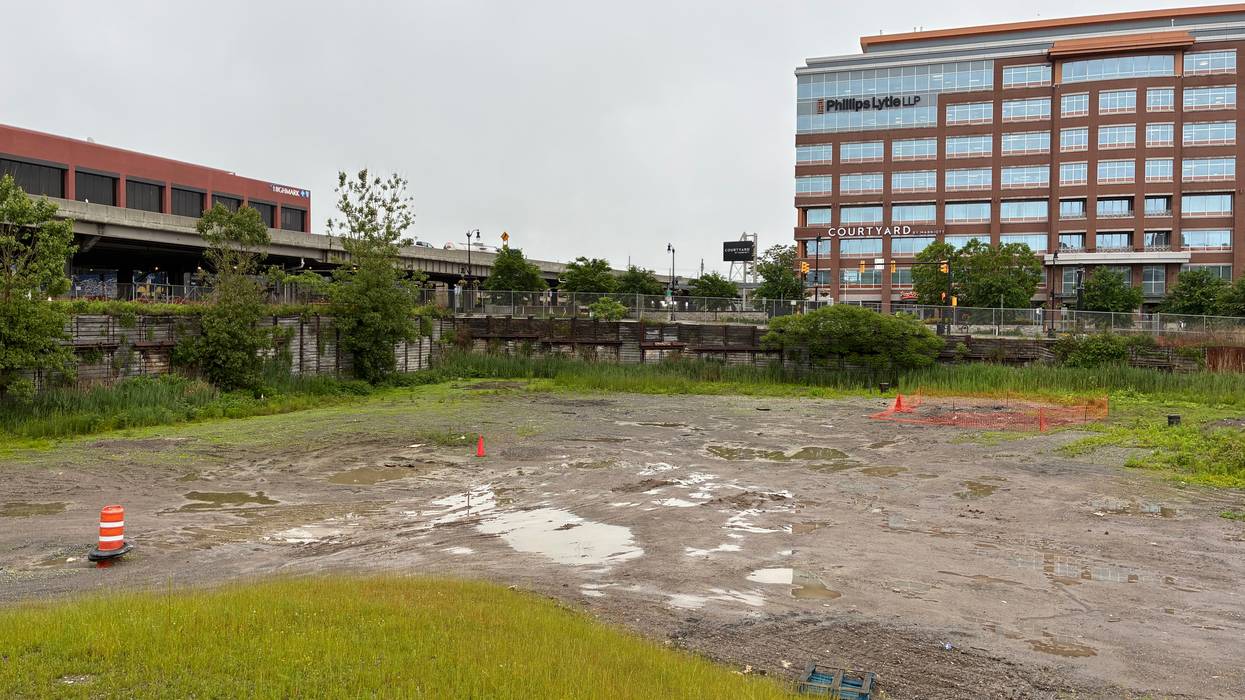
The Chair of the New York State Assembly Committee on Cities introduced the legislation - the City Fiscal Home Rule Act - in response to ESD’s proposed redevelopment of the North Aud Block at Canalside, where the state is proposing a $225 million development, with $197 million - or 88% - coming from taxpayers. The project is centered on a 30-year tax exemption, meaning the privately developed property would not go onto Buffalo’s tax rolls at its full value for three decades.
"Seeing what's happening downtown at the Aud site and the incredible, massive subsidy that's going on over there - nearly $1 million per-apartment for this housing development that they're doing - it's out of control," said Burke in an interview with WBEN. "One of the big problems with it, though, is it didn't even need city council approval or county [legislature] approval for the state to come in and say, 'No, no, no. These guys don't have to pay taxes.' And these guys, it's a company that's worth billions of dollars. This is the problem that exists, this is what makes people so angry. They know they have to pay all their bills, but the people who make the rules and the rich guys, they live by a different set of rules."
Burke says his legislation is based on a simple principle: Albany should not have the power to give away local tax revenue without local approval.
"We hear a lot about public-private partnerships, but at what point does public subsidies stop leveraging private investment and start just replacing it? That's what we're seeing," he said. "This doesn't feel like a public-private partnership when the public is doing all of the paying for things, and the private is doing all the profiting of the things. This is a problem that has to be fixed."
Under Burke’s bill, before ESD could approve a property tax exemption, abatement, PILOT or similar tax benefit for a private project located within a city, the city’s legislative body would have to approve the agreement following a public hearing.
At least 30 days before that hearing, ESD would also have to publicly disclose:
- The project’s expected market value
- The property taxes it would otherwise owe
- The value and duration of the proposed tax break
- The total amount of city tax revenue being forfeited
- All other anticipated public subsidies
- An explanation of why the project supposedly cannot proceed without taxpayer assistance.
"I think transparency is always key to these things," Burke said. "There's an opaqueness to so many decision-making processes certainly when it comes to this sort of quasi-public-private practice. Things need to be laid out on the table, and our elected representatives at the local level, at every level certainly need to be a part of it. But what's the saying? 'Democracy dies in the dark.' It's our money, and if it's not being transparently used, if we're sort of hearsaying about major hundreds of millions of dollars of public monies being used without proper oversight or local decision making, obviously transparency is going to be one of the keys to making sure that's no longer the case."
Local Tax Dollars Require Local Consent
- Burke’s legislation would amend the New York State Urban Development Corporation Act to require approval from the governing body of any city and county whose property tax revenue would be reduced by an ESD tax arrangement benefiting a private project.
- The bill would also prevent ESD from circumventing limits that apply to locally approved tax incentives. If the state wants to provide a tax exemption longer than the city itself could ordinarily authorize, it would require approval from the city’s legislative body.
- The legislation would not prevent ESD from investing in economic development, providing grants or loans, financing projects, or maintaining the traditional tax exemption for property actually owned and used by the state for a governmental or public purpose.
Burke feels this is a bill that will get plenty of backing from fellow lawmakers in Albany.
"Certainly, I expect my constituents to support it, and in this case, it being a tool to make sure a project like this doesn't happen again without proper oversight and without proper approval from local governments," Burke said. "But I'll be engaging with my colleagues on it. I'm going to be sending it around for co-sponsors, and I'm hoping this carries a lot of weight across the state."
In conversations with a number of constituents in his Assembly district, Burke says the people are pissed off, and deservingly so.
"If you think about it, even if you don't live in the city, we're all county taxpayers. But if you have to go to work, you've got to pay for your home or your rent - however you're living - no one just gives you a tax handout," he said. "Nearly $1 million per-unit of subsidized apartments, and then the actual rent will be likely subsidized as well. Everyone who has to get up early, go to work and do all the hard things all day, and then not get help, they're pissed off."
While there's not much that can be done, at this point, to try and right the tax exemption already agreed upon for the North Aud Block project, Burke thinks public pressure is going to have to be paramount in this case.
"If a developer or a business is so successful, they should be able to do these things on their own. They don't need massive, massive public subsidies," Burke said. "When people in our community are trying to figure out how they're going to pay their bills and their electric bill and their mortgage, and you turn on the TV or you check your phone or you look in the paper and boom, someone else is getting another $100 million or $1 billion; we have to do something about this. It cannot be the standard operating procedure."