

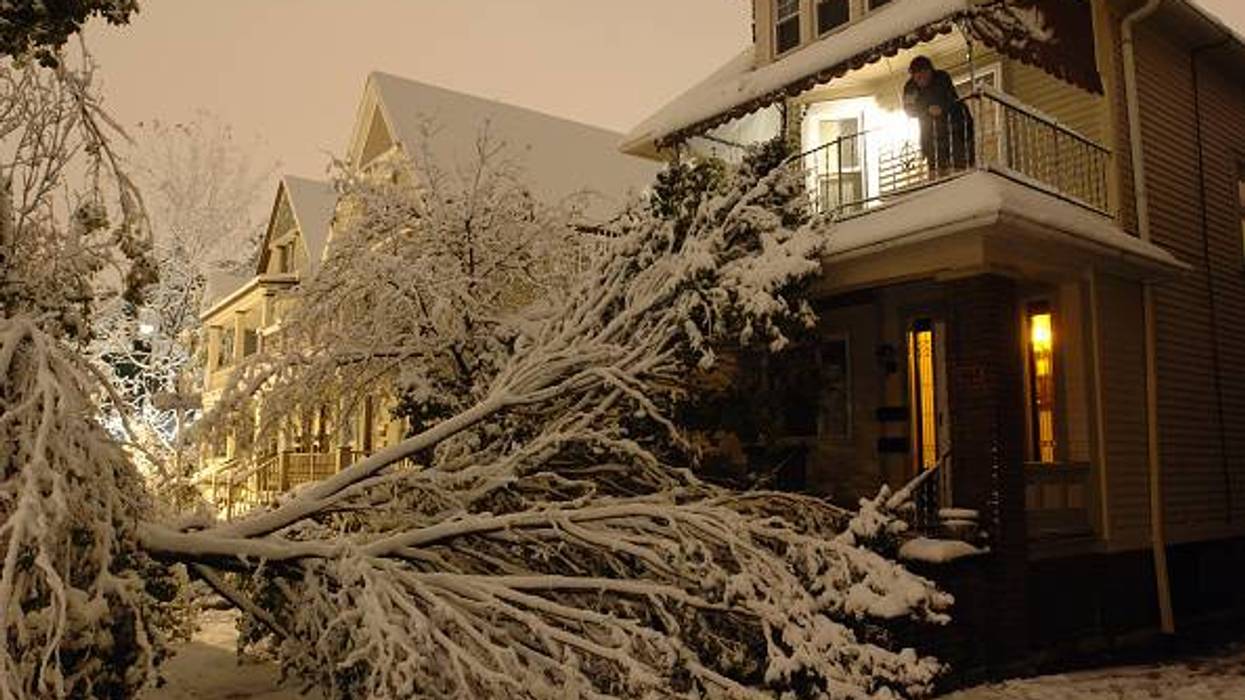

Buffalo, N.Y. (WBEN) - There were a number of lessons learned directly related to the "October Surprise" storm that struck Western New York 20 years ago on Oct. 12 through Oct. 13, 2006. Among the lessons learned due to the storm was a need for stronger communication between local government agencies and utility companies like National Grid.
National Grid regional director Ken Kujawa says when looking at any storm event forecasted today, the company has an Emergency Response Plan that tackles response plans, as well as interactions with customers, the community and media outreach.
"Everything is spelled out in our playbook," said Kujawa during an event Monday highlighting the company's response to the storm 20 years later,
With the rise of today's technology, Kujawa acknowledges it's easier than ever for utilities like National Grid to get the message out to customers and others in the community about plans to ensure the power remains on and operational for residents.
"One of the fun facts about that storm was when it hit, iPhones were not in existence at that time. They did not come out until later that year," Kujawa noted. "When you take a look at today, how we communicate with our customers, we now have text message capabilities where if a customer registers with National Grid, we have the ability to text them as soon as they lose power to let them know, 'We know you're out of power.' We now have the app on our iPhones [and Android devices] that customers are able to use to look up whether or not they're going to be restored at the time that National Grid has established on our website, we have, what are called, estimated times of restoration. You can highlight the area on the map that shows where the outage has occurred. It's just an effort by National Grid to try to give as much information to our customers as possible using the technology that we have available to us to make sure that customers know we know they're out of power, and we're working on getting it restored."
Kujawa says National Grid is also working hard to make sure the company is implementing technology on its system where opportunities present itself.
"One of the big areas of focus for National Grid right now is a technology called FLISR (Fault Location Isolation Service Restoration), and it's actually implementing technology on our poles that allows us to tie feeders together so that when one feeder loses power, we can connect to another and, effectively, limit the amount of customers that are out of power and limit the amount of time that they're out of power," Kujawa noted. "And we're making a concerted effort to go across our entire Upstate New York service territory and implement FLISR where we can. All in an effort to try to reduce the number of customers that lose power, and also for the amount of time that they lose power."
National Grid is also looking into the intensity of storms that have hit its system, and are looking at the infrastructure and as it's built out out, what do it need to look like in order to withstand the intensity of the weather impacting the region?
Part of the company's Emergency Response Plan is staying on top of the response with local government officials, especially county emergency managers.
"My team meets twice a year with Dan Neaverth and Greg Butcher - the Erie County Emergency Managers - Jon Schultz up in Niagara County, and we go through our entire Emergency Response Plan with them," Kujawa noted. "We review our list of critical facility customers with them to make sure that all of that information is up to date. And if there are any gaps, we're identifying them collectively so there's constant communication between us, so that when a storm hits, immediately we each know what our roles and responsibilities are. They know where to find us, they're not trying to hunt us down. We are always in communication with our emergency management partners at the county level. We've enjoyed you know an excellent working relationship with them, and hope to continue that well into the future.
"Our motto has been, 'You don't want to be introducing yourself to somebody during a storm.' So we work really hard to make sure that those relationships are foundational so that when a storm hits, we know exactly who we need to be talking to, who we need to coordinate with, and it goes both ways. They will sometimes reach out to us and say, 'Hey, there's a tree across this road in your wires. If you can get your wires out of this tree, we can get the tree removed and we can open up this road again.' So we will then work with our operations folks to make sure that they're responding accordingly. So again, the communication goes both ways, and we have excellent relationships with all the county emergency managers here."
The preparations never stop for National Grid, as the company is already monitoring a potential storm set to impact the Western New York region later this week.
"Every Monday morning, National Grid at 7:30 a.m. holds a statewide call, and it's specifically for electric ops. And we look at what the weather forecast is going to be for the week. And Friday, later on in the week, we're keeping an eye on right now. Hard to tell what, if anything, it may mean, but just to give you a sense as to the level of preparedness: We were already talking about Friday in our 7:30 meeting this morning, just to make sure that everyone has visibility and awareness into the fact that we could see some weather," Kujawa explained. "I think I saw a 95% chance of rain. The question will be: Rain's usually not a problem, but if there's wind coming along with it - especially with the leaves still being on the trees - that's something that we need to be aware of. So as we get closer to the end of the week, if the weather forecast worsens and we think the conditions that are going to present themselves are going to cause problems for us, then we'll start taking action accordingly."