


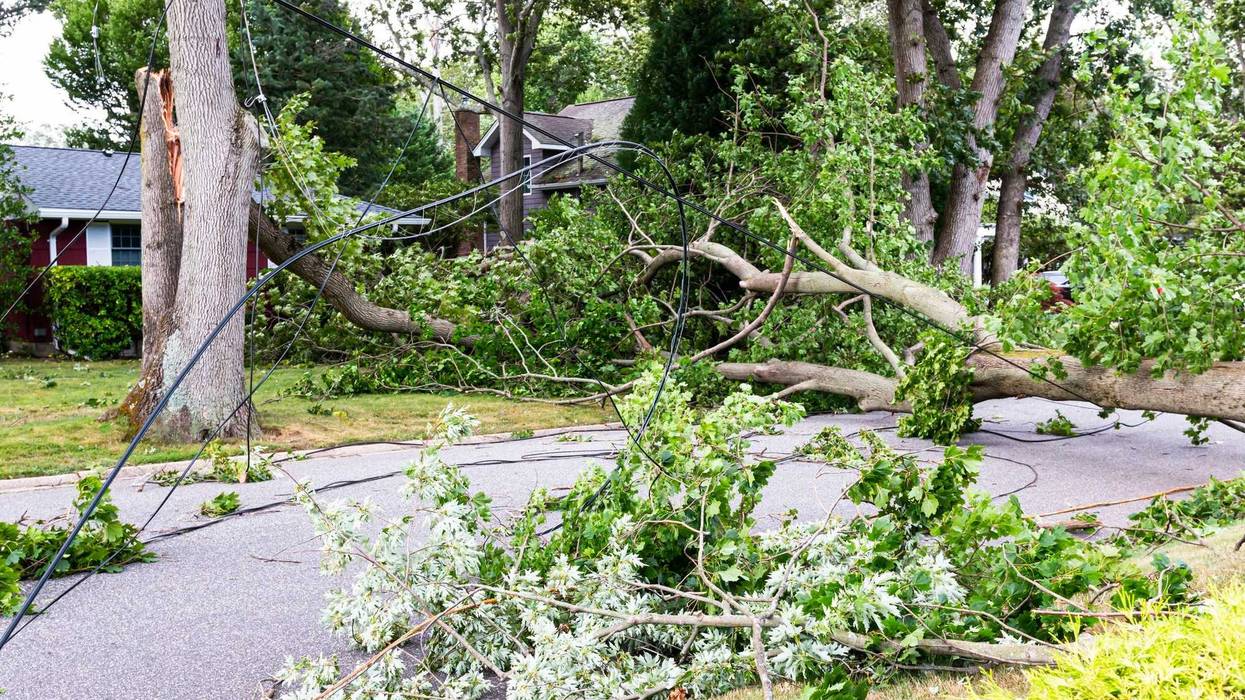

Buffalo, NY (WBEN) Just take a look up into the canopy of green and you'll fine a lot of leaves and foliage remain on trees across Western New York.
While they're pretty to look at, there is some concern should the weather turn nasty in the next couple of weeks that the leaves could propel problematic tree and power line damage.
While residents are getting their trees prepared for winter this time of year, says Jeremy Heim of AJ's Tree Services, he's taking note that trees are holding on to keep their leaves. "A lot of it is the result of the recent drought being down six inches of rain during the summer months, the trees actually went dormant at that point. What they're trying to do right now is play catch up," explains Heim, who says without a frost, a heavy snowfall could lead to considerable damage.
"If we do not get a good frost before a decent amount of snow, we could have some major damage to canopies and trees."
Heim says if it's like the heavy, wet snow we saw during the 2006 October Surprise Storm, that could lead to trouble. He says this time of year, the air's not cold enough for lighter snowfall.
Heim says people are trying to get ahead of it this time of year. "October and November, we'll get an influx of customers about trimming for house clearance, neighbor house clearance, and service line clearance," says Heim. He says branches, even in a normal situation, can't react to a heavy snow load if they have a lot of leaves on them.
Keeping an eye on trees with lots of leaves as well are the big utility companies. National Grid's David Bertola says when there's a combination of freezing rain and snow that falls on trees with leaves, that adds to the weight on the branches. "All these factors combined with strong winds could uproot trees and knock them down on power lines, which could lead to outages as we all know," says Bertola.
"Half of an inch of ice can add 500 pounds to a power line, and when you add 20 to 25 mils an hour winds, those power lines can sway in the breeze."
Bertola says there's a team of people keeping an eye on the weather. "They also look at what crew support we may need even if it's just holding crews beyond their normal schedule. We might even send crews from the eastern portion of the state into Massachusetts where some bad weather has caused outages in that region," says Bertola. He adds customers should treat any downed line as live, and you can call National Grid or 911.
There appears to be some good news weatherwise, at least for the next couple of weeks. "We're looking at temperatures and precipitation near normal through the first week of November," says National Weather Service meteorologist Heather Kenyon. "However, we are seeing some signs we're going to below normal for temperatures, mainly with highs in the 40s." This time of year, a normal high is in the 50s.
Kenyon says there are no signs of snowflakes in the next couple of weeks. Still, she notes "there is a chance overnight precipitation could switch to snow. Right now, in early November, we usually do see a tenth to 2 tenths of an inch of snow." She adds that's usually in the higher elevations. But it doesn't take a lot of snow to get branches with leaves to start breaking.


