



Buffalo, N.Y. (WBEN) - While winter is not quite over yet, the ice boom in Lake Erie will soon be removed by the New York Power Authority (NYPA) when conditions allow.
Lou Paonessa, NYPA's director of community affairs in Western New York, feels the ice boom held up pretty well this year on Lake Erie.
"Not unusual for some pontoons to break free, and we've noticed over this week - especially with the high winds - there have been some floating down river. And we appreciate the folks who have called in and identified where they are, and we've been scooping them up the last couple of days," Paonessa acknowledged in an interview with WBEN. "But we don't see any cable breaks or breached spans that are allowing larger ice flows to come down the narrower river."
Paonessa says it's not uncommon this time of year to get calls from residents in Buffalo about a pontoon that has broken off from the ice boom and washed up on shore of the Niagara River.
"A member of the public will say, 'Hey, I think we've got a piece of the boom floating by.' If it's breached on shore, they'll look at it and see if the phone number's on there and give us a call," Paonessa said. "At that point, we dispatch our boats to go out and retrieve it for public safety reasons."
From time-to-time, pontoons may find their way down river quite a ways, even ending up as far as Niagara Falls and just before the rapids above the Falls.
"We want to get it before it gets over the Falls or get stuck in the rapids above the Falls. So we've appreciated the folks who have told us that they've seen it, and we've gone out and retrieved several of them already this year," Paonessa said.
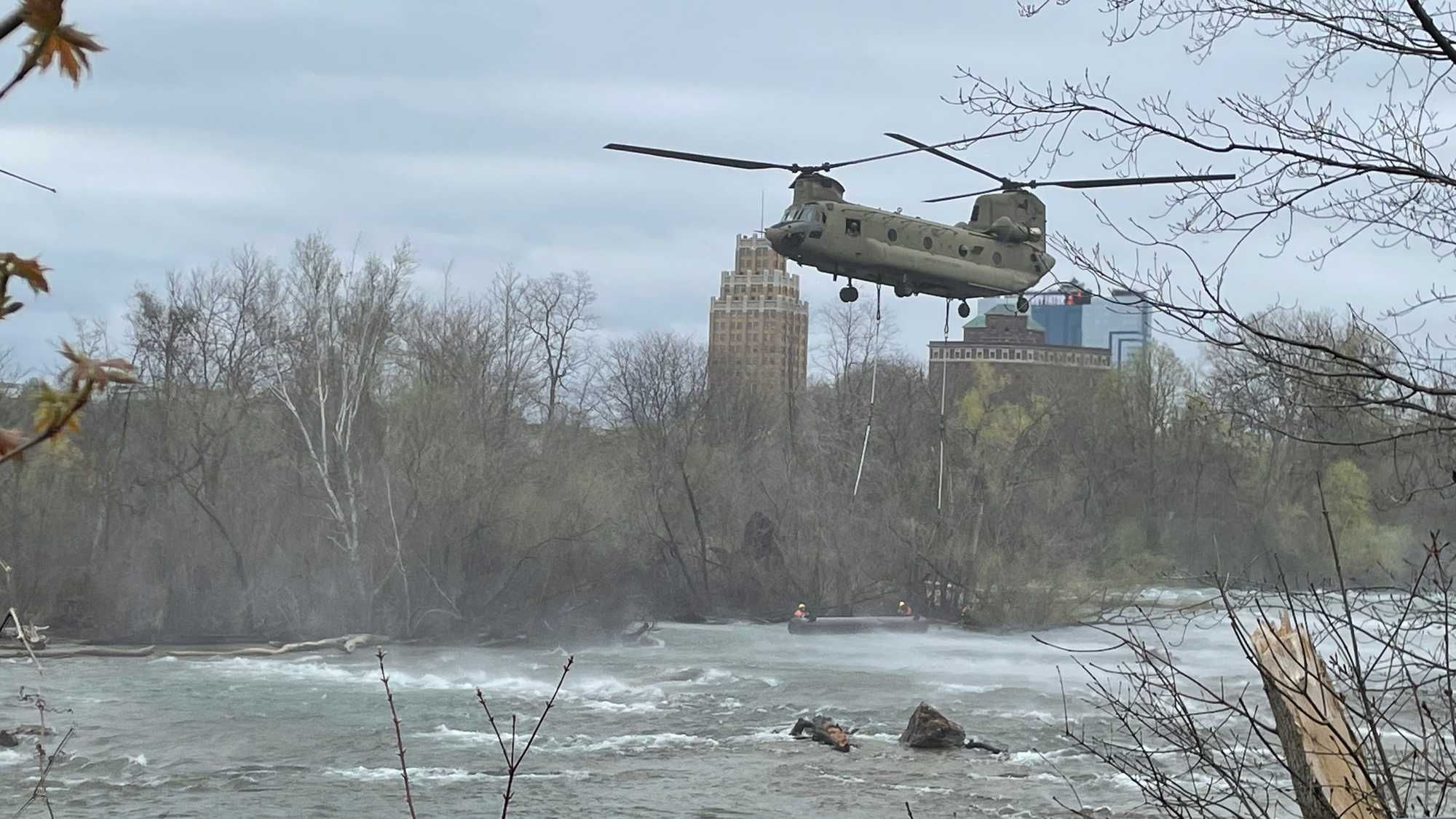
According to Paonessa, the ice boom held up well this year after taking a bit of a beating during the 2024-25 winter season in Lake Erie.
"Last year was probably one of the worst, if not the worst weather conditions that caused the most damage to the boom," Paonessa noted. "Every winter is different, and it's really the timing of when the ice shield forms behind the boom itself, versus wind and wind direction. All those can play havoc with the boom, but this year we had a nice stable ice cover, and the boom was able to - based on all the repairs we did last year - hold up much better this year than the year before."
The International Joint Commission Niagara Board of Control, along with NYPA and Ontario Power Generation (OPG) are constantly monitoring the amount of ice that remains in Lake Erie. Once the ice shield gets below 250 square miles at the Buffalo end of the lake, that's when the IJC will give NYPA the directive to start removing the ice boom.
"Based on satellite imagery, last week's warm temperatures really reduced a lot of the ice cover," Paonessa noted. "It's still well more than 250 square miles, but some warm days over the next couple weeks will have us looking at removal, sometime around April 1 or shortly thereafter. The IJC's rules require the boom to be removed by April 1, unless there's more than 250 square miles of ice on the lake."
Right now, though, Paonessa says it's too early to determine whether or not the ice boom will be removed from Lake Erie before the April 1 deadline, or it will remain in place beyond that point, similar to last year.
"The IJC will be really looking at it closely over the next couple weeks and really monitoring the conditions, and they will make the announcement and give us the direction of when it's time to take it out."
One of the groups that help out with the removal of the ice boom on an annual basis is the U.S. Coast Guard.
"We will work with NYPA, in regards to operations that involve breaking of the ice, to move vessels in-and-out of the Outer Harbor. Our efforts are to ensure that the ice boom remains intact, to protect NYPA's assets, but then also allowing commerce to continue bringing in needed salt for the region, for the roads," said Commander Adam Mosley with WBEN. "But that's the more communication that we have with NYPA."
And while the removal of any pontoon that comes loose from the ice boom in the Niagara River is the responsibility of NYPA, the U.S. Coast Guard is always on standby to provide any further assistance.
"If NYPA asks for assistance, and we have the assets that can remove the [pontoon], then we will assist. If it is beyond our capabilities, then they'll take other actions to remove that type of situation," Mosley said.