


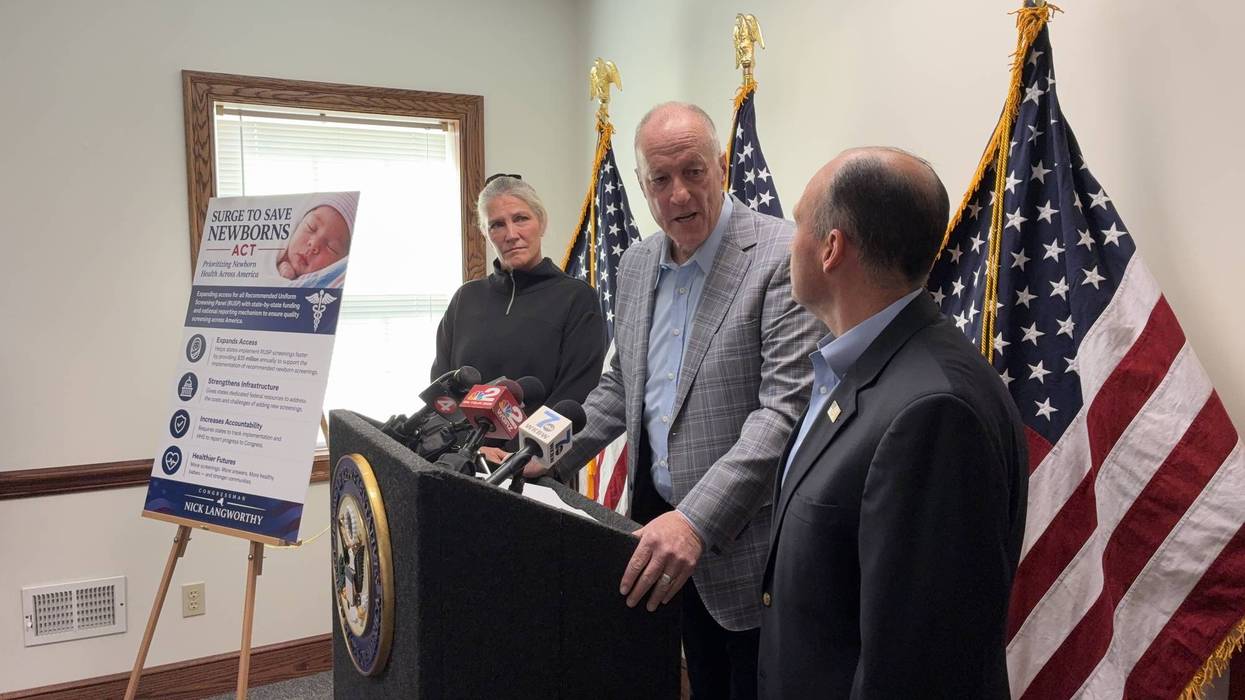

Williamsville, N.Y. (WBEN) - A new bill has been introduced in Washington, D.C. by Western New York Congressman Nick Langworthy (R, NY-23) that will expand critical access for newborn screenings across all 50 states.
Joined by Buffalo Bills Hall of Fame quarterback Jim Kelly and his wife Jill on Friday, Rep. Langworthy announced the introduction of the Surge to Save Newborns Act, legislation that would provide states with dedicated federal resources to implement newborn screenings for serious health conditions included on the federal Recommended Uniform Screening Panel (RUSP).
This bipartisan bill, introduced with Congresswoman Kim Schreier (D, WA-08), would provide $35 million every year, from 2027-to-2031, to help states implement recommended newborn screenings, and strengthen the infrastructure necessary to do it. It also requires accountability, with states disclosing what conditions they are screening for and what gaps they might be experiencing.
"This is a very simple, straightforward bill, but its implications are immeasurable," said Langworthy during Friday's announcement. "If we have the ability to detect a devastating disease in a newborn before it's too late, we have a responsibility to make sure that opportunity is there. We already have this technology in the screening infrastructure. We already know that early detection can make a profound difference for babies and families. And the problem is when a condition is added to the federal recommended uniform screening panel, that doesn't automatically mean that every state has the resources and the infrastructure to implement that newborn screening. That is the gap that this bill addresses."
Newborn screening can identify serious health conditions shortly after birth, giving families and doctors the opportunity to pursue appropriate follow-up care as early as possible. While the federal government maintains the RUSP to identify conditions recommended for inclusion in state newborn screening programs, adding a condition to the federal panel does not necessarily mean states immediately implement screening for that condition.
"I, frankly, think it would be unconscionable to know that we can detect a devastating disease early, but allow a baby to go undiagnosed simply because that state doesn't have the resources to implement that screening," Langworthy said. "Think about what that means for a family: Nine months of planning and dreaming, who are they going to be? What little personality will the baby develop? What passions will fill their soul? And you're filled with joy and optimism and a love unlike any other in the world, and you bring them home from the hospital, thinking that you have your whole life ahead of you. Only to months later, notice something isn't going right. And you go from doctor-to-doctor looking for answers, and eventually you hear the words that no parents should ever have to hear: Your baby has a devastating disease, and the window to do something may have already closed.
"There is nothing more heartbreaking than losing a child, and the Kellys have been so brave in sharing that. It is against the natural order. And while we cannot prevent every tragedy, there are some tragedies we can work to prevent, and this is one of them."
The Surge to Save Newborns Act would:
- Provide dedicated funding to states: Establish a federal grant program administered by the Secretary of Health and Human Services to help states implement newborn screening for conditions included on the RUSP.
- Target funding directly to state implementation: Allow a state's chief health executive, their designee, or a state governmental agency to apply for funding and explain how the grants would be used to implement recommended screenings.
- Track state progress: Require annual reports to Congress from FY2027 through FY2031 identifying which recommended conditions each state screens for, which have not yet been implemented, the effectiveness of the grants, and recommendations for legislative or administrative action.
- Invest in newborn screening infrastructure: Provide $35 million annually from FY2027 through FY2031, with funds remaining available until expended.
"It's so much more than just the baby and the parents. It's the entire family that's impacted by diseases, and the fact that this effort is for every single newborn, born in our country, to get tested for every single treatable disease. It's common sense," said Jill Kelly on Friday. "This isn't this huge thing we're trying to do that people just don't understand. This is common sense. Every baby in the United States should be tested for every single disease that you can treat. That's it. We want every state to get up to par to make sure that every state is being tested for every single disease."
This legislation builds on several years of work to expand newborn screening, including the Congressman’s efforts alongside Hunter’s Hope Foundation to press the Department of Health and Human Services to recommend universal screening for Krabbe disease. In May 2023, Congressman Langworthy sent a letter to then-HHS Secretary Xavier Becerra urging the federal government to recommend universal screening for Krabbe disease. Following that advocacy, the Advisory Committee on Heritable Disorders in Newborns and Children voted in January 2024 to add Krabbe disease to the Recommended Uniform Screening Panel, and HHS granted final approval in July 2024.
"This is just not for what we've been doing in the years past. This has been something we both have focused on for many, many years, and we won't stop," said Jim Kelly on Friday. "I know that, at least, I want to make sure that every parent gets that chance to have their child set those dreams and goals. And I've said this before: I know when I was a little boy, I set dream and I set goals of what I wanted to make of myself, what I wanted to become. And there's kids out there now that are not getting that chance. I want to give every child a chance to dream like I was able to do as a little boy. Being able to look up in the stands someday - whether it's in baseball, football, basketball, whether it's being a doctor - and making your parents proud of you. I want to see this happen to all these kids."
This bill will expand access for funding and resources needed for newborn screening across the country
This bill will expand access for funding and resources needed for newborn screening across the country