


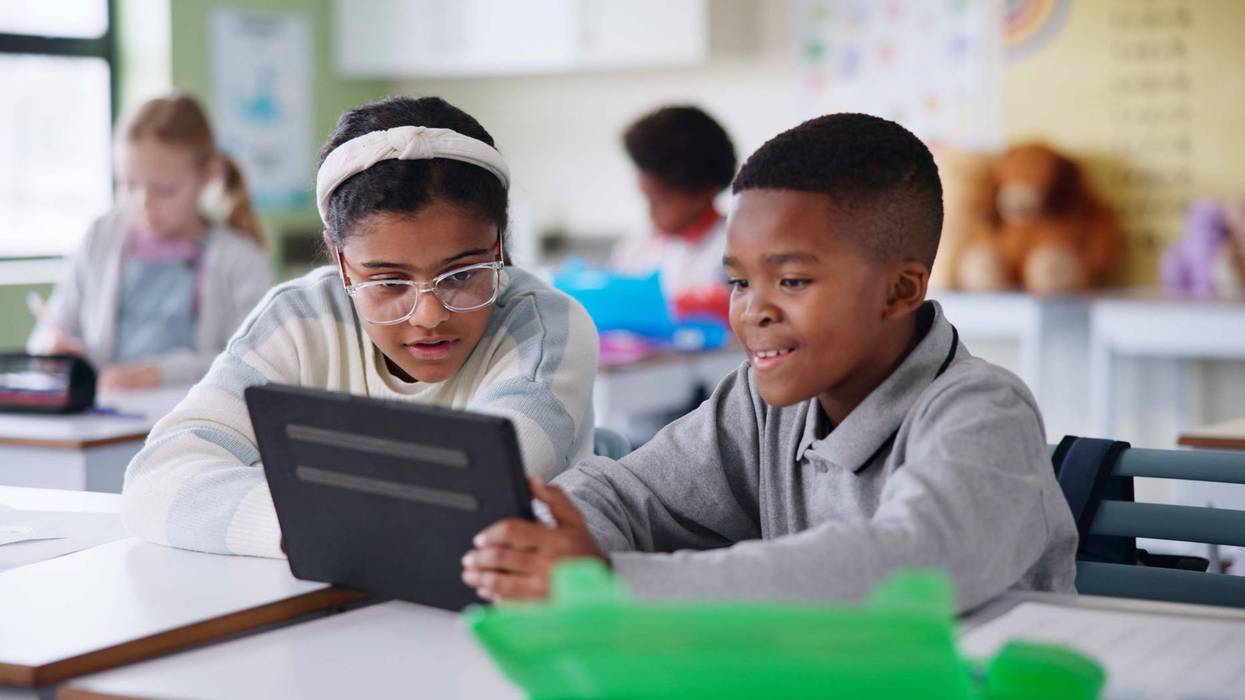

Buffalo, N.Y. (WBEN) - The state teacher's union is looking to further advance limits on educational technology in classrooms across New York, which is garnering support among teachers and administrators in Western New York.
New York State United Teachers (NYSUT) and its 82-member board of directors recently passed a resolution that calls for developmentally appropriate limits on screen time and artificial intelligence in New York schools — especially for the youngest learners — while affirming that educators, parents and families, not technology companies, should drive decisions about how technology is used in the classroom.
Specifically, the resolution calls for:
- No 1-to-1 screen/device use for students (including online assessments) in Pre-K through second grade, except to support students with documented needs such as translation or special education services;
- Requiring paper-and-pencil assessment/testing options be provided for all students as called for by NYSUT’s More Teaching, Less Testing report;
- No student-facing AI for Pre-K through second grade students;
- No non-educationally based AI for students in Grades 3-8;
- Requiring the use of AI in any grade must be supervised, educator-led and designed to promote critical thinking, digital literacy, and civic readiness, rather than replace human instruction, creativity or judgment;
- No so-called “social companion” chatbots — computer programs that simulate human relationships, for children under 16.
NYSUT says it will work with parents, experts, community partners, and other organizations to lead the state and national conversation on the appropriate role of technology in learning, especially for younger children.
Marc Bruno, teacher at Riverside High School in the Buffalo Public School District, feels this is a common sense approach by NYSUT.
"I don't even allow laptops in my room, to be honest with you. And I just read another study that if you read something in text form on a piece of paper instead of reading it on a screen, you're far more likely to retain the information. So I think the pendulum is finally swinging back to logic, reason, and common sense," said Bruno in an interview with WBEN. "And we do have the studies now that show technology is our friend, but it is also kind of our worst enemy in the same breath. Whether it comes to medical advances, scientific advances - we've come light years in the past 20 - but also I think the dark side of technology is really starting to kind of show its ugly face, and it's really damaging our kids."
Bruno feels measures like this, as well as the statewide cell phone ban that was first implemented this past school year, should have come years ago.
"I think the damage that we did to our children - our most valuable resource in any community - it's almost incalculable, because this is going to impact kids for the rest of their lives," Bruno said.
"There are so many studies that show if you have two-and-a-half hours or more of screen time per-day, you're 50% more likely to have anxiety and/or depression as a young adult. Let's think about that - I think most children have more than two-and-a-half hours a day, if you include school and if they're playing video games or on their iPad or phones when they get home. That means one out of every two of those students will have anxiety and/or depression as a young adult. We're literally feeding them poison to their brains, and there's tons of scientific studies out there, we've had enough time to kind of look at this. I just think whether it's social media, they're playing video games, they're just becoming detached from humanity."
Niagara Falls City Schools superintendent Mark Laurrie appreciates the advocacy NYSUT is taking with this resolution and agrees with it coinciding with the statewide cell phone ban in schools, but feels there are many educational opportunities and ways of learning with the help of technology. He also feels technology is a big part of preparing kids for the future when they move out of high school and into the world of work or college.
"I think it's important to have that balance, so I don't have a problem with the call for a very close look at when and where we're using screen time. I think that always should be looked at, and I support that," Laurrie said with WBEN. "I just think that teachers in the classroom need to have the ability to also make those decisions that are best for the kids and the subject matter they're teaching. To blanketly say we can only do so many minutes a day is not the way I would go. I would say, 'Look, here are some parameters, here are some thoughts. We want to do our best to have students engaged in authentic learning with conversations, speaking, work that they're producing, and use that screen time only when it's necessary for reinforcement or to research.'"
Laurrie feels the use of technology can be as a tool to reinforce concepts that have been taught already, and as a way of practice and repetition.
" If I'm teaching a concept and I am working with a different group of students while the other group of students is using technology to reinforce the skill that they've just learned, I think that's appropriate," he said. "I think the free use of just go on technology and do what you need to do is not appropriate, I don't think it happens like that. But I think when it's used as a reinforcement tool, a research tool, a tool that helps kids gain knowledge and gain information to add to their work, I think that's fully acceptable. And I think it's fully acceptable when teachers use it to have kids reinforce the concepts that are taught."
When it comes to artificial intelligence, Bruno admits it scares him in today's age, and strongly feels everyone needs to be careful in how it's used.
"I think we have to be careful with artificial intelligence that it doesn't replace our ability to think, to critically think," Bruno said. "Especially if you've ever seen that movie WALL-E, that cartoon when people don't have a use anymore, a lot of things we've seen in movies years ago is starting to become real, and it's kind of scary. Artificial intelligence is something that's here to stay, it's only going to continue to advance. I think we really need to teach our students how to use it responsibly, and we need to talk about the dangers of it.
"I think we're very unique to this planet, and I think we're irreplaceable in many ways. But also I think you have to embrace artificial intelligence, because let's face it: There was the space race, there was the nuclear arms race. Well, we're in the AI race right now, and whatever country advances in it, literally, can rule the world. So I think it's something we have to embrace, but also be very careful doing so. Not 10 years from now, not 15 years from now when the damage is done - really, really look at the dangers of it and talk about it."
One thing Bruno feels is a positive is steps are being taken now to further address the concerns of AI, which includes efforts from the teachers union, school districts and even Congress.
"I think we all really need to look at the pros and cons, and embrace the pros, but also really protect our children against the cons. I don't think we did so with social media, I don't think we did so with screen time," he said. "In fact, if you look at the new Toy Story movie - my son, he's in second grade - what's the new Toy Story movie going to be about? The iPad versus the old school toys, and it's going to probably focus on the dangers of all of that."
Laurrie knows with the ability of students, even the younger kids, to access artificial intelligence, it is going to be an ongoing issue.
"I think that the call to attention and the call to start to really watch what we're doing, in terms of how we're teaching and imparting, is a good one," Laurrie said. "I think there are times developmentally when it's going to be appropriate, and I think I always like leaving that in the teacher's discretion. I think the words 'developmentally appropriate' is key. I think when we put terms like 'never' or 'none' or ''x' number of minutes', that's when it gets a little sticky for me."
While teachers and schools are focused on limiting screen time, Bruno and Laurrie both agree that parents and guardians of students in the classroom also need to be a part of their children's technology time at home.
"We can't really control what parents are doing. Some kids go home and they're playing video games and on their iPads for eight hours when they get home, or six hours. So I think we have to teach our students to use technology responsibly," Bruno said. "I think technology does have a role in schools, I just think it should be limited. I think you've got to be a little bit old school, there's nothing wrong with reading books and doing worksheets and stuff like that. But technology is here to stay, and it's only going to continue to advance. So I'm a big fan of the yin and yang symbol of China. I think you have to try and balance it out. Teach our students or children to use it responsibly, but also we can limit it in the schools."
"You can do so much during the school day, but if it doesn't translate to what happens during the other time of the day, it becomes a conflict, because we're doing this at home, but we can't do this in school," Laurrie added. "So it's got to be rolled out in conjunction with a whole package of the whole child, and how we are raising our kids."
At least a dozen states have introduced or enacted legislation to limit unnecessary classroom screen time, and the Los Angeles Unified School District has recently moved to ban screens through first grade. New York created momentum last year with a bell-to-bell cellphone ban, a foundation NYSUT intends to build on.
NYSUT is calling for developmentally appropriate limits on screen time and artificial intelligence
NYSUT is calling for developmentally appropriate limits on screen time and artificial intelligence