

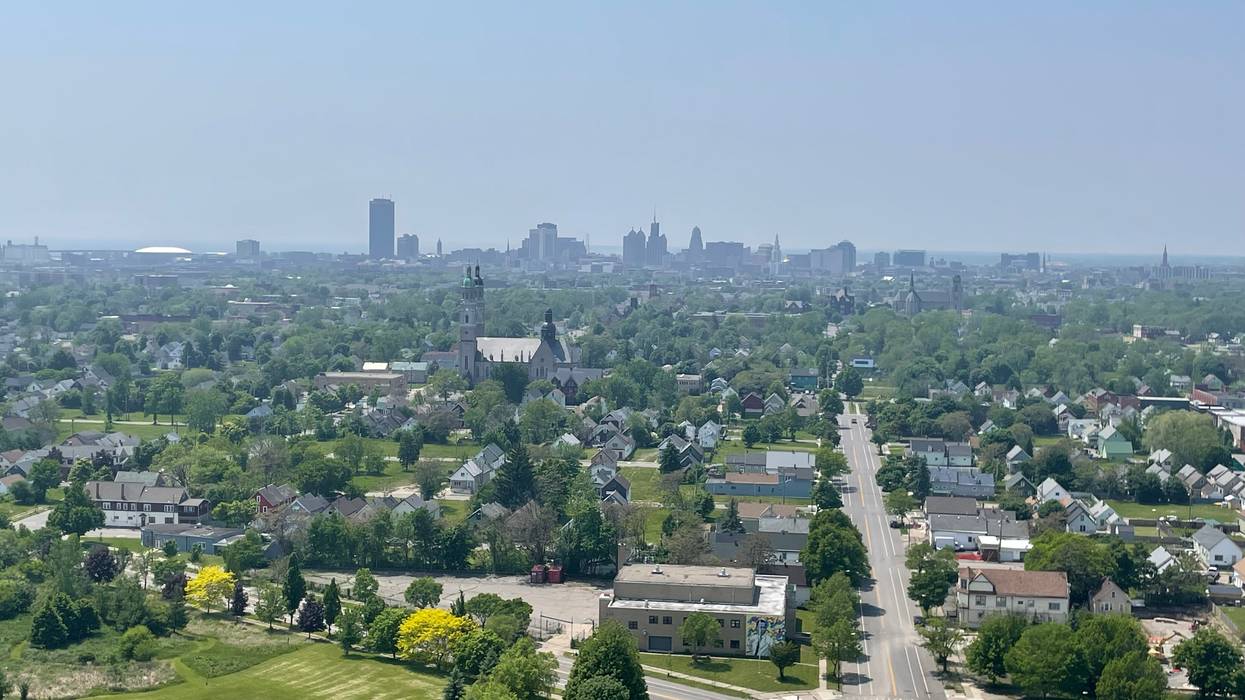

Buffalo, N.Y. (WBEN) - With wildfire smoke from Northern Minnesota and Western Ontario set to make its way to Western New York on Wednesday and into Thursday, one local meteorologist is cautioning those with any possible respiratory issues from spending too much time outside.
"What we're going to find is that the wind direction has been collecting this plume of smoke, and it's held it north of the border into Central Ontario. As we see the wind direction change, it's going to push the plume over top of Western New York and, really, much of the Great Lakes. And we'll see an increase in all the particulates from the smoke covering the sky Wednesday and Thursday," said meteorologist Andy Parker with WBEN.
The New York State Department of Environmental Conservation (DEC) has issued an Air Quality Health Advisory from 12 a.m. on Wednesday to 12 a.m. on Thursday, as air quality levels outdoors are predicted to be greater than an Air Quality Index value of 135 for fine particulates. The Air Quality Index (AQI) was created as an easy way to correlate levels of different pollutants to one scale. The higher the AQI value, the greater the health concern.
Figuring out the air quality levels set to impact Western New York is a two-part question, according to Parker.
"The first part is how much smoke is contained within the plume, and right now, as we look at it through satellite [Tuesday afternoon], it's a pretty thick plume. The second piece of the puzzle is what elevation will the smoke plume enter the area? Will it be way up high in the sky where it's really not affecting the surface, or will it mix down?" Parker noted. "There's a cold front that's going to be coming through during the day on Wednesday, sweeping out some of the humidity. But as it does, it's going to bring in some of the smoke. Right now, it looks like most of it will stay aloft, which will put kind of a sepia tone across the sky during the course of the day, as if you put a filter on your phone in the sky. It will mix down to the surface."
Parker is expecting the monitoring stations around Western New York reach elevated criteria for air quality concerns, probably up around 75 to even 150.
As those numbers increase, thus resulting in the air quality decreasing, Parker says people will notice the difference, especially anyone with respiratory issues.
"First, you're going to see it, then you're going to smell it, and then some folks are actually going to feel the effects from it. Anyone that has some respiratory issues - generally the young and some of the elderly, or anyone that has asthma - can be affected by inhaling more than what would be a normal afternoon," he said. "If the particulate is increased, that's when you can find shortness of breath, irritated eyes, things of that nature. So we'll have to watch and see what the levels are as this comes in. But I would expect later in the day Wednesday, Wednesday night, and Thursday that folks that are susceptible to respiratory ailments might want to curtail their outdoor activities at that time."
In recent years, wildfire smoke has become more prevalent in Western New York due to a heightened awareness for its effects on air quality and people's health. Back in 2023, some of the worst air quality levels were registered due to wildfires that burned across Western Canada, and saw winds push the smoke across much of the Northeastern United States.
When looking at the colorization of the plume of smoke on satellite, the density of it, Parker says there is a chance the air quality levels could reach the poor levels of 2023 for, at least, a day or two.
"It does have to travel a couple-hundred of miles, we'll see how the wind mixes it out," Parker noted. "And we'll definitely have a different color tone to the sunsets at night, and then also kind of an orangey-brownish haze during the day. Whether or not it mixes all the way down to the surface will be the key. It's definitely going to look different, but whether or not you smell it, or even taste it will all be determined by how the wind brings it down from the upper levels."
Parker adds the awareness for wildfire smoke and air quality concerns in Western New York and other parts of the country will continue, especially with the advancements in technology that allows for these levels to be well monitored.
"I think back in the day, we'd always call it 'hazy, lazy summer days', and you'd kind of see that and maybe people didn't understand the origin of it. Honestly, even science didn't track it well enough to attribute it to a specific area that was burning. But now, with the technology to monitor all of that, we're able to see it," Parker said. "I would expect the same situation would continue for the foreseeable future, where once or twice a year, we may have to deal with the smoke from some of the wildfires that naturally occur in the Northern United States and then also Canada."