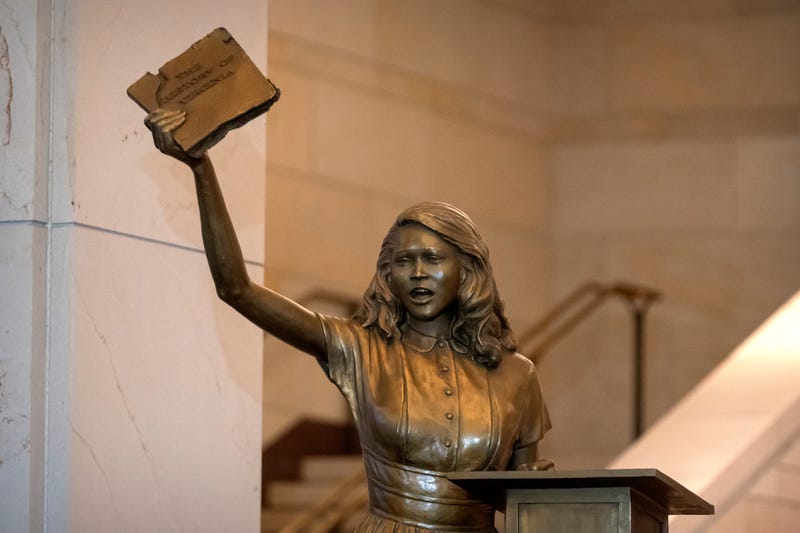
The U.S. Capitol on Tuesday began displaying a statue of a teenaged Barbara Rose Johns as she protested poor conditions at her segregated Virginia high school, a pointed replacement for a statue of Confederate Gen. Robert E. Lee that was removed several years ago.
An unveiling ceremony of the statue representing Virginia in the Capitol took place in Emancipation Hall, featuring Republican House Speaker Mike Johnson, Democratic Minority Leader Hakeem Jeffries, Republican Virginia Gov. Glenn Youngkin, Virginia's congressional delegation and Democratic Gov.-elect Abigail Spanberger.
Johnson said more than 200 members of Johns' family were on hand, listening on as the ceremony included renditions of “How Great Thou Art,” “Ain’t Gonna Let Nobody Turn Me ’Round” and “Total Praise” performed by the Eastern Senior High School choir from Washington.
"We are here to honor one of America’s true trailblazers, a woman who embodied the essence of the American spirit in her fight for liberty and justice and equal treatment under the law, the indomitable Barbara Rose Johns,” Johnson said.
Johns was 16 years old in 1951 when she led a student strike for equal education at R.R. Moton High School in Farmville, Virginia. The students’ cause gained the support of NAACP lawyers, who filed a lawsuit that would become one of the five cases that the U.S. Supreme Court reviewed in Brown v. Board of Education. The high court’s landmark 1954 decision declared “separate but equal” public schools unconstitutional.
Johns later married the Rev. William Powell and became Barbara Rose Johns Powell, raised five children and was a librarian in the Philadelphia Public Schools. She died at 56 in 1991.
The statue shows the young Johns standing to the side of a lectern, holding a tattered book over her head. Its pedestal is engraved with the words, “Are we going to just accept these conditions, or are we going to do something about it?” It also features a quote from the Book of Isaiah, “And a little child shall lead them.”
The statue replaces one of Lee that was removed in December 2020 from the Capitol, where it had represented Virginia for 111 years. The removal occurred during a time of renewed national attention over Confederate monuments after the death of George Floyd and was relocated to the Virginia Museum of History & Culture.
“The Commonwealth of Virginia will now be properly represented by an actual patriot who embodied the principle of liberty and justice for all, and not a traitor who took up arms against the United States to preserve the brutal institution of chattel slavery,” Jeffries said at the ceremony.
Johns' sister, Joan Johns Cobbs, read from a journal entry by Johns: “And then there were times I just prayed, ’God, please grant us a new school, please let us have a warm place to stay where we won’t have to keep our coats on all day to stay warm. God, please help us. We are your children too.'”
The Johns piece is part of the National Statuary Hall Collection at the Capitol, in which each state can contribute two statues. The other statue representing Virginia is of George Washington.
National Statuary Hall displays 35 of the statues. Others are in the Crypt, the Hall of Columns and the Capitol Visitor Center. Johnson said the Johns statue will be placed in the Crypt.
Former Democratic Virginia Gov. Ralph Northam had requested the removal of the Lee statue. In December 2020, a state commission recommended replacing Lee’s statue with a statue of Johns.
The Johns statue, sculpted by Steven Weitzman of Maryland, received final approval from the Architect of the Capitol and the Joint Committee on the Library in July.
Johns is also featured in a sculpture at the Virginia Civil Rights Memorial outside the state Capitol in Richmond. The former high school is now a National Historic Landmark and museum.
“It's an incredibly profound moment, a moment to stand in a tar shack classroom with a hot potbelly stove as a heater, tar paper walls, shabby desks, right where 16-year-old Barbara Rose Johns courageously organized her schoolmates and stood up to the lie — the lie was separate but equal,” Youngkin said of the museum.
__
This story corrects that Jeffries said “chattel slavery,” not “childhood slavery.”