
NEW YORK (WCBS 880) — The city that never sleeps is about to be awakened.
While Mayor Bill de Blasio has said he would like to “fully reopen” New York City by July 1, the future of the city’s business district remains uncertain.
According to one recent survey, just 15% of Manhattan’s office workers have returned to their desks and with thousands still working from home, it could mean having to reimagine New York City.
In this week’s In Depth Podcast, we spoke with Mitchell Moss, a professor of urban planning at New York University, who says one challenge in restoring New York City’s business sector is the fact that people have become comfortable working at home.
“There is now a recognition that you don't have to come in every day to work, but you might come in three or four days a week,” Moss explains. “So, the challenge is: What's the new ecology of the office district?”
He says there are several things that will likely change as people return to their Manhattan office spaces.
“We're going to have the office still be a center for interaction, for meetings, for high level decision making – but it's not going to be a five day a week office. The second big change is that we're going to see people coming in from further and further distances… the commuting shift from New York is going to get bigger, but they're all going to rely on New York because incomes are better in New York City and the island of Manhattan is still going to be the hub for global business services.”
Related
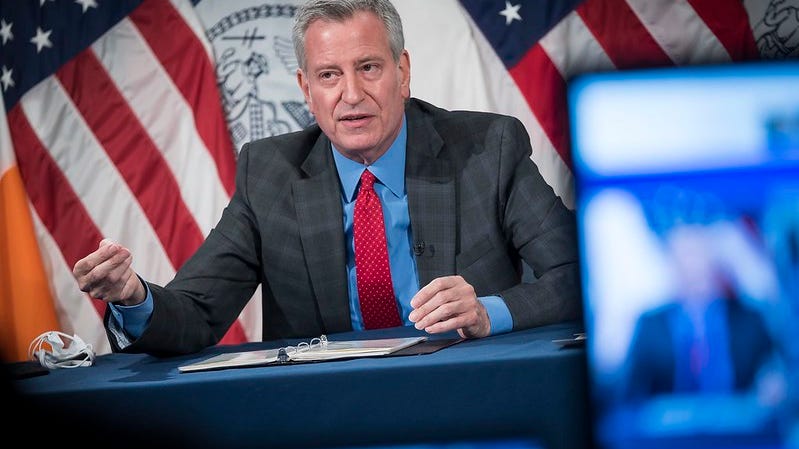
However, Moss stresses that a return to the office is not going to be enough to heal New York City’s economy.
“I think there's a great amount of fiction being perpetuated on New Yorkers. The people running for mayor are telling a great tale, but it's a fantasy. We lost 600,000 jobs. They're not going to come back in one year. At best, we get 100,000 jobs back each year. So, building this economy back has got to be a priority,” the NYU professor said. “And it can't be done just with government money because the federal money that Nancy Pelosi and Chuck Schumer and Joe Biden have given us is going to run out in two years. So, we're going to have to find a way to bring back small business, bring back entrepreneurs.”
Moss believes people are desperate to come back to Manhattan, and once they all return, the full scope of the economic damage will be easier to assess.
“The underlying part of the economy is getting people to come to work and when we get people to come to work, then we're going to find out there's more money in the economy and more jobs,” he said.
Meanwhile, Scott Rechler, the CEO and chairman of RXR Reality – which has a large portfolio of properties across the New York City region – tells WCBS 880’s Peter Haskell that restoring New York’s economy will mean redesigning office spaces and the typical 9-5 job.
“When [employees] are in the office, they're not going to be sitting at their desks doing video conferences. It's going to be much more about engaging with each other, more activation of programming and coming together as a team. Let's face it, when you think about it and when you talk to the employees, they had to work at home because it was a crisis, right? It wasn't meant to be a way of life,” Rechler said. “And working at home, it actually felt like they were living at work, not working at home. There was no beginning. There was no ‘end of day.’ For employers, they began to realize that you can play defense when you have your team working at home for some period of time, but you can't play offense. You can maintain the status quo, but you can't grow your business effectively. And so, the goal here now is to reimagine the workplace in the new normal, which is this hybrid, flexible [model] where you get the best of both.”
He says as employers also return to their office spaces, they are likely to reimagine their headquarter spaces and many will downsize by having employees work remotely, or by setting up satellite offices outside of the city.
“I think that there's going to be much more of a symbiotic relationship between New York City and the region around New York City to find the right balance of where people can live affordably, have the right quality of life, have great access to public transportation back to the city, and we can grow more effectively,” Rechler said.
Listen to the full conversation with Mitchell Moss and Scott Rechler in this week’s In Depth Podcast, available wherever you get your podcasts.