

There are approximately 30 Minnesotans at the Winter Olympic Games in Milan-Cortina, Italy, a spectacular showing for the state which is second to only Colorado when it comes to sheer numbers.
A group of those Minnesotans took some of the Olympic spotlight on Thursday, and in some historic fashion too.
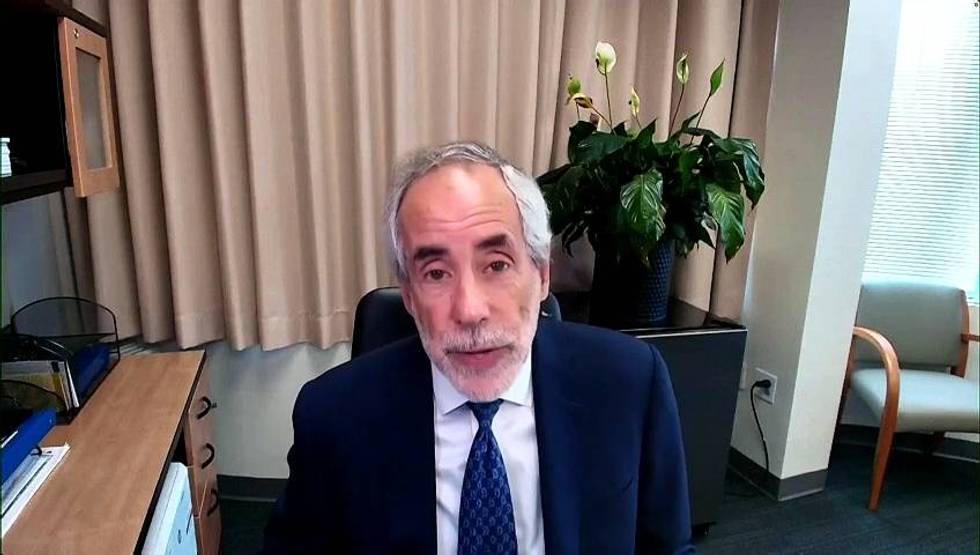
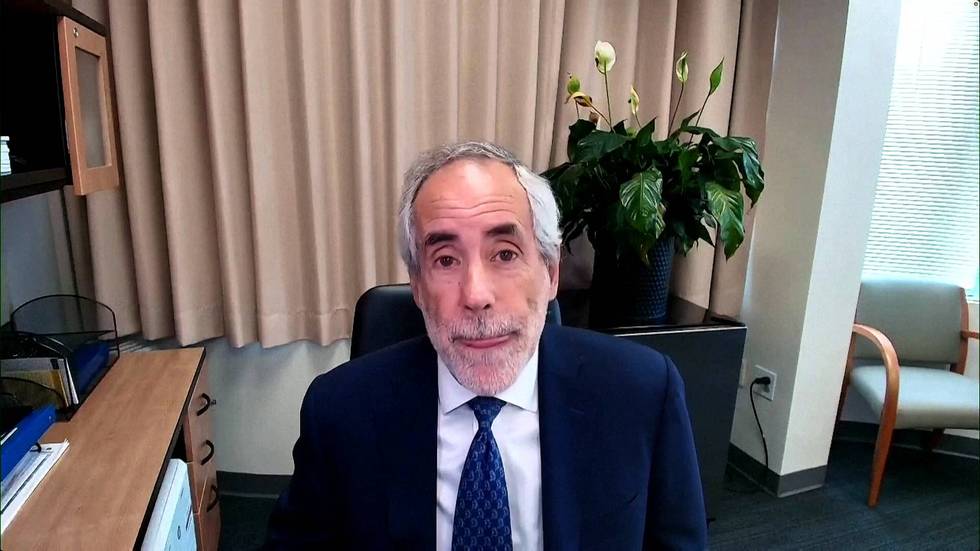
54-year-old Minnesota lawyer, who played with his teammate's dad, becomes oldest US Winter Olympian
The stakes were low — and the time ripe — for a 54-year old personal injury lawyer and six-time winner of “Minnesota Attorney of the Year” to make Olympic history.
It was the end of the U.S. men’s curling match against Switzerland on Thursday and they were down 8-2.
The team called a substitution. Rich Ruohonen, from Brooklyn Park, Minnesota, stepped onto the ice. He hurled the corner guard and watched his stone, biting his lip until it arrived safely at the left flank of the house.
“Yeah, baby! Good shot, Rich!" skip Danny Casper — who was born in 2001, making him 30 years younger than Ruohonen — shouted across the ice. Teammate Luc Violette, whose father played with Ruohonen years ago, let out a whoop.
U.S. fans gave a standing ovation. The lawyer looked wistful. He'd had just become the oldest person to compete for the U.S. at the Winter Olympics.
“I would have rather done it when we were up 8-2 instead of down 8-2," he said, “but I really appreciate the guys giving me a chance.”
Since inviting Ruohonen onto their Gen-Z team as an alternate for Casper, who has Guillain-Barre syndrome, he has become something of an honorary uncle: driving them around, waking them up for morning trainings and buying them snacks.
All while holding that much-discussed full-time job.
“We got Rich. Uh, he’s a lawyer. I don’t know if you guys knew that,” said Casper at a recent press conference, after that fact had already been mentioned four times. Curlers from the US women’s and men’s teams cracked up.
“If you need a lawyer, I think you can call Rich,” Casper said a few minutes later, again to uproarious laughter.
All jokes aside, it's a serious commitment. You don't win Minnesota attorney of the year six times by slacking.
“I get up three days a week at 5 in the morning, leave my house by 5:15 in the morning, go drive 30 miles to work out and train," Ruohonen told the AP.
He then heads to his law practice and works all day before returning at 6 p.m. before heading to practice again. He spends Thursday through Sunday away at curling tournaments, toting around a collared shirt and a tie so he can handle hearings on Zoom from the road. He has two kids with his wife Sherri: Nicholas, 21, and Hannah, 24. He has taught them to curl — as his father taught him —- but says Nick prefers hockey.
Though his teammates poke fun and make him the butt of the occasional TikTok video, there's clearly a lot of love on both sides.
It's because of the younger teammates that Ruohonen has finally gotten his Olympic moment after falling just short on several occasions. And it's because of Ruohonen that the team has a mentor and a connection to the older generation of the sport, some of whom they defeated to clinch their Olympic qualification.
“I came from the days when guys were smoking cigarettes out on the ice and all we did was throw rocks and think that we could be better,” Ruohonen said while praising his teammates' work ethic.
“Look at these guys,” he added. “Every one of them’s ripped. And every one of them sweeps their butt off."
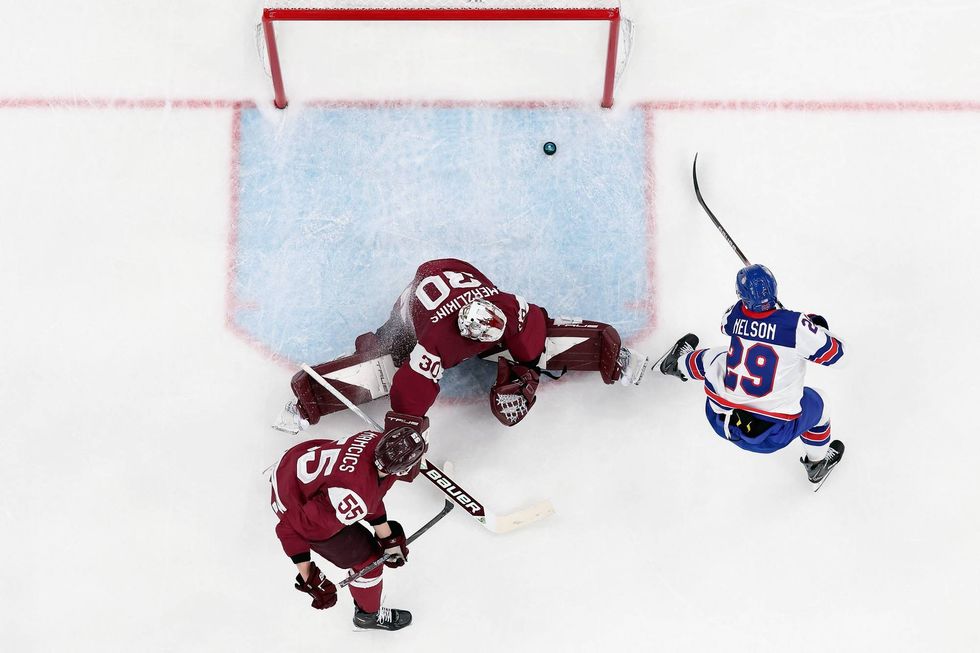 Brock Nelson #29 of Team United States scores a goal against Elvis Merzlikins #30 of Team Latvia in the second period during the Men's Preliminary Group C match between Latvia and United States on day six of the Milano Cortina 2026 Winter Olympic games at Milano Santagiulia Ice Hockey Arena on February 12, 2026 in Milan, Italy.(Photo by Jared C. Tilton/Getty Images)
Brock Nelson shines on 'another big stage' for the US at the Olympics
Brock Nelson has quite the international tradition to uphold.
He is the fifth member of his family to play hockey for the U.S. at the Olympics. Great uncle Gord Christian went in 1956, grandfather Bill and brother Roger won gold in 1960, and uncle Dave Christian was part of the “Miracle on Ice” in 1980. All from the tiny, border town of Warroad, Minnesota where hockey isn't just a sport, it's a way of life.
Nelson wasted no time making an impact in his Olympic debut Thursday night, scoring twice in a 5-1 rout of Latvia and showing why he made the team in the first place.
“Brock’s a guy that just brings a complete game,” coach Mike Sullivan said. “He’s got a mature game. He plays on both sides of the puck. He can score goals. He’s having a great year for Colorado. He’s a cerebral player. He’s conscientious defensively. You can use him on the penalty kill. If we needed him on a power play, we could use him on a power play.”
Nelson has 29 goals 55 games into his first full season with the Colorado Avalanche and is on the verge of hitting 30 for the fourth time in his NHL career, which until 11 months ago was spent entirely with the New York Islanders. Many of his U.S. teammates played alongside him at the 4 Nations Face-Off a year ago and know all about his skillset after his decade in the NHL.
“He’s probably been doing it for 15 years," said linemate Jack Hughes, who set up each of Nelson's goals against Latvia. “(This) was another big stage for him."
Nelson skated on the fourth line alongside Hughes and J.T. Miller, with Vincent Trocheck mixed in. It's a testament to the depth of USA Hockey's talent pool that standout players on their NHL teams are relegated to these kinds of depth roles, but such is life at the Olympics.
Sullivan is reluctant to call any of his forward trios the “fourth line,” usually reserved for grinders or energy guys hopping over the boards to give bigger-minute players a breather and flip the momentum with a strong shift. Nelson did so much more than that in the Olympic opener and he actually scored three times, though one was waved off after a coach's challenge by Latvia.
“You never really know how many looks you’re going to get, so you have that happen and you’re like, ‘Oh, man, maybe just not the night,'” Nelson said. “Jack was great, saying, ‘Just keep going, we’re going to get another look.’ He made a couple great plays there and found me.”
Playing for the New Jersey Devils, Hughes spent years facing Nelson on the division-rival Islanders.
“Everyone around the league knows he’s an elite two-way center,” Hughes said. “You know when you’re playing him, you’re getting a hard night.”
Nelson has 636 points in nearly 1,000 regular-season games in the NHL.
“He’s a dangerous guy,” goaltender Connor Hellebuyck said. “He’s got a big, long stick. He’s got poise with the puck. He plays his system very well. He plays two ways with the puck. I just think he’s a full-on complete player, with the vision of scoring.”
The U.S. has preliminary round games Saturday against Denmark and Sunday against Germany before the knockout round. The Americans don't necessarily have to lean too much on Nelson, but it won't hurt if another Olympic hockey player from Warroad, Minnesota, chips in some more scoring along the way.
“He moves so well, and he does all the little things really well and he’s got a great finishing touch," center Jack Eichel said. "No surprise. All of us as players really appreciate his game."
Fourth line or not, Nelson scored two goals in under 14 minutes of ice time.
“One of the biggest things a guy like that has shown, going even back to last year is what makes our team successful and that’s the sacrifice,” winger Matthew Tkachuk said. "It’s really just the sacrifice. That’s what’s going to make our team successful.”
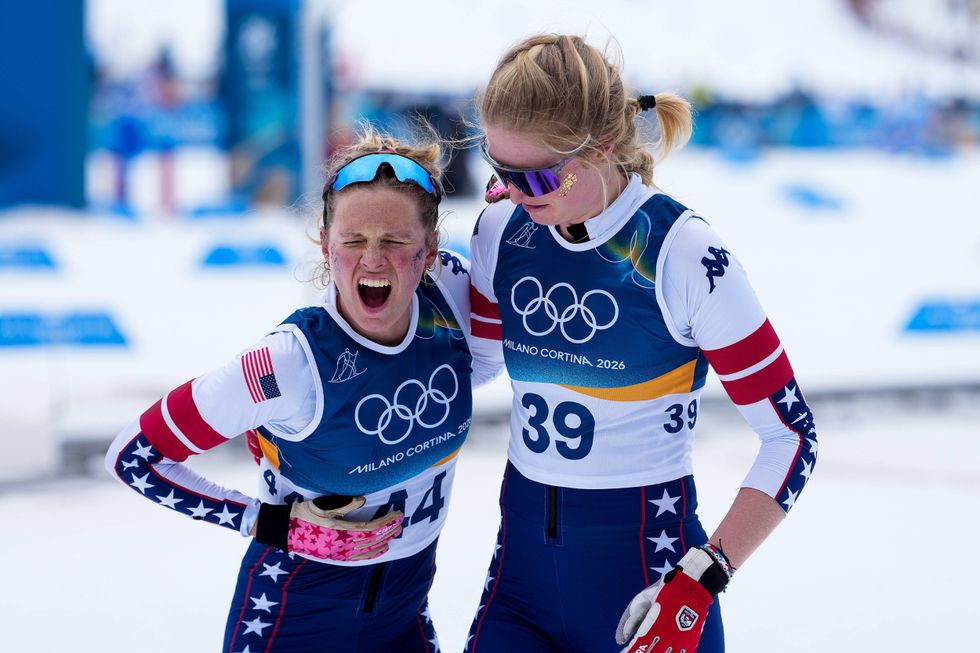 Hailey Swirbul (right) of Team United States, Jessie Diggins (left) of Team United States celebrate on day six of the Milano Cortina 2026 Winter Olympic games at Tesero Cross-Country Skiing Stadium on February 12, 2026 in Val di Fiemme, Italy. Diggins won bronze despite very painful bruised ribs in the demanding 10K race.(Photo by Michel Cottin/Agence Zoom/Getty Images)
Jessie Diggins fights injury to take bronze
Bruised ribs are extremely painful, and on Thursday, Afton, Minnesota's cross-country skiing star Jessie Diggins needed to plow through the agony in the hopes of achieving something satisfying from her last Winter Olympics in Milan Cortina.
Diggins was hurt in a fall in her opening race — the 20-kilometer skiathlon — on Sunday and the toll also limited her ability to put in a strong finish in the sprint classic on Tuesday in Tesero.
The current World Cup leader and one of the most decorated U.S. cross-country skiers was eliminated in the quarterfinals by eventual bronze medalist Maja Dahlqvist of Sweden. Diggins was visibly uncomfortable late in the sprint after a fast start, struggling to generate power in the finishing stretch.
“When I crashed in the skiathlon I bruised my ribs and it is really painful,” Diggins said. “Double poling is pretty tough right now so I’m doing the best I can. But it’s not my finest finishing stretch of my life.”
Frida Karlsson of Sweden dominated the women's 10k on Thursday but the effort by Diggins was a reminder of her fortitude.
Diggins, racing in her final season, collapsed to the ground, shouting out in pain after finishing the freestyle race at the Milan Cortina Games and adding to her gold, silver and bronze career medal tally.
The 34-year-old American finished 49.7 seconds behind a Swedish one-two, with Karlsson clocking 22 minutes, 49.2 seconds. Ebba Andersson was second, 46.6 seconds behind the leader.
“I need a new body,” Diggins said. “Honestly, I think I’m the happiest, most grateful bronze medallist in the whole world. It’s been one heck of a painful week. Two days ago, I was like, I don’t know how I’m going to do this.”
She hugged her Swedish rivals before stepping onto the podium to chants of “Jessie! Jessie!” from a crowd that included a large traveling group of her family and friends.
“I just felt like I was skiing out of my body the whole time. And I was just trying to fight for every single second and to leave it all out there,” Diggins said. “I’ve been up at night with my ribs clicking in and out of place. It’s just really been hard.”
Her medal is the second for the U.S. team in cross country at the Games, following Ben Ogden’s silver medal sprint in the men’s competition. But Diggins said the pain of racing Thursday made her unaware of her position in the standings.
“I had no idea what place I was in,” she said. “It’s been disconcerting and really, really painful.”
Showing emotion, Diggins said she had received video messages of support from elderly relatives unable to make the trip, adding: “I saw my husband and got a big smooch before the start and that really helped me out.”