


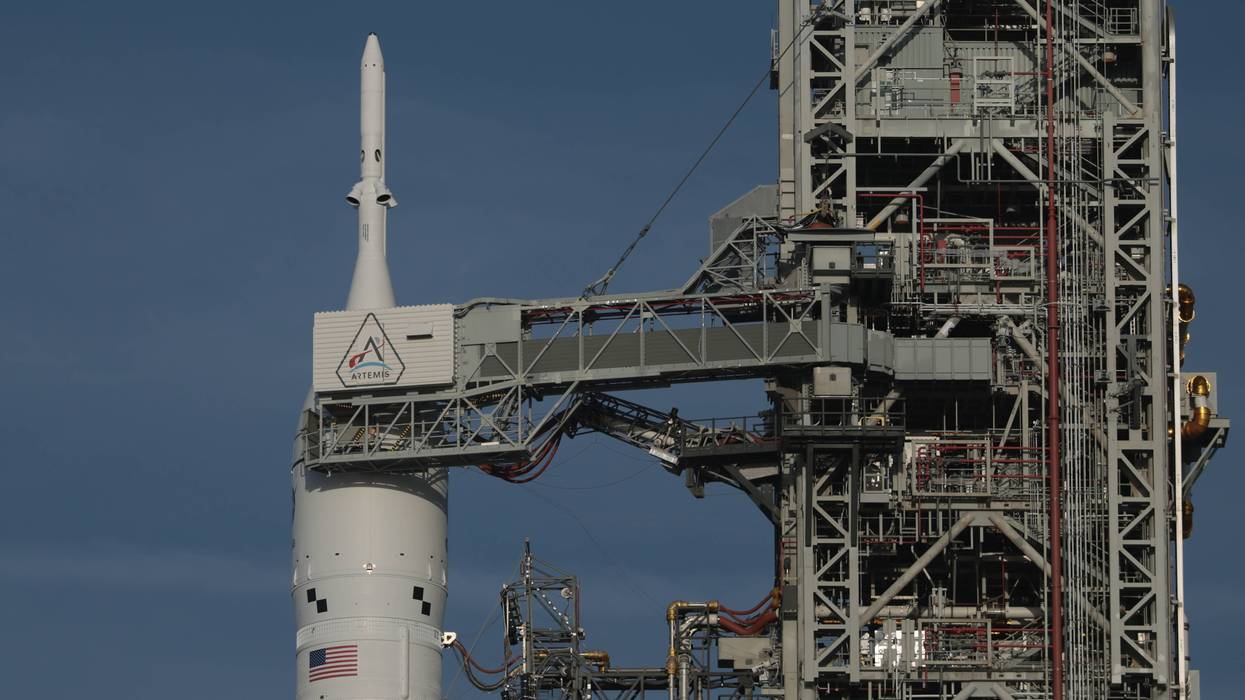
NASA's launch team has loaded more than 700,000 gallons of fuel into the 32-story Space Launch System rocket, setting the stage for the Artemis II mission crew members to board.
The mission is NASA’s planned lunar fly-around by four astronauts that will be the first moon trip in 53 years.
The Space Launch System rocket is poised to blast off Wednesday evening with a two-hour launch window beginning at 6:24 p.m. EDT at Kennedy Space Center in Florida.
Artemis astronauts Reid Wiseman, Victor Glover, Christina Koch and Jeremy Hansen will be on board. They’ll hurtle several thousand miles beyond the moon, hang a U-turn and then come straight back. No circling around the moon, no stopping for a moonwalk — just a quick out-and-back lasting less than 10 days. NASA promises more boot prints in the gray lunar dust, but not before a couple practice missions.
Unlike the Apollo missions that sent astronauts to the moon from 1968 through 1972, Artemis’ debut crew includes a woman, a person of color and a Canadian citizen.
Artemis II is the opening shot of NASA’s grand plans for a permanent moon base. The space program is aiming for a moon landing near the lunar south pole in 2028.
Among those paying close attention to the moon rocket launch is former WCCO Radio Meteorologist Mike Lynch, who told WCCO's Vineeta Sawkar that Artemis II is incredible. Lynch is the author of several books on astronomy and stargazing.
"This spacecraft is way, way more sophisticated than Apollo, unbelievably," Lynch said. "I'll give you one example. "The guidance system that led Apollo to the moon and back, there is more computer power in your smartphone than there was in that computer back 50 years ago."
Lynch says this first flight back to the moon is more of a safety check, where Artemis II won't actually go into orbit around the moon, instead doing a loop around it.
"Because if they were to get into orbit around the moon, and for some reason their propulsion rocket wouldn't work, then they would be trapped there," says Lynch. "So they're doing what they call a free return, where they're going around the moon and using literally Isaac Newton's gravity theory to get them back to Earth."
Astronauts head to the launch pad
Wiseman, Glover, Koch and Hansen have left the Neil Armstrong Operations and Checkout Building and are on their way to launch pad 39B.
Waving to family, colleagues and news photographers, the crew boarded the so-called astrovan for the 9-mile ride to the launch pad and their awaiting SLS rocket.
NASA fueled its moon rocket Wednesday for humanity’s first lunar trip in more than half a century, aiming for an evening liftoff with four astronauts.
Tensions were high as hydrogen fuel started flowing into the rocket hours ahead of the planned launch. Dangerous hydrogen leaks erupted during a countdown test earlier this year, forcing a lengthy flight delay.
But no significant leaks occurred by the time Wednesday's fueling wrapped up. The launch team loaded more than 700,000 gallons of fuel (2.6 million liters) into the 32-story Space Launch System rocket on the pad, setting the stage for the Artemis II crew to board.
“It is time to fly,” commander Reid Wiseman said on the eve of launch via X. Favorable weather was forecast.
Three Americans and one Canadian will fly around the moon without stopping or even orbiting — then head straight back for a Pacific splashdown. They will set a new distance record for the farthest humans have traveled from Earth as they zoom some 4,000 miles (6,400 kilometers) beyond the moon and then hang a U-turn.
Astronauts last flew to the moon during Apollo 17 in 1972.
Artemis II is the opening shot of NASA's grand plans for a permanent moon base. The space program is aiming for a moon landing near the lunar south pole in 2028.
“The next era of exploration begins,” NASA Administrator Jared Isaacman posted on X.
Best wishes already have started to pour in, including from England's King Charles III to Canadian Space Agency astronaut Jeremy Hansen.
Hansen will become the first non-U. S. citizen to launch to the moon. The crew also includes Christina Koch and Victor Glover, the first woman and first Black astronaut, respectively, destined for the moon.
“In this historic moment, you stand as a bridge between nations and generations,” the king wrote in a letter to Hansen, “and I commend you for your courage, discipline and vision that have brought you to this threshold.”
Former WCCO meteorologist Mike Lynch says the technological advances since Apollo are "incredible"
Former WCCO meteorologist Mike Lynch says the technological advances since Apollo are "incredible"