



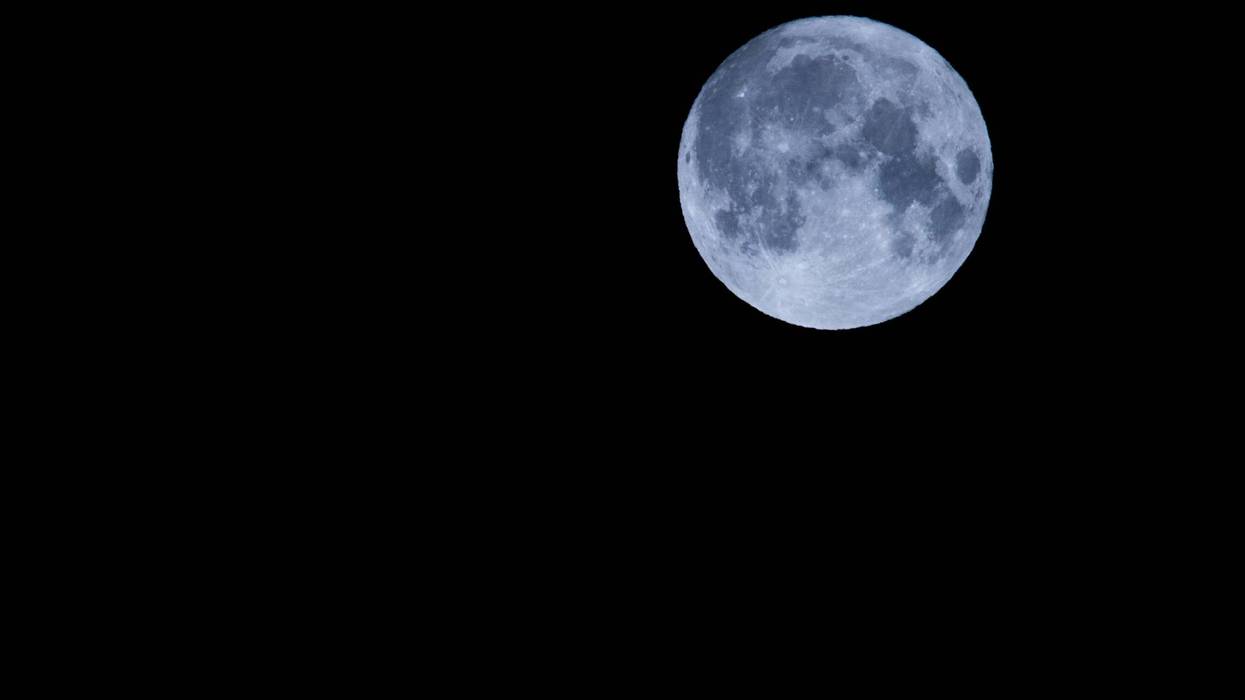

Get set for a rare blue micromoon this weekend — a blue moon that's also the most distant and smallest-looking full moon of the year.
A bonus: The brilliant star Antares will photobomb Sunday's spectacle for a celestial three-for-one.
A blue moon occurs every two to three years when a second full moon squeezes into a single month. May 1 saw this month’s first full moon. It's the smallest full moon we see.
Former WCCO Radio meteorologist Mike Lynch says it hardly ever happens.
"Because the month of phases on the moon, what we call the synoptic period between full moons, is 29.5 days," Lynch explains. "Well, look at the math. I mean, there's at most what, 31 days in a month, so it doesn't happen that often."
He says oddly, the moon isn't actually going to look blue.
"If anything, it's going to be probably a little more orange because this time of year," Lynch said. "The full moon takes a very low track across the sky, and if there's any humidity or any smoke in the air, it tends to turn it red."
Since the moon's orbit isn't a perfect circle, the upcoming full moon will be farther from Earth than usual at a distance of 252,360 miles (406,135 kilometers), making it seem a bit smaller and dimmer. It's the opposite of a supermoon when a full moon comes closer to us than normal. The most recent supermoon, for instance, was just 225,130 miles (362,312 kilometers) away.
The Virtual Telescope Project’s Gianluca Masi, who will provide a live webcast from Italy, said Sunday’s micromoon will appear about 6% smaller and 10% dimmer than that of an average full moon — “differences that are subtle enough to likely go unnoticed by most observers.”
The scene will be especially thrilling south of the equator across the Pacific.
For stargazers in Argentina, Chile, New Zealand, eastern Australia, parts of Antarctica and a smattering of other islands, Antares will vanish temporarily as the blue micromoon passes in front of it.
The red supergiant star, 550 light-years away, is known as the “heart of scorpion” in the constellation Scorpius. A light-year is almost 6 trillion miles (9.7 trillion kilometers).
There won't be any disappearing act for those looking up elsewhere in the world, with Antares constantly visible alongside the full moon.
And despite the name, this blue moon won’t appear turquoise, sapphire or any other shade. The term simply refers to the uncommon occurrence of two full moons in one month.
AP Science Writer Marcia Dunn contributed to this story.