


As we approach the 250th Birthday of the United States this July, WCCO takes a looks back through the eyes of Minnesota over those same 250 years.
This month we focus on the first African-American born in the state. This story begins with George Bonga in 1802. Around that time, George Bonga was born to a Black father and his Ojibwe wife. His father, Pierre Bonga, worked in the fur trade with the Ojibwe near Duluth.
"He's known to have been the first African-American born in the state," says Geneologist Mica Anders. "Something that's really interesting about him though, is when we celebrate him, we single him out in a way that doesn't recognize that he was a member of a whole family, right? He had parents, one of whom was African-American, one of whom was Native American. He had siblings."
George's younger brother, Stephen Bonga, was also a notable fur trader and translator in the region.
He wasn't just the first African-American born here though, he was more than that.
"He was a fur trader," says Anders. "He worked in partnership as a translator because, since he was multiracial, he was able to communicate in multiple languages between some of the other fur traders and some of the Native people in the community at the time."
He frequently guided white travelers and traders through the region, at a time when Minnesota wasn't yet a state. Bonga was comfortable in many worlds, working as an advocate for the Ojibwe in their dealings with trading companies and the United States government.
Bonga was also involved in the first criminal trial held in Minnesota in 1837. That year, an Ojibwe man was accused of murdering a white man at Cass Lake, known as Red Cedar Lake at the time. Though initially in custody, the man escaped. According to contemporary accounts, Bonga trailed the man over five days and six nights during the winter, eventually catching him, and bringing the man back for trial. In one of the first criminal proceedings in the area, Che-ga-wa-skung was tried and acquitted. Bonga's actions were unpopular with some of the Ojibwe, but he continued living with or near them for the rest of his life.
The American Fur Company folded in the 1840s, and Bonga opened a lodge on Leech Lake with his wife. It was there that he died in 1874.
Though the spelling is different, Bungo Township in Cass County is named after Bonga's family.
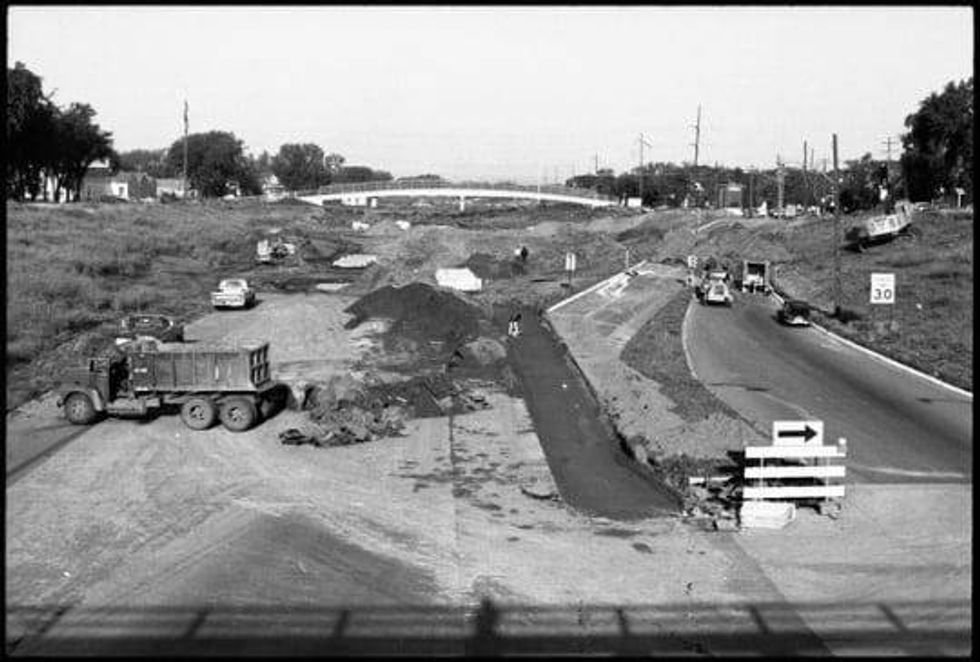 Interstate 94 construction near Fairview Avenue, in St. Paul, which cut the primarily neighborhood of Rondo in two and ended decades of that historically Black hamlet in the Twin Cities.(Minnesota Historical Society / St. Paul Dispatch-Pioneer Press)
State's Black history still celebrated in the Rondo Neighborhood
You can't talk about Minnesota's African-American past without talking about the significance of the Rondo Neighborhood either.
It was one of three neighborhoods, including North and South Minneapolis, impacted by the construction of Interstate 94 and marked the end of what was the city's only middle-class neighborhood made up primarily of Black residents. The freeway cut the neighborhood in two.
"To be able to still see those buildings and say, 'my grandma lived there,' or 'my great grandma lived there, and that's the place people went shopping,'. Or, you know, people are able to say, 'I still worship at Pilgrim Baptist Church or I still go to St. Peter Claver.' So I think that's the thing that makes Rondo so special, is it's still alive," Anders explains.
The freeway opened in 1968, and although the African American community was injured, it maintained a strong identity.
Rondo Days has become the largest African-American-sponsored festival in Minnesota. It features a parade, live music, food, and vendors at the Martin Luther King Rec Center each July.
There are also groups trying to revive Rondo as a cultural district with Reconnect Rondo leading that charge.