


As a sergeant for the Minnesota Department of Corrections at the state prison in Oak Park Heights, Matt Stanley had been attacked several times. But the last incident on June 18, 2024, was different. “I was nearly killed,” Stanley recalled. “Three inmates attacked me.” Stanley was stomped on for more than a minute.
After the attack and hospital stay, Stanley required therapy of all kinds: physical, neurological, and mental. A colleague told him about the Invisible Wounds Project in Forest Lake, which became Stanley’s home base between appointments. Today, he is the new community outreach specialist, a position made possible because of a $100,000 Opioid Settlement Fund grant from Washington County to the Invisible Wounds Project in 2026.
The Invisible Wound Project is a nonprofit that works to improve the mental health and wellness of those who have served or are serving in the military, police, fire, EMS, frontline medical staff, corrections, dispatch, and their families. It was founded by Russ Hanes, who knows firsthand that “the helpers need help.”
Hanes spent 17 years in public safety working as a police officer, corrections officer, and 911 dispatcher. In 2011, he was diagnosed with PTSD. “In 2015 I was suicidal, and I was drinking too much, basically doing all the things you’re not supposed to be doing,” Hanes recalled. “I looked around for help and couldn’t find any help. I got through it.”
In 2018, Hanes started the Invisible Wounds Project. Then in 2024, he opened the support center in Forest Lake, which includes a large welcoming space with high-top tables and couches for guests to gather, a gym, kitchen, woodworking space, art room, laser room, and immediate access to therapists.
“In 2025, we served more than 2000 people and did more than 125 suicide crisis interventions,” Hanes added. He said they are on pace to shatter those numbers in 2026, even tripling suicide crisis interventions. But Hanes stressed the Invisible Wounds Project support center is about more than just crisis. “This is a place where you can connect to those hobbies that are going to keep you well.”
Hanes explained they saw firsthand how guests who worked with wood or in the art studio were getting benefits.
“We lucked into it,” Hanes added. “We didn’t realize scientific data was backing it up. We just knew we saw great results from people working in the wood shop or painting.”
Hanes cited the book “Your Brain on Art” by Susan Magsamen and Ivy Ross, who explore neuroaesthetics and how engaging in an art project helps calm an overactive brain to lessen stress and anxiety and shift out of a "fight or flight" state.
“When you do these healthy things, like painting, drawing, woodworking, working out or yoga for 45 minutes or longer, the amygdala resets,” Hanes added.
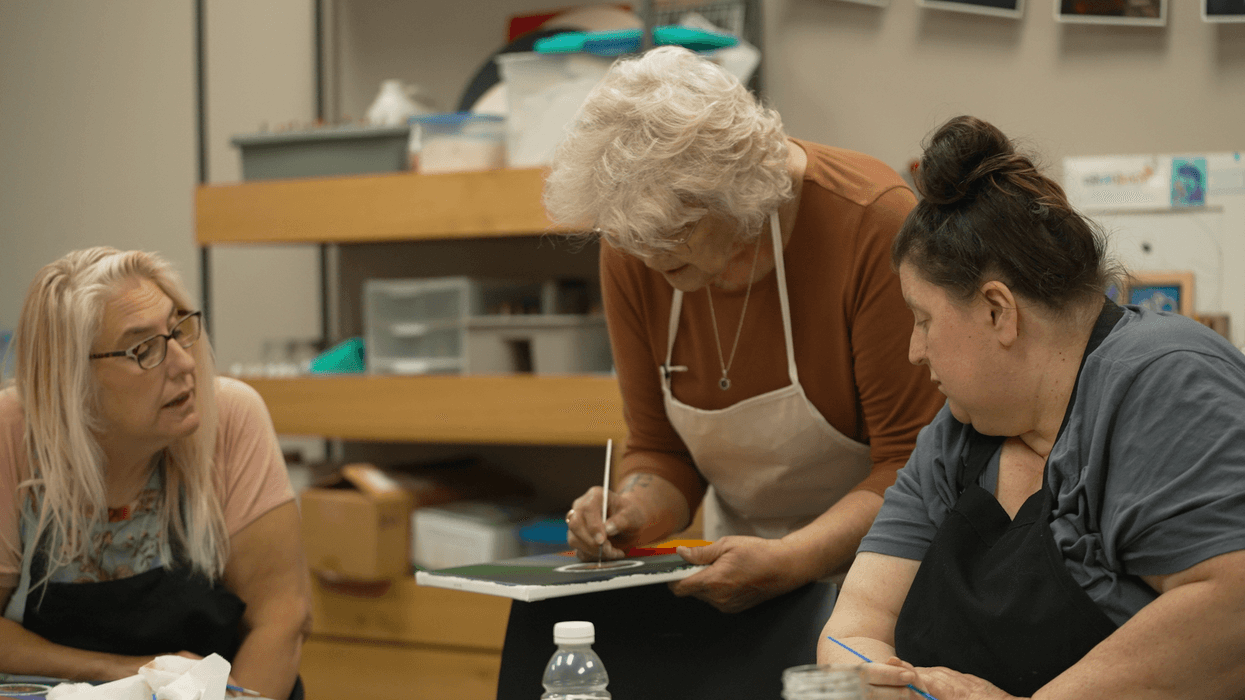
Ruth Titus sees this process firsthand as a volunteer art instructor at Invisible Wounds Project.
“Today we’re doing a dandelion painting,” Titus explained while describing her art class offering that afternoon. “One of the things I love about the puff (of the dandelion) is that it’s rejuvenating. The puff, as it flies away, will start new life, and so for them, I’m hoping to convey the message that this isn’t just a dandelion puff that we’re doing; it’s representative of those things in your life where maybe new beginnings need to happen.”
The restarts happen often at the support center.
Stanley, who recalled extensive work to get his badly beaten body back into shape, just finished a practice test to become a physical therapist in the gym at the Invisible Wounds Project. After coming back from his own near-death experience, he wants to help people transform both physically and mentally to beat whatever obstacle they face.
“I’m still alive, the experts tell me, because of my physicality. Stronger people are harder to kill.”
To see more stories of hope and learn about resources from the Invisible Wounds Project, go here.