


Farmers, truckers and economists say a move to cut taxes on diesel will provide little relief from record-high fuel prices that have soared since the U.S. attacked Iran months ago.
Industry groups said they appreciate President Donald Trump’s executive order expanding the use of a diesel now reserved for off-road work, but farmers already have access to the fuel and many have already wrapped up harvest. Truckers will struggle to navigate differing state rules.
“In the context of diesel prices that are over two dollars more than they were last year, it just doesn’t come close to closing that wound,” said Matt Perdue, president of the North Dakota Farmers Union.
With less than a month to go before the November election, diesel prices continue to hit record highs as some farmers transport their crops for processing and others rush to complete their fall harvest. Many have been feeling the squeeze as costs for inputs like diesel, fertilizer and seed have soared thanks to refinery constraints and supply disruptions amid the Iran war.
Diesel averaged $6.30 per gallon across the country on Wednesday, more than 70% higher than one year ago, according to motor club AAA. The executive order defers the $0.24 federal tax per gallon of regular diesel, used for road projects, until the end of the year. Most states also levy their own tax on diesel.
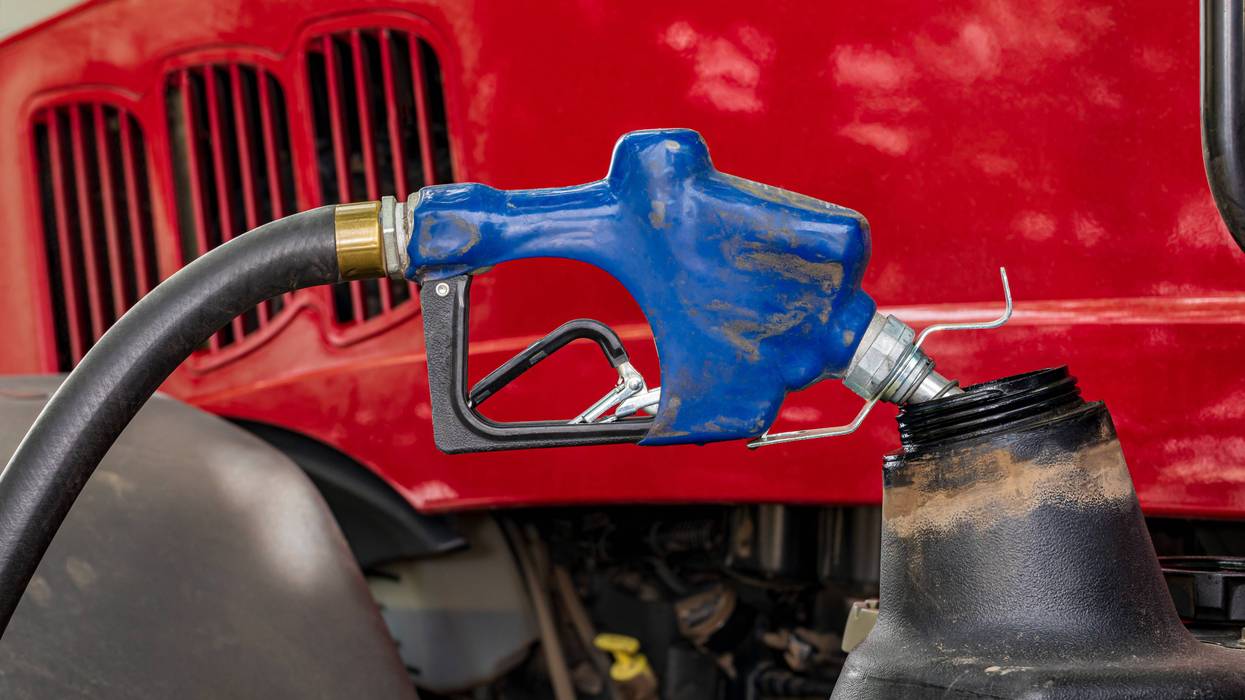
“Dyed” diesel is the same as regular diesel, except for its red dye to help law enforcement enforce penalties for on-road use. It's already allowed for off-road purposes like farming equipment, such as tractors and combines, as well as construction and heating uses.
Gas Buddy analyst Patrick De Haan tells WCCO Radio's Chad Hartman that it may save a few cents here and there, but it doesn't really address the price pressures are significantly up since last year.
"Today we're $2.50 a gallon higher, prices have come down a little bit, but still at $6.18 a gallon," De Haan says. "This was billed as a way to save farmers, but most farmers are already using dyed diesel. And keep in mind the reason this is coming up, dyed diesel is essentially an off-road version of diesel. If you're not on the roads, you don't need to contribute to their infrastructure maintenance and buildouts, and a lot of farmers are in their fields. So, that's why farmers have gotten a pass here on dyed diesel being essentially a greatly reduced taxed diesel."
De Haan says it's clear the president wanted to reduce the cost of freight, but just waiving something at the federal level doesn't mean it waives the state taxes.
"That is up to them," De Haan adds. "And so where we've gone with this dyed diesel is it sounds like a huge, a great fix, but it's in theory a very narrow passageway for only a few people to be able to utilize this. If you're living in a state, if you don't cross a state boundary and you're in a state that's waiving the enforcement, you can fill up with dyed diesel if you can find it. A lot of Minnesota areas, this is maybe something you'll find in rural areas, but this is definitely not something you're going to find at the average truck stop. So availability is greatly reduced."
De Haan also says crossing state lines brings a risk if some states are enforcing dyed diesel laws.
"You still could get thousands of dollars in fines and tickets," he explains. "And by the way, the icing on the cake here is that if anyone really noticed Trump's announcement, this is a deferral of taxes. This doesn't mean we're free and clear."
In other words, there are potential downsides and risks.
"That is why lobbying groups that represent truck stops, truck drivers, all up and down, they're not saying go rush out and do this," De Haan explains. "They're saying, 'well, be very careful what you do,' because the details are a lot different than the headlines."
Who will see benefits
Savings can compound if states take similar actions; many have eased restrictions or waived taxes on dyed diesel, including South Dakota and Iowa. Perdue said North Dakota has waived the tax on regular diesel. But where the state decision is focused on farmers, he believes the federal decision would largely benefit those on other levels of the supply chain.
Farmers who will see the most benefit are those who haul their own product, like livestock or fresh produce, on public roads. Those who have already wrapped up harvesting won't see savings.
“Most of our diesel use is behind us,” said Perdue, who grows spring wheat, durum and canola on his family farm.
Both trucking companies and independent truckers may not see much relief either. The effect is likely to be negligible for big trucking companies because the order is on a federal level and states make their own rules, Patrick De Haan, head of petroleum analysis at GasBuddy, wrote in a social media post.
“The largest diesel users are the least likely to use dyed diesel,” he wrote. “A national carrier crossing five or six states in a day faces enormous risk with a patchwork of rules, legal in one state, and subject to fines in the next.”
Many states exempt road diesel from sales tax but apply sales tax to dyed diesel instead, he said.
Easing limits on red-dyed diesel will likely have a minimal effect for small truckers, who pay for fuel up front, said Todd Spencer, president and CEO of trade group the Owner-Operator Independent Drivers Association. He estimates every $1 increase per gallon in fuel costs independent truckers about $400 more per week.
Increased demand for dyed diesel
The savings will be small, but it could still increase competition for dyed diesel, said David Ortega, food economics and policy professor at Michigan State University.
“I think there's a real chance this could backfire and make the situation worse for farmers," he said. “Basically anybody that’s running a truck on the highway on regular diesel can now be using this off-highway diesel. Even someone that owns a diesel pickup truck potentially has access to this other type of diesel.”
Perdue in North Dakota said he expects a “rush for dyed diesel, and we’ll see how the supply responds.”
But not all dyed diesel pump stations are set up for larger trucks like semis, said Paul Mitchell, a professor of agricultural and applied economics at the University of Wisconsin-Madison.
“It’s going to come down to infrastructure ability to get your vehicles to a place that you can use and fill them up with,” he said.
Supply shortages persist
Henry Hanscom, American Trucking Associations chief advocacy and public affairs officer, pointed out that the executive order directs temporary penalty relief and potential tax deferral for using red-dyed diesel, not outright tax forgiveness. He said the ATA would review the Internal Revenue Service’s implementing guidance of the policy when it is available.
Last month, Trump had threatened a diesel export ban, though he later said it is off the table. On Friday, G7 countries agreed to release 100 million barrels of oil and fuel products.
“One of the problems we have right now in the world is there’s not enough diesel fuel,” said Gregg Ibendahl, farm management specialist at Kansas State University.
But underlying causes like geopolitical issues won't be solved overnight.
“The problem we’ve accumulated right now with the Strait of Hormuz and the Russia-Ukraine war, those are going to be longer term things to get fixed,” he said. “Getting that world supply back up again is going to be, I think, at least a year, even in the best cases.”