


U.S. President Donald Trump said he has demanded about seven countries send warships to keep the Strait of Hormuz open as Iranian strikes kept slamming into Gulf countries Monday.
Colonel David Hunt, U.S. Army (Ret.), a New York Times bestseller, and a military analyst for the Fox News Channel, told WCCO's Chad Hartman on Monday that unless a friendly government is in place in Iran, starting the war was a waste.
"Without it, you failed because you killed them," Hunt says. "You break it, as Powell said, you own it. You sure broke it. You've not just killed them, you killed the next three in succession. So, if we don't have a favorable government in Iran, this is for nothing."
Hunt says that it is also crucial that the Strait of Hormuz is made safe, which he calls incredibly complicated.
"There is a lot of infrastructure that goes in, in coordination, and by the way, that coordination didn't work very well," Col. Hunt explained. "We lost 3 F-15s at the beginning of this. Never happened before in the history of the Air Force. And this was done by a foreign country using our gear. So that it is doable, but you've got to get the owners of these tankers feeling safe. And they don't right now because three of those boats got blown up last week, one from Thailand. To move through that two-mile, narrow strip, there's some convincing of that to do. The president offered to pay for their insurance. They don't need the president to help pay for their insurance. They need the president to guarantee their safety to go through that narrow strait."
The president said at an event at the White House on Monday that “numerous countries” have told him “they’re on the way” to help police the strait but he complained about their reluctance.
“The level of enthusiasm of enthusiasm matters to me,” he said.
He seemed to suggest their hesitancy showed a lack of reciprocity by countries that have defense agreements with the U.S.
“I know that we’ll protect them and if ever needed, if we ever needed help, they won’t be there for us,” he said.
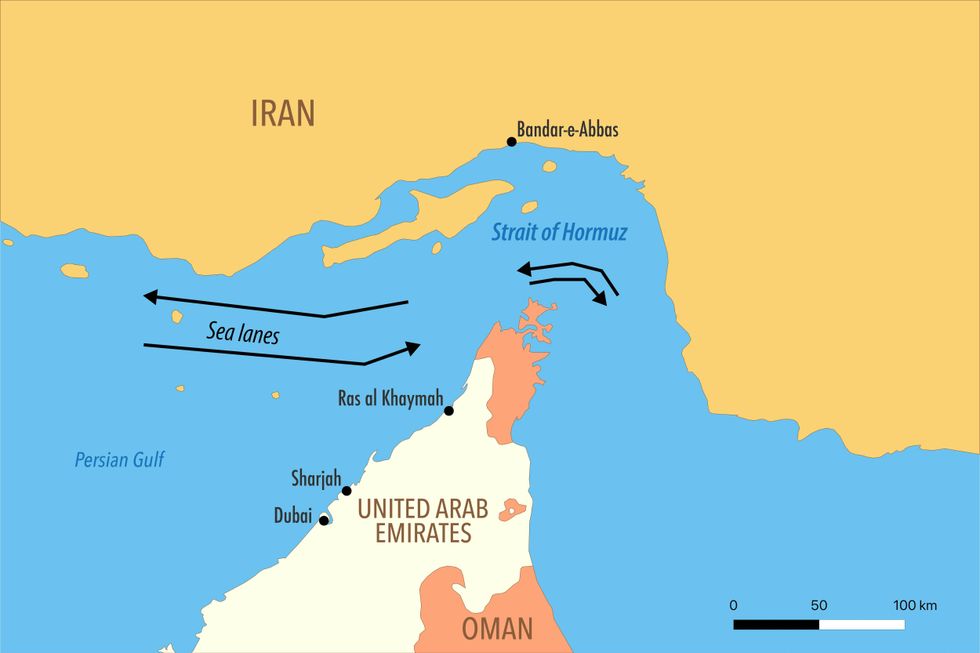
Map of the Strait of Hormuz with sea lanes, surrounding territories, and shipping routes.
(Getty Images / Dimitrios Karamitros)
Trump said the U.S. is negotiating with countries heavily reliant on Middle East crude to join a coalition to police the waterway where about one-fifth the world’s traded oil normally flows, but declined to name them.
A day after Trump demanded other countries to join a coalition to police the Strait of Hormuz, Israel’s envoy to the U.N. tried to make the case that the burden shouldn’t be just on America’s closest ally in the region.
“We understand the need to support the effort of the U.S. and it should be a global effort,” Danny Danon said. “You look at Israel, a tiny country and you know Iran is I think 80 times bigger than Israel and we take a lot of the burden for the world.”
IEA says emergency oil stocks could be tapped again if needed
The 32 member countries of the International Energy Agency could release more oil from emergency stockpiles if necessary, on top of 400 million barrels announced last week. That was the message Monday from IEA Executive Director Fatih Birol.
Birol said last week’s release was a “buffer for now” that had helped restrain the increase in oil prices. But he added there are “a lot of stocks left despite this huge release.”
That means “we can do more later, as and if needed.”
Birol says members have a further 1.4 billion barrels in reserves or industry stocks that governments could access.
The IEA head says the single most important factor for a return to stable flows of oil and gas would be a resumption of tanker traffic through the Strait of Hormuz.
Before the Iran war, the global economy consumed about 101 million barrels of oil a day. Brent crude is trading at over $100 a barrel.
Oil prices are down, and stocks are up Monday, though such moves have been quick to change since the war in Iran began.
The S&P 500 rose 1% in early trading, coming off its third straight losing week, its longest such streak in a year. The Dow Jones Industrial Average was up 325 points, or 0.7%, as of 9:35 a.m. Eastern time, and the Nasdaq composite was 1.2% higher.
The driver for markets once again was the price of oil. A barrel of benchmark U.S. crude fell 4.1% to $94.62, easing some pressure off the economy after topping $102 earlier in the morning. Brent crude, the international standard, fell 1.4% to $101.72 per barrel after earlier getting as high as $106.50.
Oil prices have been mostly ripping higher from roughly $70 per barrel since the United States and Israel began their attacks on Iran.