



Iran’s Revolutionary Guard says it has lifted a self-imposed limit of 2,000 kilometers (1,200 miles) on the range of its ballistic missiles, suggesting the country may seek to develop missiles capable of reaching more distant targets as fears of renewed all-out war rise.
Meanwhile, airstrikes near Yemen’s capital killed at least 27 people, according to a spokesman for Yemen’s Houthi-run Health Ministry. In Israel, the president tapped opposition candidate Gadi Eisenkot to form a government, in a post-election setback for Prime Minister Benjamin Netanyahu.
Here is the latest news from the Middle East on Saturday. Read our full coverage here.
Iran's Revolutionary Guard lifts its missile-range limit
The comments by the spokesman of Iran’s paramilitary Revolutionary Guard came days after the country’s supreme leader, Ayatollah Mojtaba Khomeini, warned that “any kind and level of threat” from the U.S. or Israel would face a response without geographic limits.
Asked at a Tehran news conference about the limit on missile ranges, Gen. Hossein Mohebbi said, “That restriction has been lifted for us.”
Iran is not known to have missiles that can go beyond the 2,000-kilometer (1,200-mile) limit. However, U.S. officials have said technology from Iran’s space program can be repurposed to build intercontinental ballistic missiles.
US military fires on commercial vessel in Gulf of Oman
U.S. Central Command said late Saturday it disabled a St. Kitts-flagged ship after it ignored multiple warnings and attempted to leave the region after visiting an Iranian port.
U.S. forces have been enforcing a naval blockade on Iran for months in and around the Strait of Hormuz, a crucial strategic waterway for global shipping, including of oil.
Iran established a chokehold on the strait at the beginning of the war, and has claimed attacks on tankers. On Saturday night, the Iranian military said two tankers in the area had hit mines and caught fire.
The U.S. says its blockade had redirected 144 commercial vessels through the end of October. U.S. Central Command also announced Saturday a new task force focusing on hampering Iran’s transportation options through its land borders and the Caspian Sea.
Iran media report explosions on Qeshm Island
Iran state media also reported on Saturday evening the sound of two explosions on Qeshm Island in the strait, as well as several explosions in the port of Jask.
It wasn’t immediately clear what caused the explosions. U.S. Central Command didn’t immediately respond to an AP request for comment.
Houthis say airstrikes kill more than 2 dozen people near Yemen’s capital
Airstrikes in a village near Yemen’s capital, Sanaa, killed at least 27 people and wounded 36 others, mostly women and children, on Saturday, said Anees al-Asbahi, a spokesman for Yemen’s Houthi-run Health Ministry.
The Associated Press could not independently verify the claims. The Houthi spokesman accused Saudi Arabia, whose Information Ministry did not immediately reply to an AP request for comment.
Since the summer, fighting has escalated between the Iranian-backed Houthis and their Saudi-backed opponents.
Israel's president taps opposition leader to form new government
Israeli President Isaac Herzog said Saturday night that he was giving opposition candidate Gadi Eisenkot the first opportunity to form a new government following elections on Oct. 27.
Eisenkot, a former military chief, ran as the main challenger to Prime Minister Benjamin Netanyahu, leading a bloc of parties seeking to oust Israel’s longest-serving premier. With neither his nor Netanyahu's bloc winning a majority in parliament, the task to negotiate a coalition remains challenging in the deeply divided country reeling from the Oct. 7, 2023, Hamas-led attacks and the three years of wars that have followed in Gaza and beyond.
Rains mark return of winter misery for Gaza's Palestinians
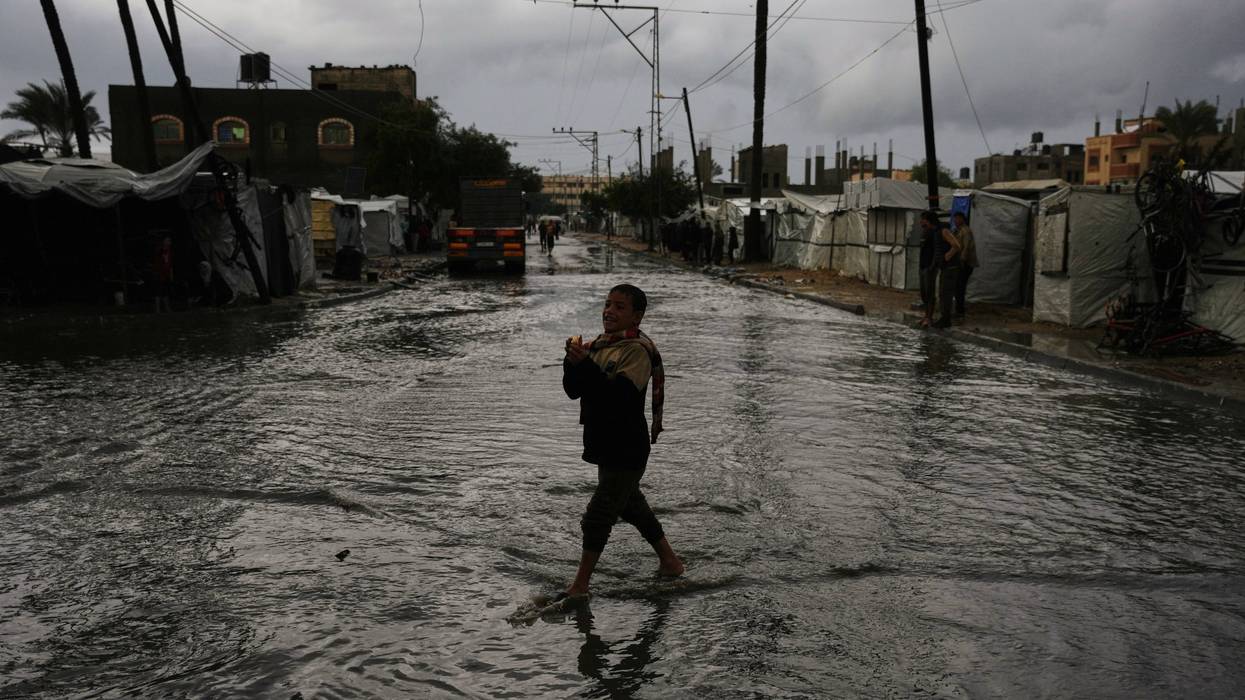
In the Gaza Strip, displaced families spent a sleepless night as heavy rain flooded their fragile tents, soaking mattresses and belongings, and turning camp pathways into pools of muddy water.
The rain marks the start of another difficult winter for the more than 1.6 million Palestinians living in tents or other makeshift shelters in the territory, where nearly the entire population has lost its homes during Israel’s campaign triggered by the Oct. 7 attacks.
Midterms suggest frustration with Israel among US Democrats and Republicans
The results of the U.S. midterm elections suggest that long-standing U.S. support for Israel is on rocky ground on both sides of the aisle. Democrats, who gained control of Congress, are fiercely divided, and many Republicans are increasingly critical of Israel’s government, particularly its wartime conduct in Gaza.
On Tuesday, as Americans went to the polls, President Donald Trump suggested cutting off aid to Israel. Then, a staunch critic of Israel, Abdul El-Sayed, became the first Muslim elected to the U.S. Senate.
The Democratic senator-elect from Michigan addressed U.S. Vice President JD Vance as “JD, habibi” — a common Arabic term of affection — in his victory speech. And Vance partly blamed the Republicans’ massive electoral losses across the country on U.S.-Israel relations, including the war in Iran the two countries launched jointly on Feb. 28.
___
This report will be updated throughout the day as new developments emerge.