
Optionality: the quality or fact of affording or including options; the availability of options.
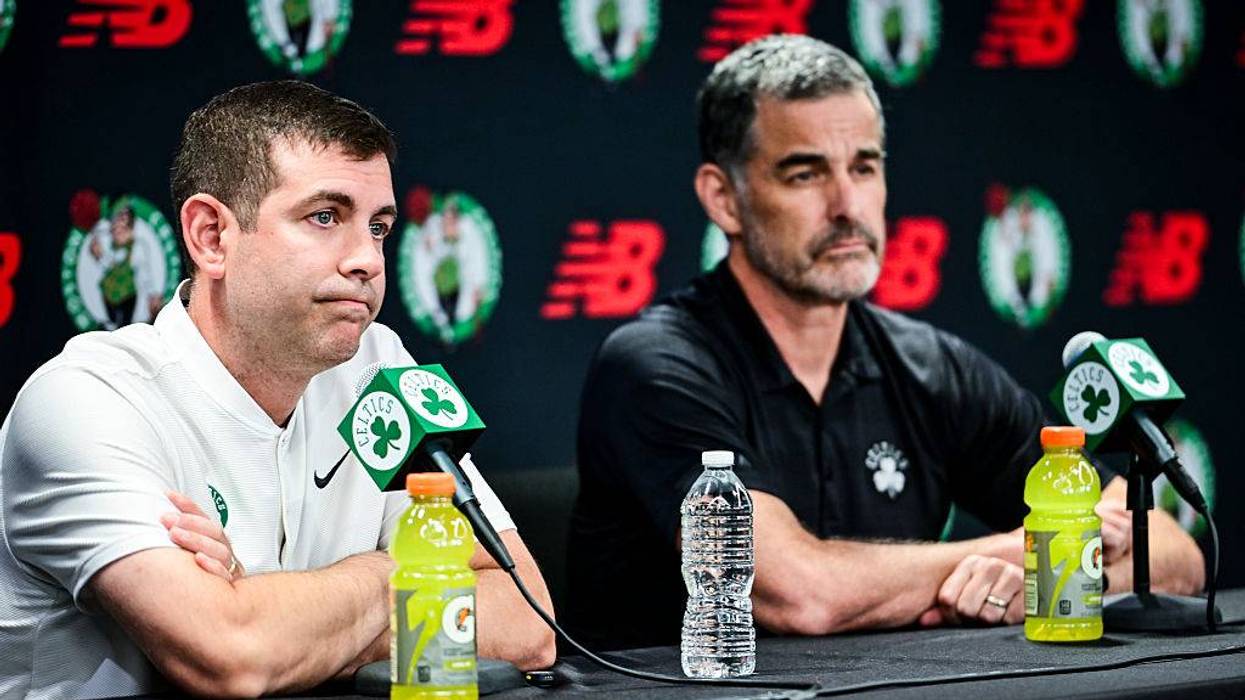
That was the word of the day as Boston Celtics President of Basketball Operations Brad Stevens and Lead Owner and Governor Bill Chisholm sat down for a nearly 45-minute press conference to discuss the stunning trade that sent Jaylen Brown to the Philadelphia 76ers in exchange for Paul George, two first-round picks, and two second-round picks.
“When I looked at our team, and I looked at where the league was heading, looked at the way that we’ve finished the last couple years, and also looked at the unbelievable way we’ve played in the regular season the last couple years, the path looked a little bit more challenging to me,” Stevens said as part of an eight-minute opening statement.
“I might be wrong. I’m not going to stand up here and be defensive about that, but the path looked a little bit more challenging with 70% of our cap and such a high percent of our usage tied into two players. And the reality in this era and in this day and age at the NBA, you could see it obviously, with the last couple of champions and some of the teams that were at the very top of the league, when it was all said and done at the end of this year, is that you have to do a great job and you have to have the optionality to do a great job of building out depth that can hopefully replace the irreplaceable individual.”
That word, optionality, was used a dozen times throughout the afternoon. And it’s a word Stevens knows Celtics fans don’t want to hear after watching one of the faces of the franchise get sent out of town.
“I keep going back to myself as a kid, and I don’t want to hear about picks and ‘optionality,’” he said. “Unfortunately, in my position, that matters. So, that’s where we are. Can I tell you exactly what is going to happen? No. We’re excited about Paul. We’re excited about a lot of our young guys, we’re excited about the depth of our group, we’re excited about our very best players, and we think we’ve got a good team, and we think we’ve got a lot of options moving forward.”
But that raises the obvious question: where is the optionality?
The answer isn’t necessarily found in immediate salary savings.
Even after waiving his $3.9 million trade kicker, the 36-year-old George is still set to earn $54.1 million this season, just a couple million less than Brown’s $57.7 million salary.
However, in 2027-28, George holds a player option worth $56.5 million, which would be the final year of his contract.
Brown, meanwhile, is owed $61.6 million and $65.6 million over the next two seasons and is eligible for a two-year, roughly $140 million extension later this month.
“I think the biggest thing is that it’s that plus the picks. Plus the optionality moving forward. Paul’s contract is shorter,” Stevens said. “I think that we did the deal because Paul George is a good player, and we got draft assets.”
So, yes, the trade was financially motivated. But it wasn’t necessarily about eliminating the cost. It was about finding a way to better utilize that spending.
“No, absolutely no,” Chisholm said when asked if it was a financial mandate to move Brown. “This is all about basically trying to win, and I think really trusting in our process. I think we have the best front office in the NBA, and they put in their work, and they came to the conclusion this was the best way for us to win, and that’s the mandate, is to win, and I just have to keep saying that. We’ll spend whatever it takes to do that, the mandate is to win.”
Notably, Chisholm also revealed the idea to trade Brown came from Stevens and the basketball operations department, not ownership.
“Brad and his team came with a recommendation, this is the way we’re gonna win, and I looked at it, and I had the same reaction, I was like, ‘Wow, this is the fan in me like really tough,’ And then recognizing, I said this back in the fall, like I recognize that I have accountability and I’m accountable for it. Brad’s accountable to me for it, and his team’s accountable to him, but the mandate here is to win, and we came to the conclusion, they convinced me this was the best way for us to win, and then I got there,” Chisholm said. “But it was, it was hard, it was really hard. And I recognize this is a big, big move, and frankly, I didn’t anticipate it would happen this fast in our ownership, but here we are.”
Those words will likely ring hollow for Celtics fans.
Yes, Chisholm took over at a difficult time with the team deep in the second apron and needing to reshape the roster.
But each of his two offseasons has been filled with significant roster moves that, so far, have brought little to show for it.
Last season, the Celtics traded Jrue Holiday for Anfernee Simons before flipping Simons for Nikola Vucevic — a move that could be described as a basketball decision given Boston’s lack of center depth, but one that also helped them avoid the luxury tax. Vucevic signed a one-year, $3.9 million minimum contract with the Orlando Magic this offseason after being a healthy scratch in Boston’s Game 7 loss to Philadelphia.
Kristaps Porzingis was traded for Georges Niang and a 2031 second-round pick. Niang and two second-rounders were then flipped for RJ Luis Jr., who was waived before the season started.
Al Horford and Luke Kornet departed in free agency, and now Brown is off to Philadelphia.
Chisholm, a Massachusetts native and lifelong Celtics fan who made his fortune in private equity, said the decision to move Brown — along with the team’s other moves — was driven by basketball, not finances.
“Well, I just don’t necessarily agree with the premise there, that [the moves] were salary-based. Every decision that was made, even the prior decisions, I should say, those were basketball decisions. We would have gutted the team for the future had we not done those things. The second apron is a real thing, and I know you know that. So, that was not about money; those were basketball decisions,” he said.
“And I put this one in the same category as well. I mean, there is no — The money here, you said it to Brad, and the money’s not [different. It’s] marginally different. So, it’s not about the money at all. This was, again, trying to put together the right set of players and assets to win now, to win next year, the following year, and the year after that. That’s what this was about. None of these were about money. We have some more room now. Like if we see something we wanted, Brad’s got the green light to do that.”
“I know there’s people who feel like, ‘Oh, there must be a smoking gun somewhere on the money,’ but that’s just not what this is about. And I can say it, and I’ll keep saying it, but I’ll also prove it to you when the time comes. When we have the opportunity, we’re going to do that. And we’ve given ourselves the flexibility to do it now. So, it’s fine to keep asking the question, because I know we have to prove it, and we will.”
Time will tell whether that’s truly the case and whether the Celtics were right to move Brown. But for now, this move appears to be more about the on-court fit and the challenge of building around the bloated contract Brown was on than it does a cost-cutting move.
“It is an interesting time. The new CBA coincided with seven years after the supermaxes were instituted. We may not be sitting here if there was a rule in the CBA that said, ‘The guys that you drafted that you signed for 35% supermaxes count as 25% of the cap, because then that would allow you to build out towards the aprons with a lot less flexibility, or with a lot more flexibility,” Stevens said.
“But the reality is that those are hard to build. And even look back on again, I don’t want to just throw a bunch of numbers, but like 47% of the cap is what we, what those two guys were when we won it all, right? And that’s just going up and up, and that’s tough.”
In the short term, though, after this trade and the signings of Mike Conley and Mitchell Robinson, it appears Boston’s 2026-27 roster is largely set.
“Ultimately, there are a lot of small steps that it’ll take to build out the depth and the team that we ultimately want to. And again, we’re not up here to defend ourselves in this decision that is going to certainly be scrutinized; we’re okay with that, but we’re more so dealing with the emotions of Jaylen not being here,” Stevens said.
“I don’t anticipate anything in the very near term. I think that we do like the team we have. We might be able to add to it, but at the end of the day, we like the group we have, we like the people that we think we’ll be able to officially sign. Those types of things. But we’re cognizant that we have a lot of work to do.”