

On nights like this one, emotions aren't hard to uncover.
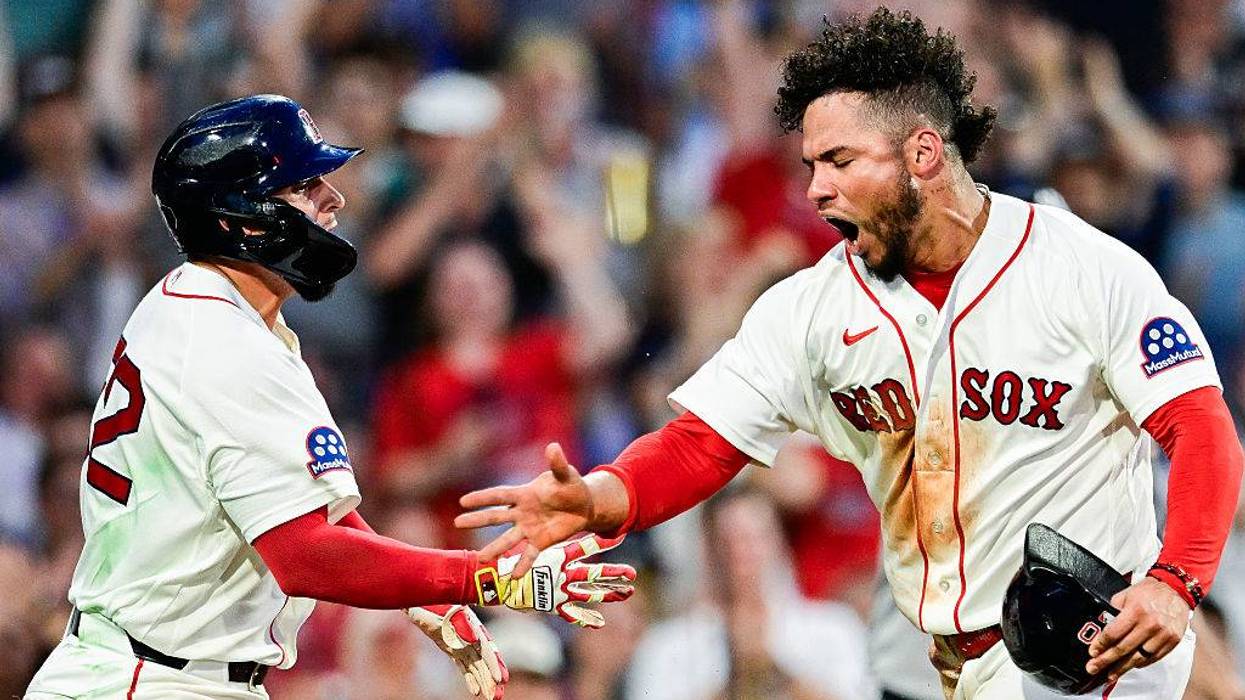
There were the home runs from Willson Contreras and Caleb Durbin. We had a bizarre ejection, with Contreras getting the boot for simply tapping his head. And, of course, a fifth win in a row - this one coming thanks to a 6-3 victory against the Nationals - will always amp up the Fenway Park attitude.
But it was one image that stood out from all the others. That was of Contreras breaking down in tears in the dugout after circling the bases after his first-inning home run. It was a rare visual. Then again, it has been an out-of-the-ordinary few days.
Contreras is one of five Venezuelans playing for the Red Sox, joining Monday night's starting pitcher, Ranger Suarez, Carlos Narvaez, Andruw Monasterio, and Wilyer Abreu. All of them are living unique lives these days, a reality that the first baseman reminded the world of both after the home run and after the game.
They are waking up and checking their phones. They are going to bed checking their phones. They are checking their phones virtually every waking hour throughout each day since the tragic earthquakes in Venezuela Wednesday night. For a few hours, they play baseball games, but even then there is no escape.
Anyone who witnessed or listened to Contreras would understand that.
"I think it’s just the emotional part of Venezuela that got to me, got the best out of me," Contreras said after the win. "I wasn't feeling good the whole day. I was kind of down, sad, and I hit a homer, of course. I tried to help my dugout, but the first thing that I said was 'Venezuela.' That was the first thing that came out of my mouth. And it's for Venezuela, and I think that, of course, I'm helping the team to win. It's good, but I think every homer from now on is going to be for the Red Sox and Venezuela."
He added regarding the impetus for the post-home run emotions, "Everything that's going on in Venezuela, I think. It's not easy to hide. It's not easy just to show up and play with everything that's going on in my country. The second tragedy in the last 27 years, I think. And it hurts when you see people are trying to help, and they're being retained. It hurts when you see aides trying to get to La Guira and being detained, it sucks seeing so many bad things going on in Venezuela. So, I don't think we deserve all of this. We are good people, good country. We are good people that are trying to live a better life. We're not even close to that, as a country."
Conteras wasn't alone in navigating the continued wave of sobering news from his home country, with the latest projections putting the death toll over 1,700 people.
"Obviously very, very hard, very hard to be here, when you want to be out there physically trying to help," Suarez noted. "But at the end of the day, we're trying to do our best to try to support them. And, and also, we just want to send my best wishes forward for my people over there in Venezuela and to let them know that they're not alone."
"For us, it's too much," said Monastario, whose family members are still in Caracas dealing with aftershocks. "You have to learn how to control your emotions. It's tough for us because you want to be there but you can't. You learn to play for three hours and deal with everything outside of baseball."
For Contreras, the night was made even more complicated by his out-of-nowhere ejection by first base umpire Nic Lentz. In his next at-bat after blasting his 421-foot homer, the righty hitter was thrown out after tapping his head following a call from Lentz confirming that Contreras didn't check his swing.
Red Sox manager Chad Tracy quickly came out of the dugout to plead his case, followed by Contreras and bench coach Jose Flores.
"I called him out on appeal for the check swing, and as he was walking back to the dugout, he started gesturing, tapping his helmet, like he wanted to challenge something that is not a challengeable call," Lentz told a pool reporter. "And so disrespect, and again gesturing towards what he thought was an incorrect call, got him removed from the game.” The umpire added, "You can have a little bit of discretion. But in a situation like this, where it's pretty immediate and showing disagreement or trying to gesture in that sort of manner, it would be immediate."
After the game, Contreras explained his side of the story.
"It wasn’t directed at him," he said of the tapping of the helmet. "I was looking at the fans, and a Dominican fan was talking to me during while I was tapping my helmet. So I was looking at him, he kept telling me, 'You're good, you're alright, just breathe. I was like, OK. And then when I got to the dugout, that I saw Chad going out. And then I turned around. Then (Marcelo) Mayer told me, you got thrown out. I was like, for what? And then I went out there to explain to him, to ask why he threw me out. He told me, like, because you tapped your helmet. I was like, yeah, I didn't make eye contact with you, I didn't argue, I didn't yell, I didn't do nothing wrong, and he told me, yeah, but I have to throw you out. I was like, you didn’t have to, but you made that choice. That’s it."
Home runs. Controversy. Another win. And a big dose of reality.
It was the kind of summer night at Fenway few will forget.
"I feel like all Venezuela's citizens are living this. We are in the same situation," Contreras said. "I think everybody is trying to help. Everybody is trying to do the best we can for Venezuela. People that are living here in the United States or different parts of the world, the only thing we can do is to use our social media to spread awareness and to let the world know what's going on in Venezuela, because it's been happening for a lot of years now, and it's nothing new, and I think USA has known that perfectly. So just finish the job."