


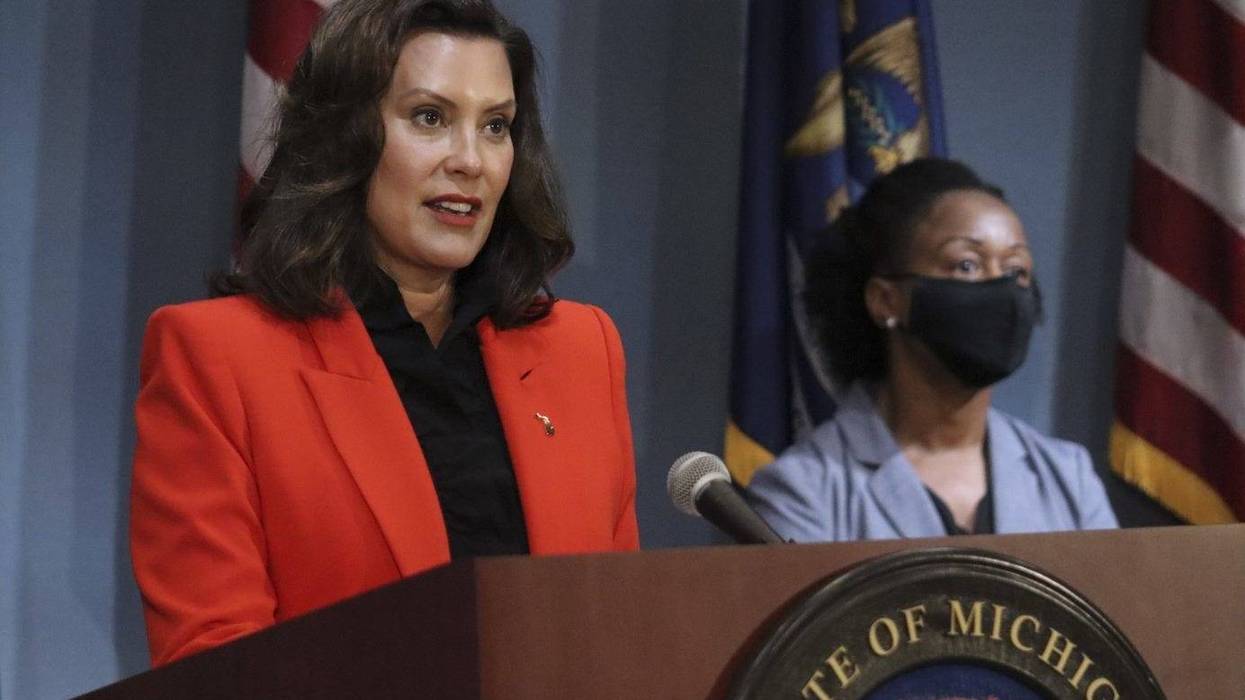

(WWJ) Governor Gretchen Whitmer is speaking out about the Michigan Supreme Court's determination that she exceeded her powers during the COVID-19 pandemic.
The ruling will not take effect for at least 21 days, according Whitmer. Until then, "my emergency declaration and orders retain the force of law;" she said in a statement.
The current State of Emergency is set to expire on October 27.
"I have done everything in my power to protect our seniors, small businesses, and first responders from the worst public health emergency in over a century. Thanks to the hard work of millions of Michiganders who sacrificed and did the right thing, we have saved thousands of lives and laid the foundation for a strong economic recovery," Whitmer said in the statement.
She said the toll has been devastating for Michigan, with nearly 6,780 residents who have tested positive for the virus passing away, according to the Michigan Department of Health and Human Services (MDHHS). The state's fatality rate is at 5.4%, slashed nearly in half from about 10% in the early days of the pandemic.
"This virus has now killed more Michiganders than World War I. It is a novel virus for which there is no cure, and which has infected the President of the United States, members of the United States Congress, and Legislators across our state," she said.
In a 107-page ruling; Justices Stephen Markman, Brian Zahra, David Viviano and Elizabeth Clement said the Emergency Powers of the Governor Act of 1945 is in violation of the Michigan constitution because it claims to delegate the legislative powers of state government to the executive branch, also known as the governor's office.
University of Detroit Mercy Law Professor, Larry Dubin, told WWJ it is unlikely she will be able to challenge the ruling.
"In the constitution, the legislator has certain powers that cannot be done by the executive branch, the governor. And the governor has certain powers in case of emergencies," Dubin said.
The Emergency Management Act and the Emergency Powers of The Government Act allows the governor to enter orders to "to protect life and property or to bring the emergency situation within the affected area under control," according to the ruling.
Related: Michigan Supreme Court: Whitmer exceeded her emergency powers amid COVID-19 pandemic
Four of the seven justices said, under those qualifications, she over-reached in her authority to declare a State of Emergency beyond April 30.
"This decision…basically said that after April 30th, the power (of the governor) has not been properly exercised," Dubin said.
Governor Whitmer argues the situation is far from "under control."
"This virus continues to take the lives of Americans every single day, and without a cure or approved vaccine, that will continue for the foreseeable future."
It remains unclear exactly what this will mean for mask requirements, business restrictions and other COVID-19 restrictions.
However, Whitmer said "many of the responsive measures (she) has put in place to control the spread of the virus will continue under alternative sources of authority that were not at issue in today's ruling" after the 21 days are up.
MLIVE reports a spokesperson for the Governor said the 21 day timeline comes from a Supreme Court rule that puts all rulings into effect after that time.
She urged Michiganders to continue to take the virus seriously.
"(We need to start) pulling together as Americans and working as one nation to defeat this virus. That means wearing a mask, washing your hands frequently, and maintaining six feet of physical distancing."
Related: Whitmer rolling U.P. back to phase 4 after surge in COVID-19 cases
The ruling comes as Whitmer signed an Executive Order moving the Upper Peninsula back to Phase 4 in the MI Safe Start Plan, amid a "surge" of cases. In a statement, she said the region is boasting the most "concerning numbers" in the state with 283 absolute cases per million and 5.1% positivity. The MDHHS reports 23 adults are hospitalized in the UP with a confirmed case of the virus, with one on a ventilator. However, the region only has just over 700 hospital beds and 100 ventilators altogether; according to MDHHS. That is a fraction of the nearly 12,800 hospital beds in Metro Detroit (Region 2N and 2S) and approximately 2,100 ventilators.
Despite Michigan Supreme Court's ruling, Whitmer said she will continue to do all she can to help the people of Michigan get through this pandemic.
"Michiganders have grit, and there is no challenge we can't meet. I want the people of Michigan to know that no matter what happens, I will never stop fighting to keep you and your families safe from this deadly virus."
Below is the Governor's full statement:
"Since the beginning of this crisis, I have done everything in my power to protect our seniors, small businesses, and first responders from the worst public health emergency in over a century. Thanks to the hard work of millions of Michiganders who sacrificed and did the right thing, we have saved thousands of lives and laid the foundation for a strong economic recovery. But COVID-19 still poses a clear and present danger to the people of Michigan, our economy, and our way of life.
This virus has now killed more Michiganders than World War I. It is a novel virus for which there is no cure, and which has infected the President of the United States, members of the United States Congress, and Legislators across our state. This virus continues to take the lives of Americans every single day, and without a cure or approved vaccine, that will continue for the foreseeable future.
Today's Supreme Court ruling, handed down by a narrow majority of Republican justices, is deeply disappointing, and I vehemently disagree with the court's interpretation of the Michigan Constitution. Right now, every state and the federal government have some form of declared emergency. With this decision, Michigan will become the sole outlier at a time when the Upper Peninsula is experiencing rates of COVID infection not seen in our state since April.
It is important to note that this ruling does not take effect for at least 21 days, and until then, my emergency declaration and orders retain the force of law. Furthermore, after 21 days, many of the responsive measures I have put in place to control the spread of the virus will continue under alternative sources of authority that were not at issue in today's ruling.
I know this is hard. We all want this crisis to be over, and we all want life to return to normal as soon as possible. But the only way we will get through this is by pulling together as Americans and working as one nation to defeat this virus. That means wearing a mask, washing your hands frequently, and maintaining six feet of physical distancing. Michiganders have grit, and there is no challenge we can't meet.
I want the people of Michigan to know that no matter what happens, I will never stop fighting to keep you and your families safe from this deadly virus."


