

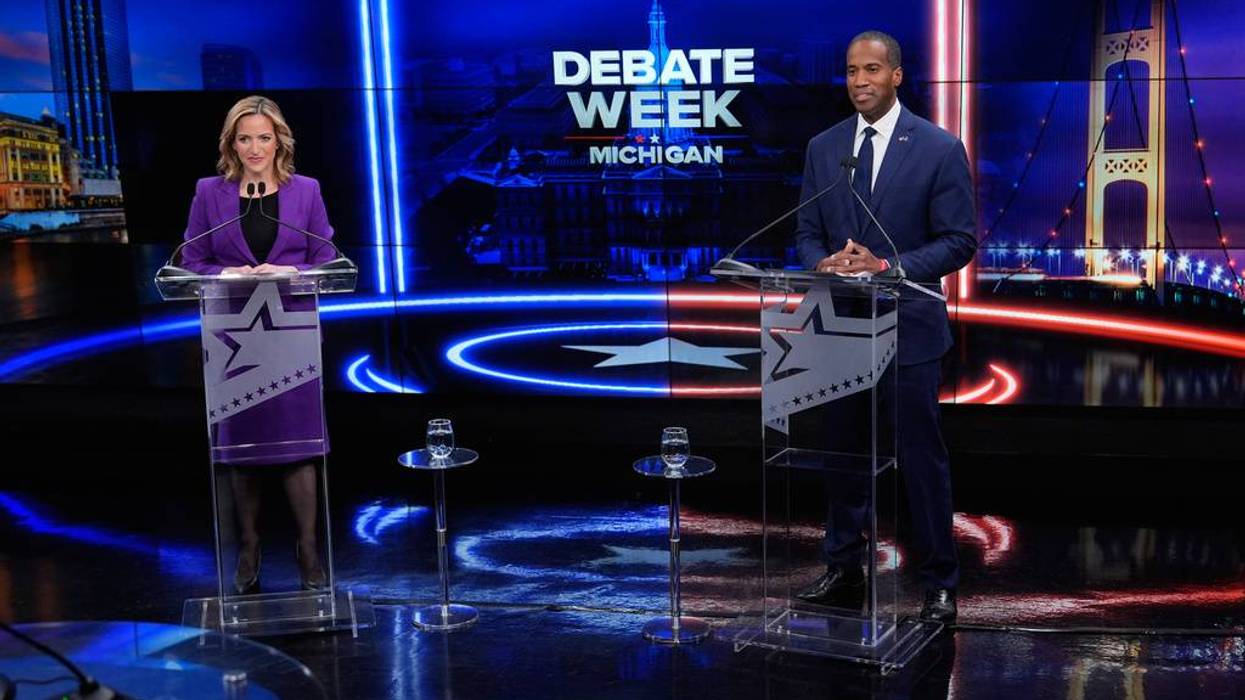

(WWJ) Democratic Secretary of State Jocelyn Benson and Republican U.S. Rep. John James took the stage Tuesday night for a high-stakes gubernatorial debate, offering sharply contrasting visions for Michigan’s economic future, energy policy, public safety, and public education ahead of the midterm election — now less than one month away.
So, who won? You decide.
Here's a look at what they had to say about some of the key issues.
Trump’s tariffs and trade policy
The impact of federal trade policies on Michigan’s economy served as an immediate point of friction. Benson repeatedly tied James to President Donald Trump’s trade policies, labeling the economic burden on U.S. citizens the "John James tax".
"These reckless tariffs have been supported by my opponent, and that's why we call them the John James tax because they are costing Michigan $5,600 each household, more than any other state in the nation," Benson said. She vowed to negotiate a subnational agreement directly with Canada on her first day in office to eliminate tariffs on goods moving across the border.
James pushed back on Benson’s claims, pointing to his industry experience and defending his record in Congress. He said he's not to blame for the higher prices Michiganders are paying, and said he'd actually prefer that Trump play nice with Canada.
"I've actually never voted to increase tariffs on Canada despite what she (Benson) says," James said. "I've actually called out the administration specifically talking with the trade ambassador and saying that we must get back to the table, stop acting like children, and negotiate a reciprocal, fair, and mutually beneficial arrangement to make sure that we can bring our jobs back and protect our industry."
The affordability crisis, gas and taxes
Addressing Michigan's rising cost of living, both candidates proposed different approaches to provide financial relief to working families. James argued that state government mismanagement has driven up expenses, citing ranking metrics where Michigan lags behind other states.
"Our costs are up. Our wages are down. And Lansing is corrupt," James said, outlining a plan to phase out the state income tax using funds saved by eliminating government waste. "We have to go at this in a fair and balanced manner... We can use [it] to put more money back in your pockets and spur and grow the economy."
Benson focused her economic pitch on targeted tax credits and reducing everyday expenses, including a proposal to pause the gas tax; something many Michiganders have been asking for with gas prices well above $4 and even up to $5 a-gallon in recent weeks.
"Middle-class tax cuts are an important part of my agenda," Benson noted, proposing a $5,000 tax credit for long-term caregivers as well as relief for families covering child care costs. "I'm open to suspending the state gas tax, but I also think we need to be clear how we got here."
James agreed that suspending the gas tax is a good idea, saying: "Yes... 52 cents off of a gallon would actually take us down into the 3s."
Education reform and reading proficiency
Prompted by recent state rankings placing Michigan 44th in K-12 outcomes, the debate shifted to literacy and K-12 education. James praised Mississippi's recent literacy gains and advocated for adopting similar curriculum standards and accountability measures in Michigan schools.
"We need to focus on phonics. We need to focus on the science of reading. We need to focus on literacy. We need to prioritize common sense over crazy," James said. He also backed student retention for struggling readers as a necessary policy:
"Retention is absolutely on the table. And we have to make sure that we're doing it in a manner that doesn't hurt or crush the spirit of the child... I want public schools to be successful. I want private, home, and charter schools to be successful, because a quality education is a basic civil right."
Benson, pointing to her background in teaching, outlined a comprehensive education guarantee while rejecting rigid mandates imposed by politicians.
"I'm ready to go further than what they've done in Mississippi by implementing a five-pillar plan... It includes a Michigan education guarantee that will ensure our kids are college or career ready no matter what public school they graduate from," Benson said.
Regarding grade retention, she argued that educators should been the ones to make the call. "I believe that teachers should be the ones making those calls, making those decisions, far more than a politician or a governor should be... so that in the future we're talking about the Michigan miracle, not the Mississippi one."
Tensions over data centers
The expansion of data centers across Michigan sparked some of the evening's most aggressive exchanges, with both candidates accusing each other of financial conflicts of interest and undermining local control.
Benson called for an immediate pause on new data center developments until stricter regulations are established.
"I've called for a moratorium on any new data center developments until we have real guardrails in place to protect local control, protect our water, require data centers to shoulder the burden of any energy usage, and invest in community benefits agreements," Benson said.
She then accused James of profiting off the industry, saying "My opponent has become a multi-millionaire buying stocks in data center companies that he regulates."
James rejected the accusation, defending his financial disclosures and reiterating his support for municipal autonomy over state-level bans.
"My position on data centers has been clear... We must have local control," James said. "Our electricity bills can't go up. We need to protect our water, prevent pollution... and we need to prioritize our blighted brownfields over productive green farmland."
Flock cameras, surveillance and public safety
Turning to public safety and privacy rights, the candidates discussed the expanding deployment of license plate-reading Flock cameras across — which have been the subject of debate in multiple Metro Detroit communities.
Benson emphasized the need for statewide standards to guard against federal overreach and privacy violations.
"The state should put guardrails on the use and abuse of any technology that would harm the privacy of our residents, especially in a situation like this where so many local communities have raised concerns," Benson said.
James centered his response on constitutional protections, framing privacy as an absolute right.
"Our Fourth Amendment is non-negotiable," James said. "The right to privacy is a constitutional right, and I will protect that as governor. Yes, we need to make sure that our communities are safe, we will protect local control, but we absolutely must protect our constitutional rights.
Early voting is already underway in Michigan, ahead of midterm election day on Nov. 3. James and Benson are running to replace Gov. Gretchen Whitmer, who is term-limited. For complete election information, visit the Michigan Voter Information Center at this link.